
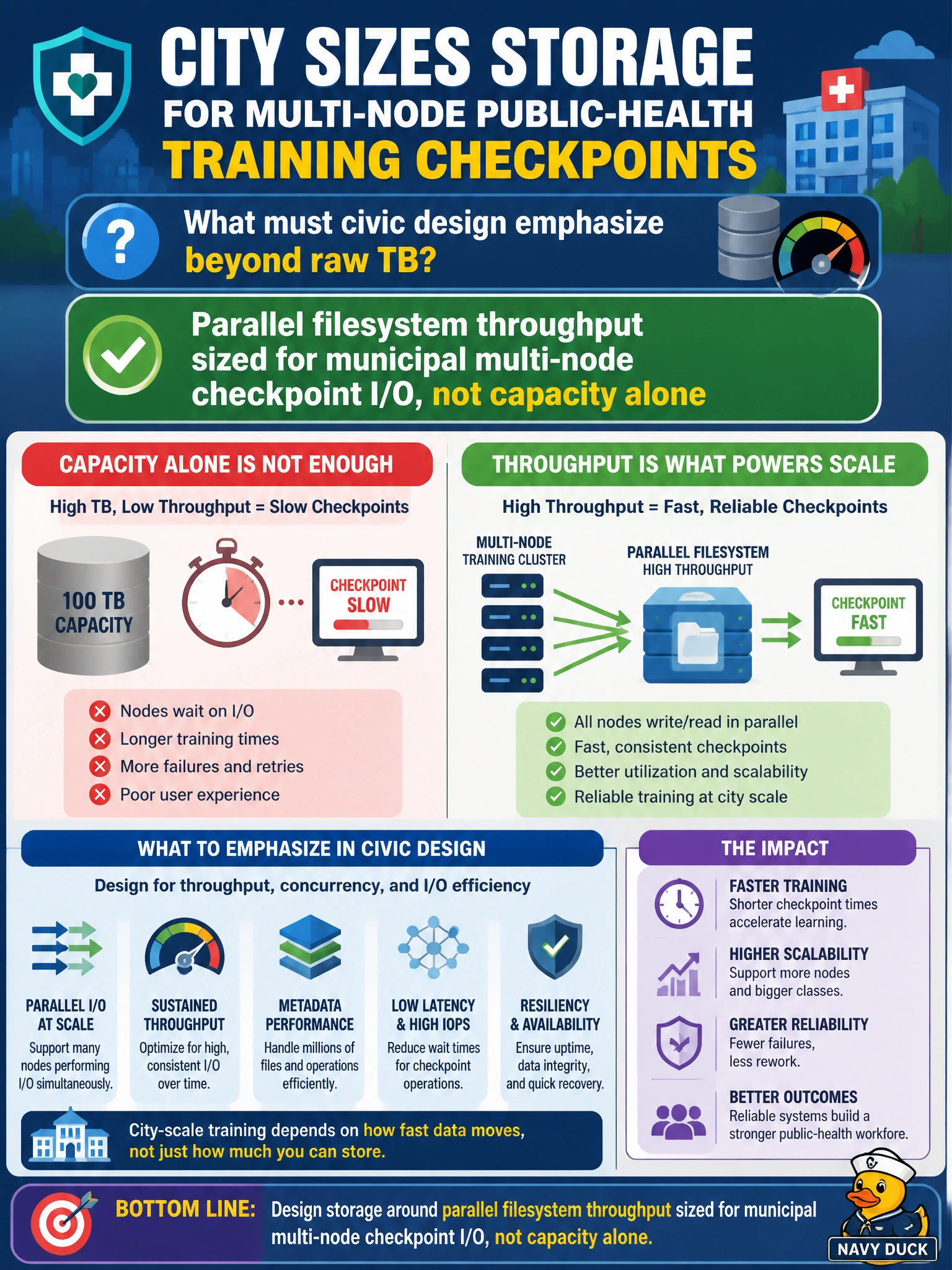
City sizes storage for multi-node public-health training checkpoints. What must civic design emphasize beyond raw TB?
Select an answer to reveal the explanation.
Short Explanation
You need storage that keeps your multi-node checkpoints moving, not just a large tank. Parallel filesystem throughput matters; LED color, bezel branding, and tape-only retention do not meet that live training I/O need.
Full Explanation
Parallel filesystem throughput sized for municipal multi-node checkpoint I/O, rather than capacity alone, is essential for public-health training. Checkpoints and sharded dataset reads are sensitive to bandwidth and IOPS across many GPU nodes at once; raw terabytes without parallel throughput can leave accelerators stalled on storage. You should size the parallel filesystem for concurrent readers and writers typical of distributed training, then validate latency under load—not just enclosure capacity. LED color fails conceptually because enclosure aesthetics do not move checkpoint bytes. The brand name printed on the bezel also fails because marketing is not a throughput requirement. Prioritizing tape restores for long-term retention on the assumption that checkpoint jobs can tolerate serial access fails because tape suits cold-archive patterns, not the parallel, low-latency checkpoint traffic of live multi-node training. Exam caveat: distinguish capacity from performance and parallel access; more TB alone misses the checkpoint I/O pattern. The parallel filesystem must still meet municipal durability and backup policy, since throughput does not protect PHI-capable training artifacts. Practical check: measure sustained aggregate read and write bandwidth and metadata rate while multiple public-health nodes checkpoint concurrently, compare results with training-step goals, adjust stripe or client counts or tiering as needed, and reject designs supported only by raw-capacity figures without a multi-node I/O test.