
311 inference nodes and training nodes need different VLAN and QoS treatment on the city cluster. How should that be applied?
Select an answer to reveal the explanation.
Short Explanation
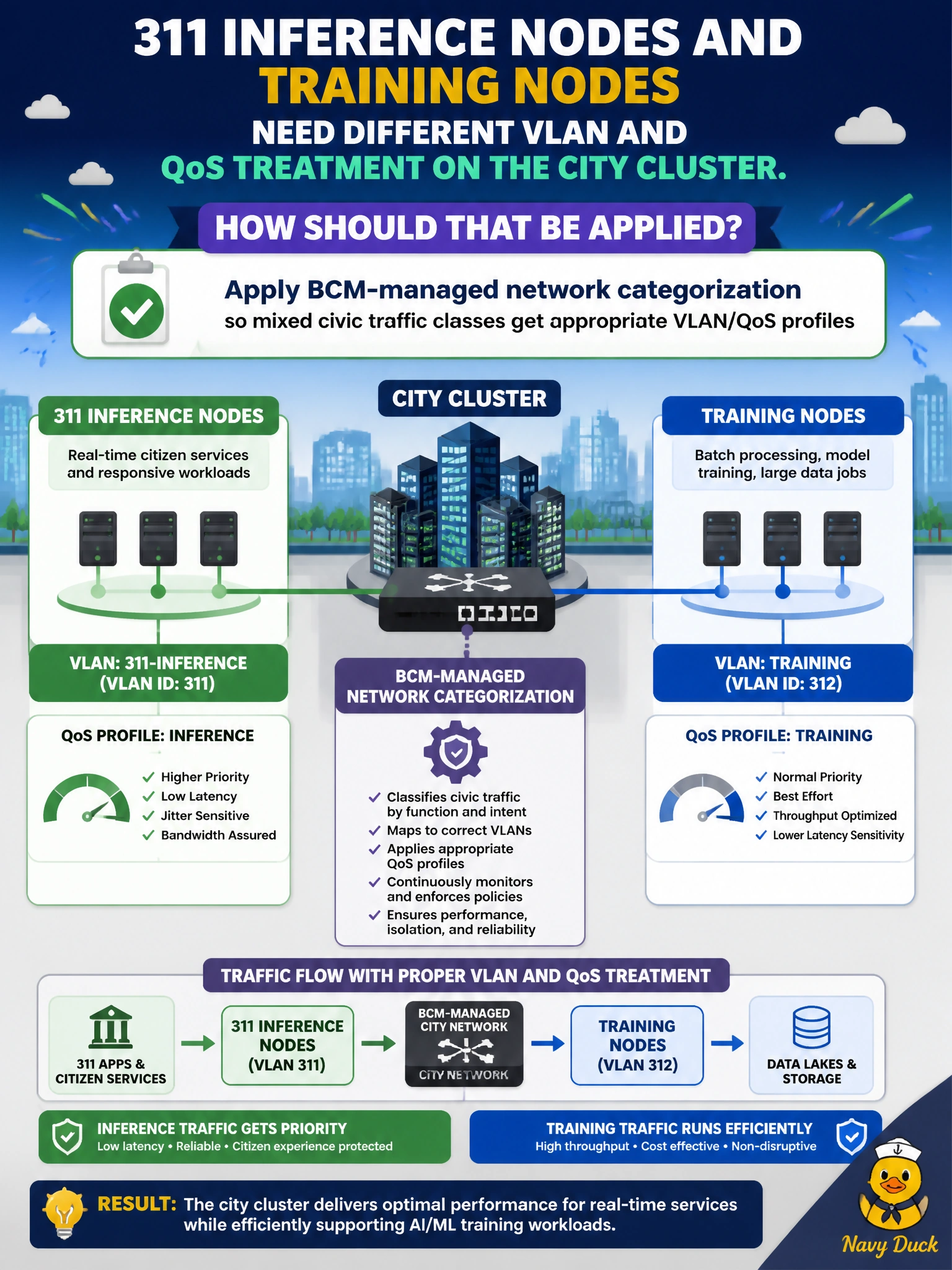
311 inference and training are different traffic classes—like buses versus freight on the same avenue. BCM-managed network profiles (VLAN/QoS) keep them from stomping each other. Hoping best-effort works, or only tuning VPN laptops, misses the cluster fabric.
Full Explanation
311 inference nodes and training nodes needing different VLAN and QoS treatment should receive BCM-managed network categorization so mixed civic traffic classes get appropriate VLAN/QoS profiles. Latency-sensitive municipal inference and bulk training flows share physical fabrics but must not share best-effort fate. Using identical best-effort settings for all traffic and hoping inference survives invites training bursts to degrade citizen-facing 311 latency. Only changing QoS inside end-user laptops connecting over VPN never shapes east-west cluster traffic between GPU nodes. Asking developers to compress models instead of touching network profiles may reduce bytes but is orthogonal to enforcing traffic-class isolation on the fabric. Exam caveat: BCM applies the node/network categorization model you design—wrong VLAN design still fails; the exam point is using BCM-managed profiles rather than hoping or tuning endpoints only. Operational check: assign inference and training nodes to distinct BCM network categories/profiles, verify VLAN tags and QoS markings on representative interfaces, run concurrent 311 inference and training, and confirm inference latency remains within civic SLO while training still completes.