
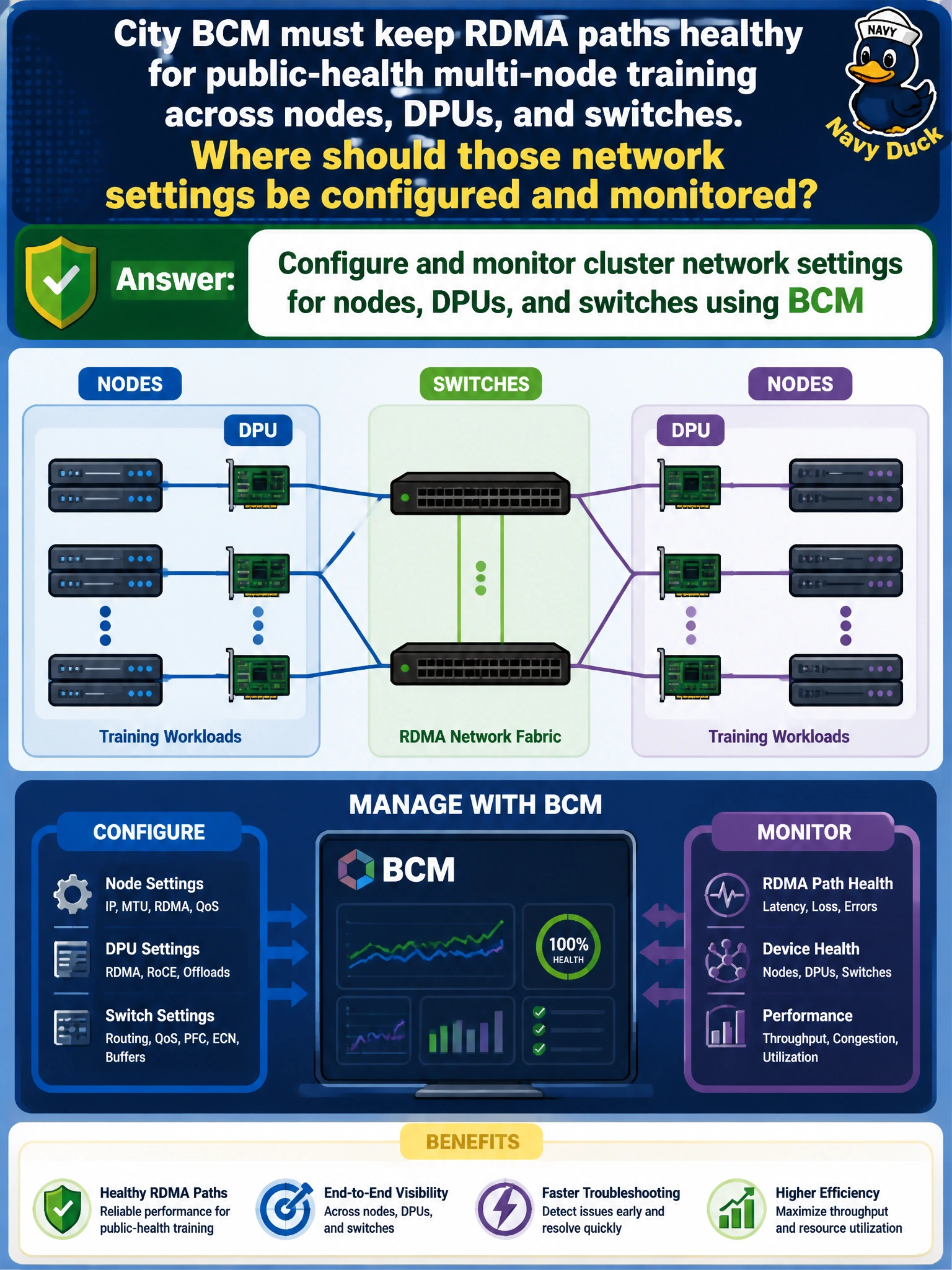
City BCM must keep RDMA paths healthy for public-health multi-node training across nodes, DPUs, and switches. Where should those network settings be configured and monitored?
Select an answer to reveal the explanation.
Short Explanation
Multi-node public-health training lives or dies on the RDMA path—BCM is where node, DPU, and switch settings get watched and fixed. Lobby Wi-Fi and localhost-only modes will not carry that fabric. Stuffing IPs into containers also skips the real cluster network control plane.
Full Explanation
Keeping RDMA paths healthy for public-health multi-node training requires configuring and monitoring cluster network settings for nodes, DPUs, and switches using BCM. Multi-node municipal training depends on the AI fabric—not on consumer access networks—and BCM is the control plane that aligns host, DPU, and switch settings with that fabric. Only adjusting Wi-Fi consumer routers in the clinic lobby cannot provision or monitor InfiniBand/RoCE paths between training nodes. Hard-coding IP addresses inside each training container while skipping fabric settings creates brittle overlays that ignore DPU/switch health and RDMA configuration. Disabling all RDMA so public-health jobs use localhost-only communication collapses multi-node scaling and forces inefficient patterns unsuitable for distributed training. Exam caveat: BCM network management complements—not replaces—correct cabling and switch configs; ops still validate physical and subnet design, but settings and monitoring belong in BCM. Operational check: in BCM, review node/DPU/switch network profiles for the public-health category, confirm RDMA-related settings are present and consistent, run a multi-node training smoke test, and watch BCM network monitoring for errors during the run.