
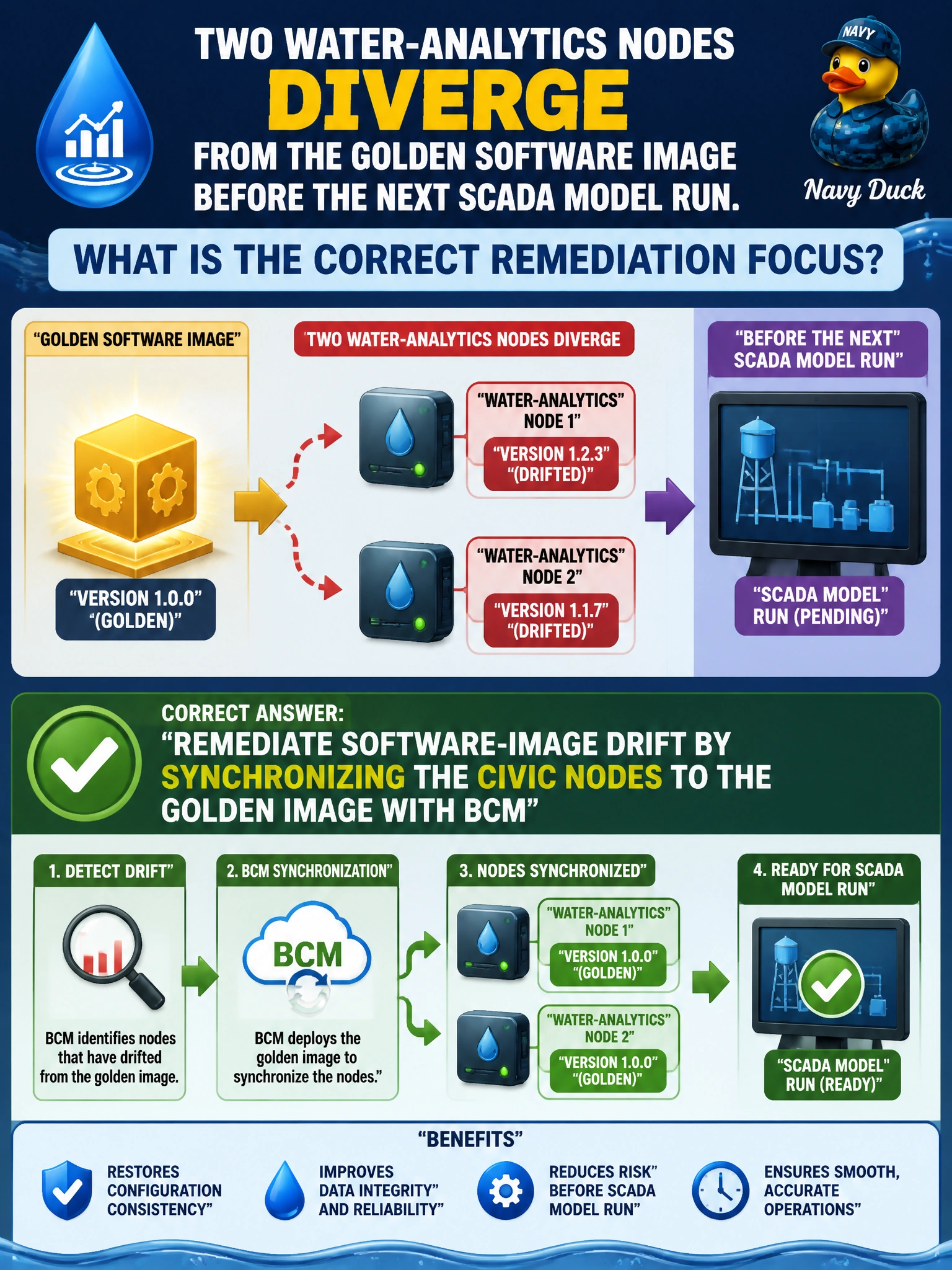
Two water-analytics nodes diverge from the golden software image before the next SCADA model run. What is the correct remediation focus?
Select an answer to reveal the explanation.
Short Explanation
Diverged water nodes are like two pump stations on different firmware—bad news before a SCADA model run. BCM image sync pulls them back to the golden civic image. Treating drift as “creativity” just guarantees the next job fails in a new way.
Full Explanation
Two water-analytics nodes that diverge from the golden software image before the next SCADA model run need remediation focused on synchronizing those civic nodes back to the approved baseline with BCM. Image drift breaks reproducible drivers, libraries, and container assumptions that municipal AI jobs depend on for consistent SCADA analytics. Celebrating divergence as creative local customization with no documentation guarantees the next SCADA analytics job fails in a novel way and cannot be root-caused against a known good. Replacing BCM with sticky notes listing each node’s unique packages abandons centralized image control and cannot scale or audit across the water utility estate. Disabling networking on the golden image server so drift cannot be corrected actively blocks the remediation path operators need. Exam caveat: after sync, verify category membership and any node-specific network/storage overlays still apply—syncing image should not casually wipe required BCM network profiles. Operational check: identify drifted packages/versions via BCM, synchronize both water-analytics nodes to the golden image, confirm matching software levels, run a SCADA model smoke test, and lock change windows so ad-hoc SSH package installs cannot recreate drift.