
After a vendor GPU firmware advisory, city BCM must prepare nodes before Monday’s 311 peak. Which BCM action set is appropriate?
Select an answer to reveal the explanation.
Short Explanation
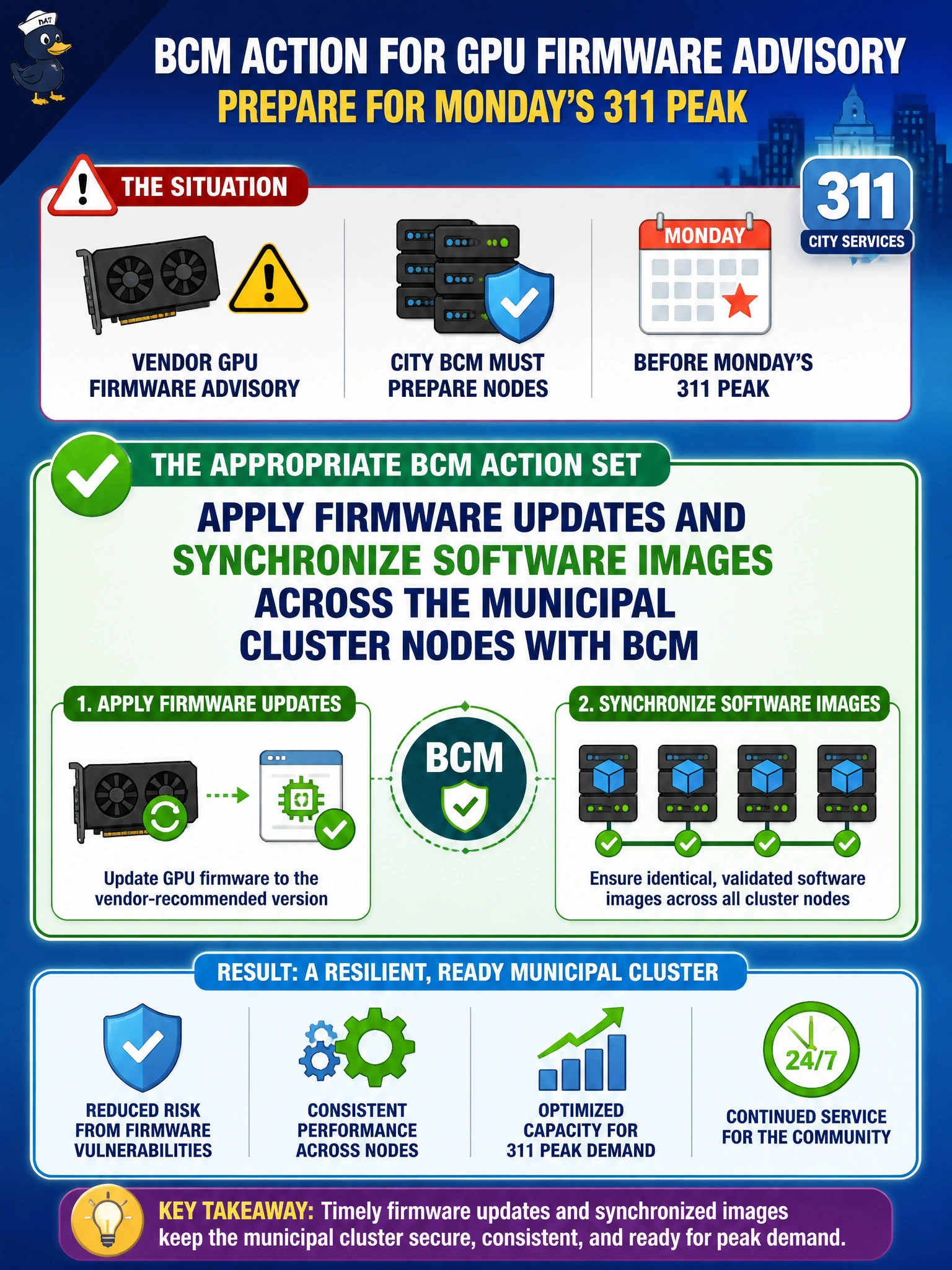
A firmware advisory before Monday 311 peak is a coordinated pit stop, not DIY flashing from home Wi-Fi. BCM applies the firmware and syncs software images so every civic node lines up before traffic hits. Ignoring the advisory or uninstalling BCM invites a mid-peak surprise.
Full Explanation
After a vendor GPU firmware advisory, city BCM must prepare nodes before Monday’s 311 peak by applying firmware updates and synchronizing software images across the municipal cluster with BCM. Controlled image and firmware rollout is how civic GPU estates stay consistent, supportable, and ready for peak citizen-facing inference. Ignoring the advisory and only rebooting login nodes leaves compute GPUs on vulnerable or unsupported firmware and does not apply the required updates to the nodes that actually serve 311. Asking each analyst to flash GPUs from personal laptops over Wi-Fi invents an unmanaged, unauditable, partially applied fleet—exactly what BCM exists to prevent before a demand peak. Uninstalling BCM so nodes can diverge freely before the peak maximizes configuration drift right when 311 load arrives. Exam caveat: schedule firmware/image sync inside a maintenance window that still completes before Monday peak; rushing mid-spike is worse than a planned brief drain. Operational check: stage the advisory update in BCM, sync a pilot category, validate nvidia-smi/firmware levels and a 311 smoke inference job, then roll remaining municipal nodes and confirm image/firmware homogeneity before Monday open.