
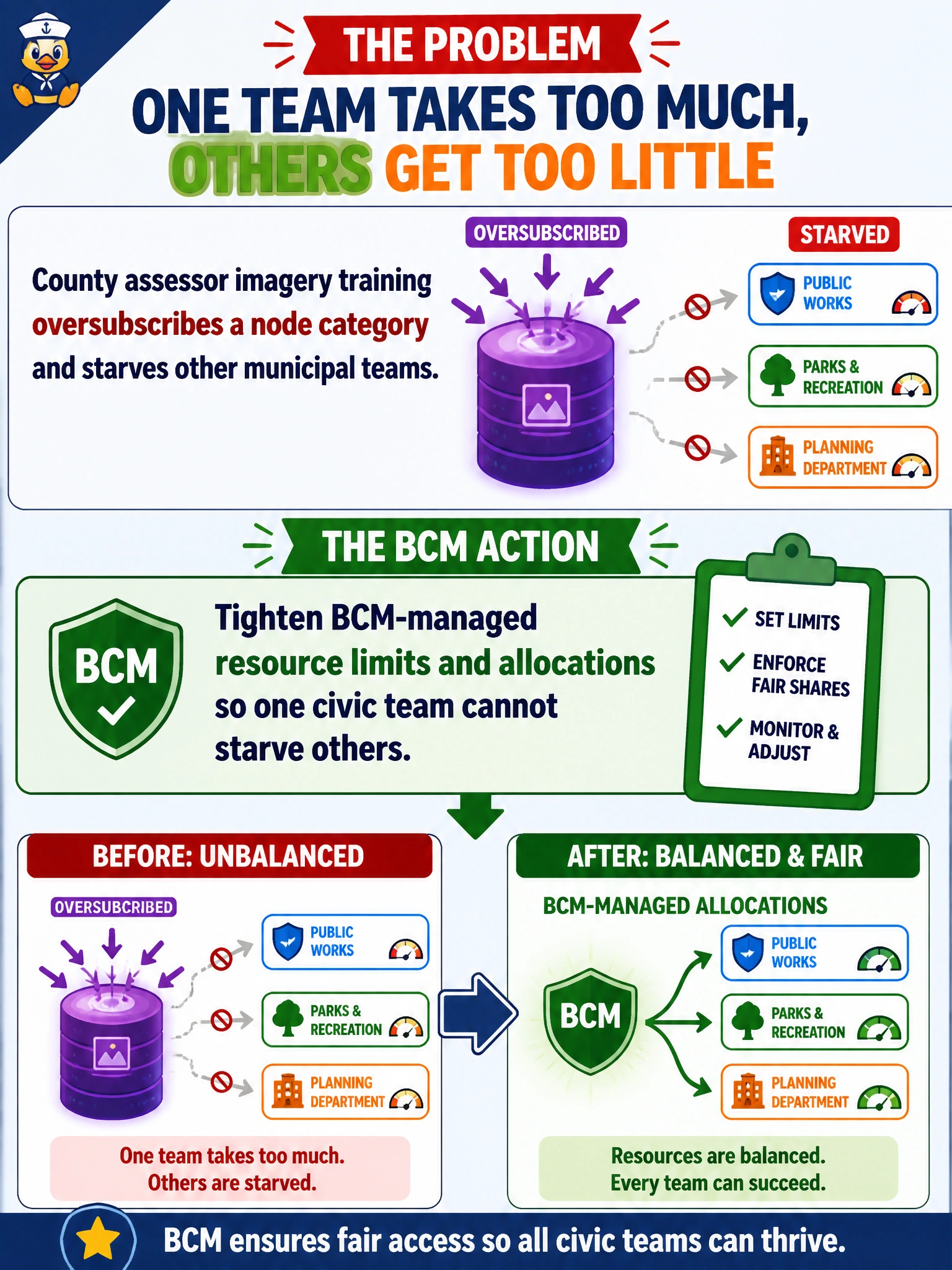
County assessor imagery training oversubscribes a node category and starves other municipal teams. What BCM action addresses the allocation problem?
Select an answer to reveal the explanation.
Short Explanation
One assessor job hogging a category is like one department booking every conference room—limits have to shrink. Tighten BCM resource allocations so imagery training cannot starve the rest of the county’s AI work. Lifting caps or fleeing to unmanaged desktops just moves the outage.
Full Explanation
When county assessor imagery training oversubscribes a node category and starves other municipal teams, the BCM action is to tighten managed resource limits and allocations so one civic team cannot monopolize shared GPU categories. Workload-manager controls under BCM exist precisely to bound consumption with quotas, fair shares, or category caps. Granting the assessor unlimited preemption over public-safety jobs with no caps inverts priority and can interrupt life-safety workloads for back-office imagery. Removing all resource limits so every team can oversubscribe freely amplifies the starvation problem and abandons multi-tenant governance. Moving assessor training exclusively to unmanaged desktops outside BCM forfeits image consistency, RDMA fabrics, accounting, and reproducibility—the opposite of professional municipal AI operations. Exam caveat: tightening limits may require negotiating service-level expectations with the assessor’s office; the technical fix is still caps/allocations, not unbounded privilege. Operational check: inspect current assessor usage versus limits, reduce GPU/time caps or raise competing teams’ shares, resubmit mixed workloads, and confirm public-safety and other civic jobs regain capacity on the contended category.