
Public-health Spectrum-X leafs drift until RoCE and QoS settings disagree. How should engineers restore consistency?
Select an answer to reveal the explanation.
Short Explanation
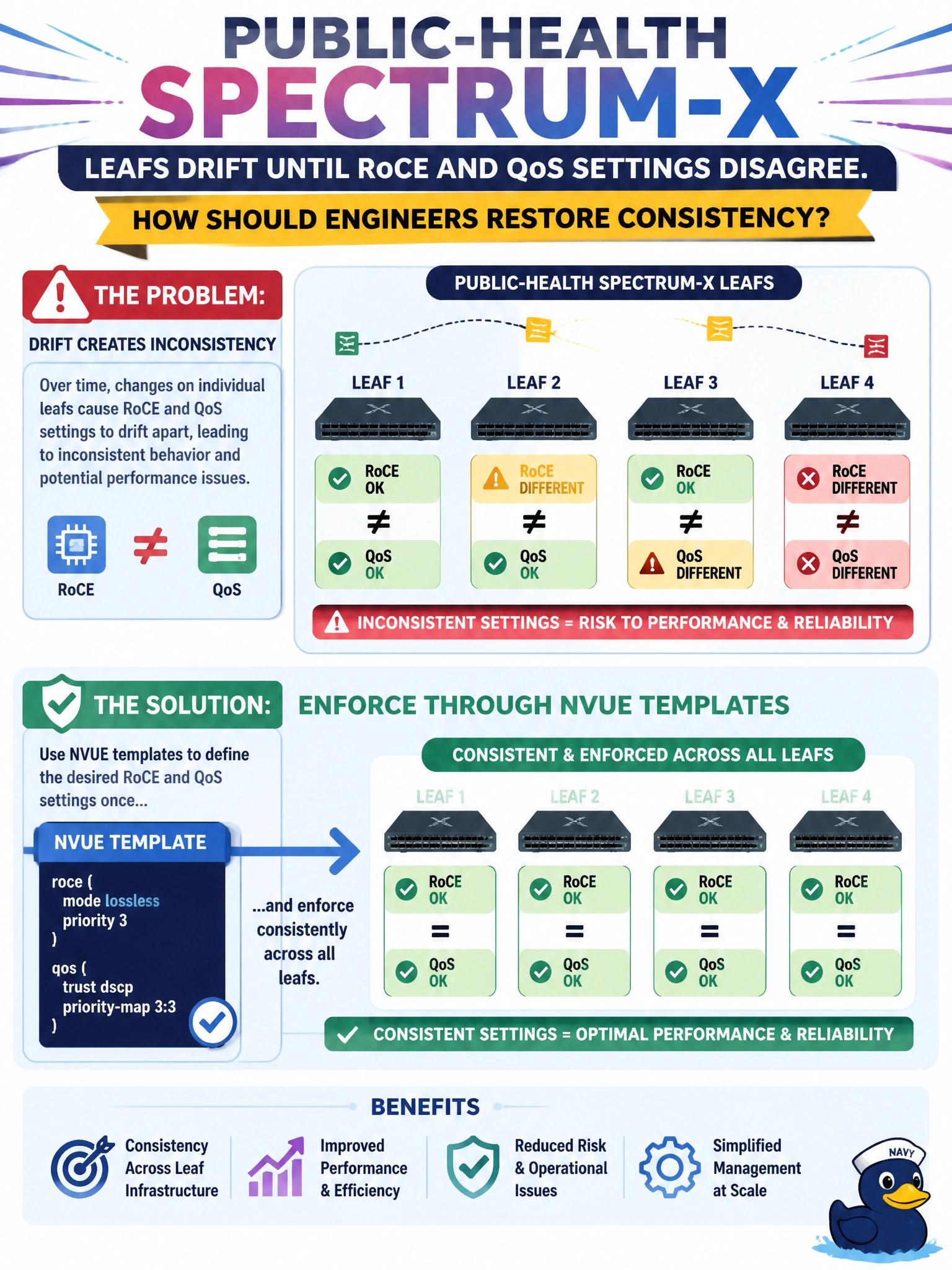
Drift is when every public-health leaf tells a different RoCE story. Snap them back with NVUE templates that enforce the same RoCE and QoS settings everywhere that matters.
Full Explanation
When public-health Spectrum-X leafs drift until RoCE and QoS settings disagree, consistency must be restored by re-applying the intended configuration model—not by abandoning RoCE or monitoring. Enforcing RoCE and QoS settings through NVUE templates across the leafs re-converges municipal Spectrum Ethernet behavior so PFC, ECN, priorities, and related RoCE prerequisites match the public-health standard on every affected leaf.
Pushing RoCE and QoS settings with NetQ monitoring jobs across the leafs misassigns the tool: NetQ is built to observe and validate fabric state and detect drift, not to be the configuration-push mechanism that enforces RoCE and QoS settings onto the leafs—using it that way leaves no template-based source of truth to re-converge from. Tuning ECN and PFC thresholds from host NIC firmware to align leaf queues works the wrong end of the link: NIC firmware settings on the hosts cannot enforce or correct switch-side RoCE and QoS configuration on the Spectrum-X leafs themselves, so the leafs stay drifted. Reinstalling consistent SONiC images with ONIE to reset QoS buffers on leafs is a disruptive, outage-causing operation that wipes the switch OS to chase a configuration problem that NVUE templates can fix in place, without the downtime or risk of a full image reinstall.
Exam caveat: after template enforcement, verify that workload RoCE paths still meet latency and loss expectations—template apply success is necessary but not sufficient without a data-plane check. Operational check: revise or select the NVUE templates that encode RoCE/QoS, apply them to drifted public-health leafs, confirm template compliance, and spot-check RoCE counters or test traffic for restored consistency.