
An emergency-management NOC runbook starts Spectrum-X allocation triage. Which diagnostic should come early?
Select an answer to reveal the explanation.
Short Explanation
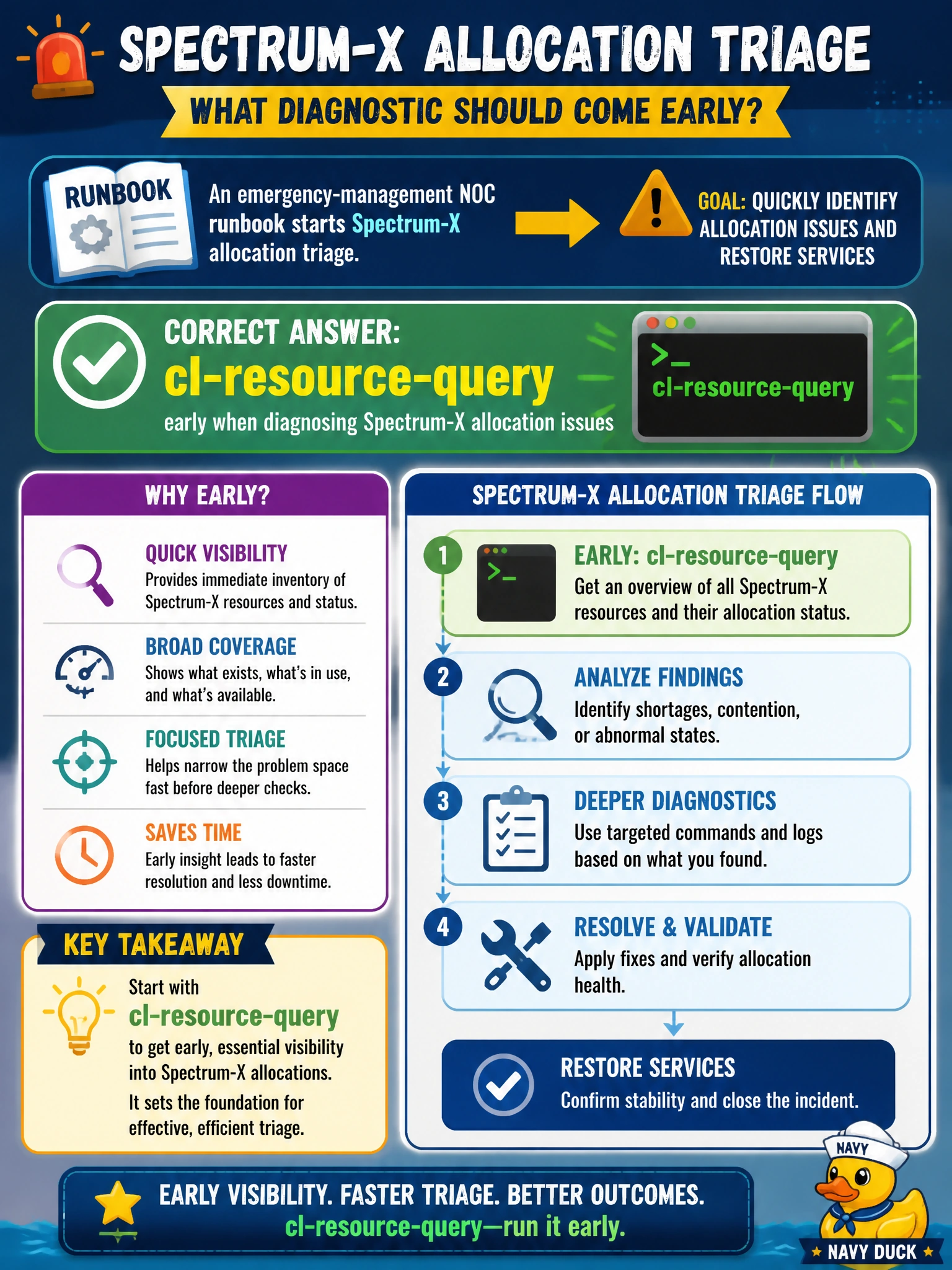
Don’t boil the ocean first—check the resource cupboard. Put cl-resource-query early in the emergency-management Spectrum-X allocation triage runbook.
Full Explanation
An emergency-management NOC runbook starting Spectrum-X allocation triage should put cl-resource-query early when diagnosing Spectrum-X allocation issues. Early resource query quickly answers whether ASIC allocation pressure is in play, which focuses subsequent steps. For civic emergency-management fabrics, that ordering reduces mean time to clarity during incidents when every minute of AI fabric degradation matters.
Reviewing WJH drop counters for forwarding anomalies during triage fails as an early diagnostic because it targets forwarding drops rather than Spectrum-X allocation headroom, and it can create noise before cl-resource-query confirms whether allocation pressure exists. Validating EVPN control-plane sessions before resource utilization check fails by placing control-plane session verification ahead of the ASIC allocation question, delaying the evidence needed to focus triage. Inspecting NetQ fabric telemetry for link-state validation in triage fails as the early step because link-state visibility does not answer the Spectrum-X allocation question and should follow cl-resource-query, not precede it.
Exam caveat: Early does not mean only. After cl-resource-query shows or rules out allocation pressure, continue with WJH, topology, and change history as needed. Do not disable other Spectrum telemetry while triage is active.
Operational check: Update the emergency-management Spectrum-X allocation runbook so step one (or an early numbered step) is cl-resource-query on affected switches, with output saved to the incident timeline before WJH drop-counter review, EVPN session validation, or NetQ link-state inspection begins.