
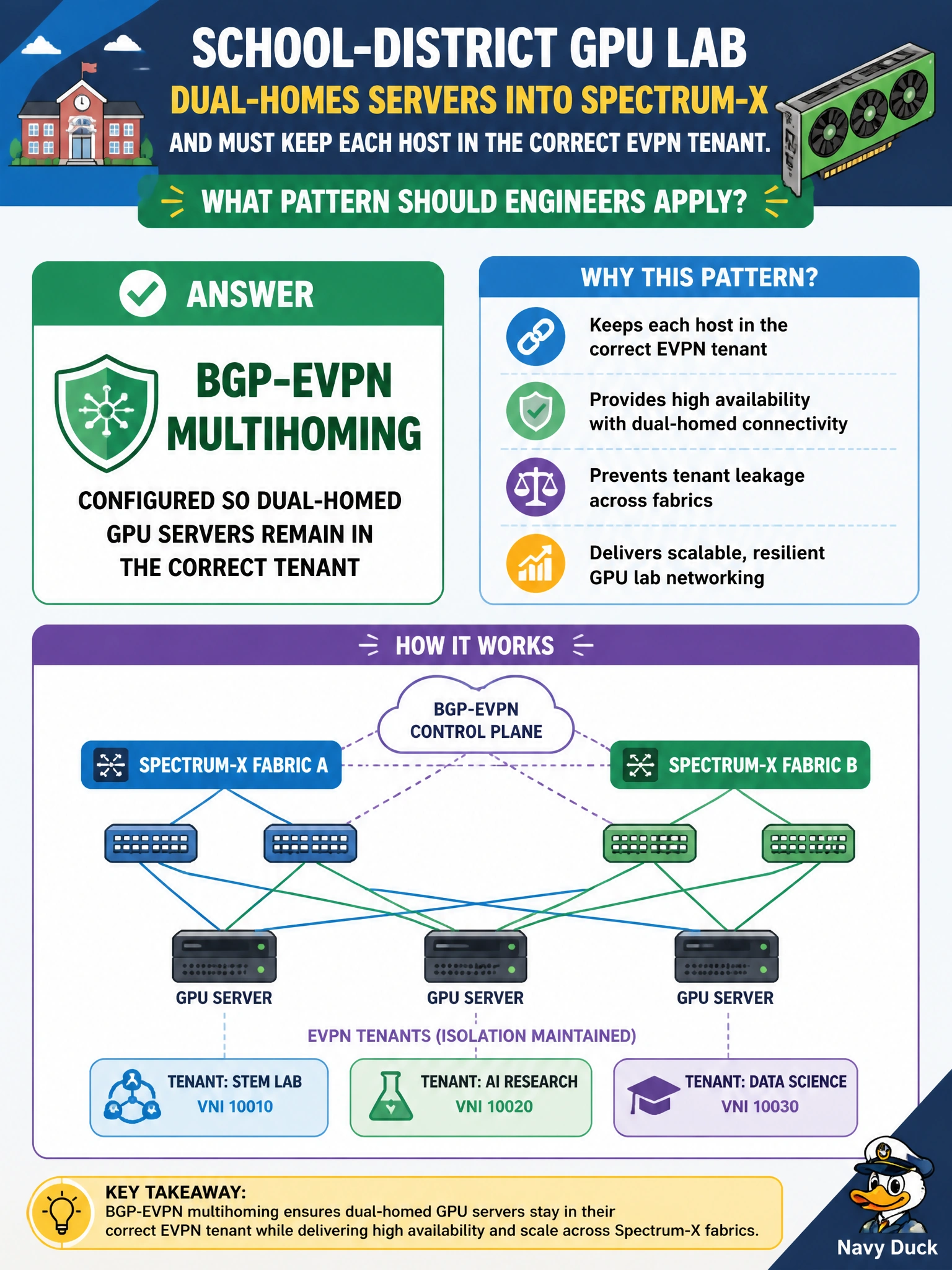
A school-district GPU lab dual-homes servers into Spectrum-X and must keep each host in the correct EVPN tenant. What pattern should engineers apply?
Select an answer to reveal the explanation.
Short Explanation
Dual-homed school GPU servers are like buses with two driveway exits—EVPN multihoming keeps both exits in the right tenant neighborhood. Without that pattern, a host can wander into the wrong EVPN tenant after a leaf flap.
Full Explanation
A school-district GPU lab that dual-homes servers into Spectrum-X must keep each host in the correct EVPN tenant across both attachments. The right pattern is BGP-EVPN multihoming configured so dual-homed GPU servers remain in the correct tenant. EVPN multihoming (with Ethernet Segment Identifier concepts and consistent VLAN/VRF binding on both leaves) lets a server use two uplinks for redundancy without splitting the host across tenants or creating asymmetric learning that breaks isolation. For civic labs, that preserves both availability and tenant correctness when a leaf or uplink fails.
Configure common ESI values on leaf ports to extend multihoming across different tenants fails by concept: a single ESI must identify one Ethernet segment, not span multiple tenants, so extending it across tenants erases isolation and can cause the host to be learned in the wrong EVPN tenant or leak traffic across boundaries. Enable EVPN single-active multihoming for dual-homed GPU servers needing ECMP throughput fails by concept: single-active elects only one designated forwarder, so both links cannot carry ECMP traffic simultaneously, and it does not ensure both attachments stay inside the correct tenant VRF. Map both server uplinks to separate ESIs while sharing a single EVPN tenant VNI fails by concept: separate ESIs treat the two uplinks as different Ethernet segments rather than one multihomed segment, which can cause duplicate MAC learning, split-horizon violations, or inconsistent tenant placement despite the shared VNI.
Exam caveat: EVPN multihoming keeps the dual-homed host in one tenant when configured consistently; mismatched VLANs, VRFs, or ESI values between the two leaves will still break tenant placement. Operational check: validate identical tenant/VLAN mapping on both dual-home leaves, confirm EVPN multihoming state for the school GPU Ethernet segment, fail one uplink in a maintenance window, and verify the host remains reachable only inside its assigned EVPN tenant with no cross-tenant route learning.