
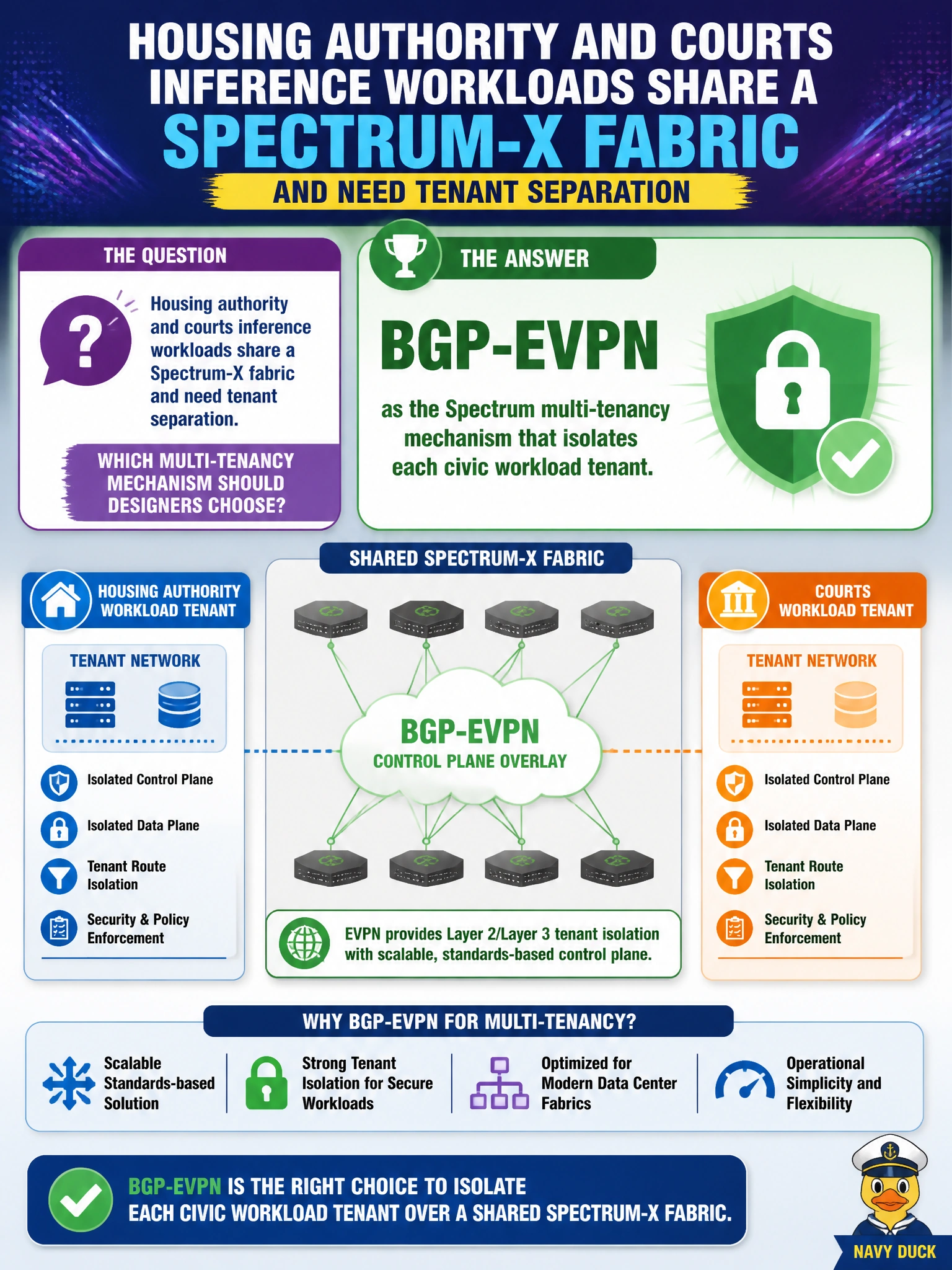
Housing authority and courts inference workloads share a Spectrum-X fabric and need tenant separation. Which multi-tenancy mechanism should designers choose?
Select an answer to reveal the explanation.
Short Explanation
You can run housing and courts on the same Spectrum-X fabric, but you’ll need BGP-EVPN to keep each tenant isolated. It’s the multi-tenancy tool that separates civic inference workloads without building separate physical fabrics.
Full Explanation
Housing authority and courts inference workloads that share a Spectrum-X fabric need a multi-tenancy mechanism designed for Ethernet AI fabrics. Designers should choose BGP-EVPN as the Spectrum multi-tenancy mechanism that isolates each civic workload tenant. EVPN provides scalable overlay segmentation with VRFs, so housing models and court models can share leaf/spine capacity without sharing routing tables or East-West reachability. That matches NVIDIA Spectrum networking practice for multi-tenant AI Ethernet while respecting municipal separation-of-duty expectations between agencies.
Per-tenant VXLAN VNIs with head-end replication for tenant broadcast traffic on Spectrum-X fails by concept: it lacks a BGP-EVPN control plane, so it cannot advertise tenant routes or VRF membership and creates inefficient broadcast flooding across housing and courts GPUs. Dedicated VRF instances with 802.1Q VLAN mapping at Spectrum-X leaf ports for civic tenants also fails—it pins tenants to static port VLANs instead of using an EVPN control plane, so it does not scale as an Ethernet AI fabric multi-tenancy mechanism. SR-IOV virtual functions assigned per civic workload with host network namespaces for isolation fails because those are host-level constructs, not the Spectrum-X Ethernet multi-tenancy control plane, and they cannot enforce tenant routing boundaries across the leaf/spine fabric.
Exam caveat: selecting BGP-EVPN is the architectural answer; correct RT policy, VTEP/ESI design, and operational change control are still required to keep housing and courts isolated day to day. Operational check: provision distinct EVPN tenants/VRFs for housing and courts, verify each agency’s GPU servers only learn their tenant routes, document RT import/export, and run a periodic isolation test so Spectrum-X multi-tenancy remains evidenced—not assumed—for municipal reviewers.