
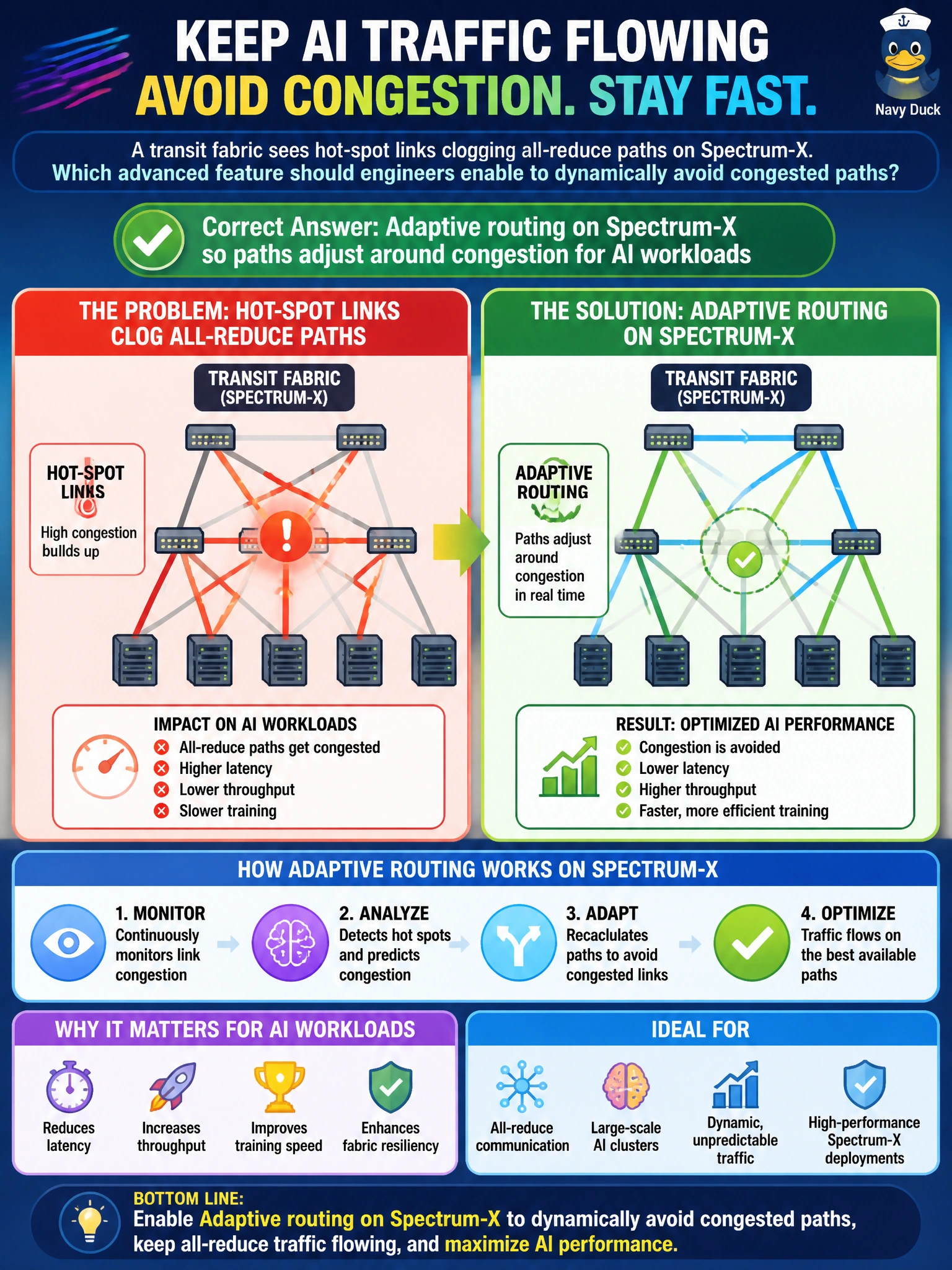
A transit fabric sees hot-spot links clogging all-reduce paths on Spectrum-X. Which advanced feature should engineers enable to dynamically avoid congested paths?
Select an answer to reveal the explanation.
Short Explanation
Hot-spot links on the transit fabric are like a jammed tunnel during rush hour—adaptive routing on Spectrum-X is the detour system that steers all-reduce traffic onto clearer paths. Enable it so AI flows are not glued to the clogged link.
Full Explanation
A transit fabric with hot-spot links clogging all-reduce paths on Spectrum-X should enable adaptive routing so paths adjust around congestion for AI workloads. Adaptive routing uses fabric state to steer flows away from overloaded links, improving collective completion times when static ECMP load distribution with fixed hashing leaves hot-spot uplinks clogged because it cannot react to fabric state. For transit ML all-reduce, that dynamic avoidance is the advanced Spectrum-X feature that matches the symptom.
Static ECMP load distribution with fixed hashing to spread flows across Spectrum-X uplinks cannot steer around congestion; fixed hashing can still leave hot-spot links clogged because it does not react to fabric state. ECN-based congestion control to signal senders to reduce injection rates slows injection but does not reroute all-reduce traffic away from overloaded links, so it will not clear hot-spot paths. NVIDIA SHARP aggregation on switches to reduce collective traffic volume reduces in-network traffic volume but does not dynamically route around congestion; it complements adaptive routing rather than replacing it.
Exam caveat: hot-spot all-reduce on Spectrum-X points to adaptive routing (with visibility), not static ECMP fixed hashing, ECN-based congestion control, or SHARP aggregation. Operational check: enable adaptive routing on the transit Spectrum-X fabric, watch telemetry for reduced hot-link utilization during all-reduce, and keep ECMP/telemetry available so engineers can see path shifts; do not rely on static ECMP fixed hashing, ECN-based congestion control, or SHARP aggregation as the path-avoidance policy. After enablement, correlate adaptive routing decisions with all-reduce completion times on the transit fabric and keep a known-good ECMP baseline so engineers can compare static hashing versus adaptive behavior during incident review on Spectrum-X.