
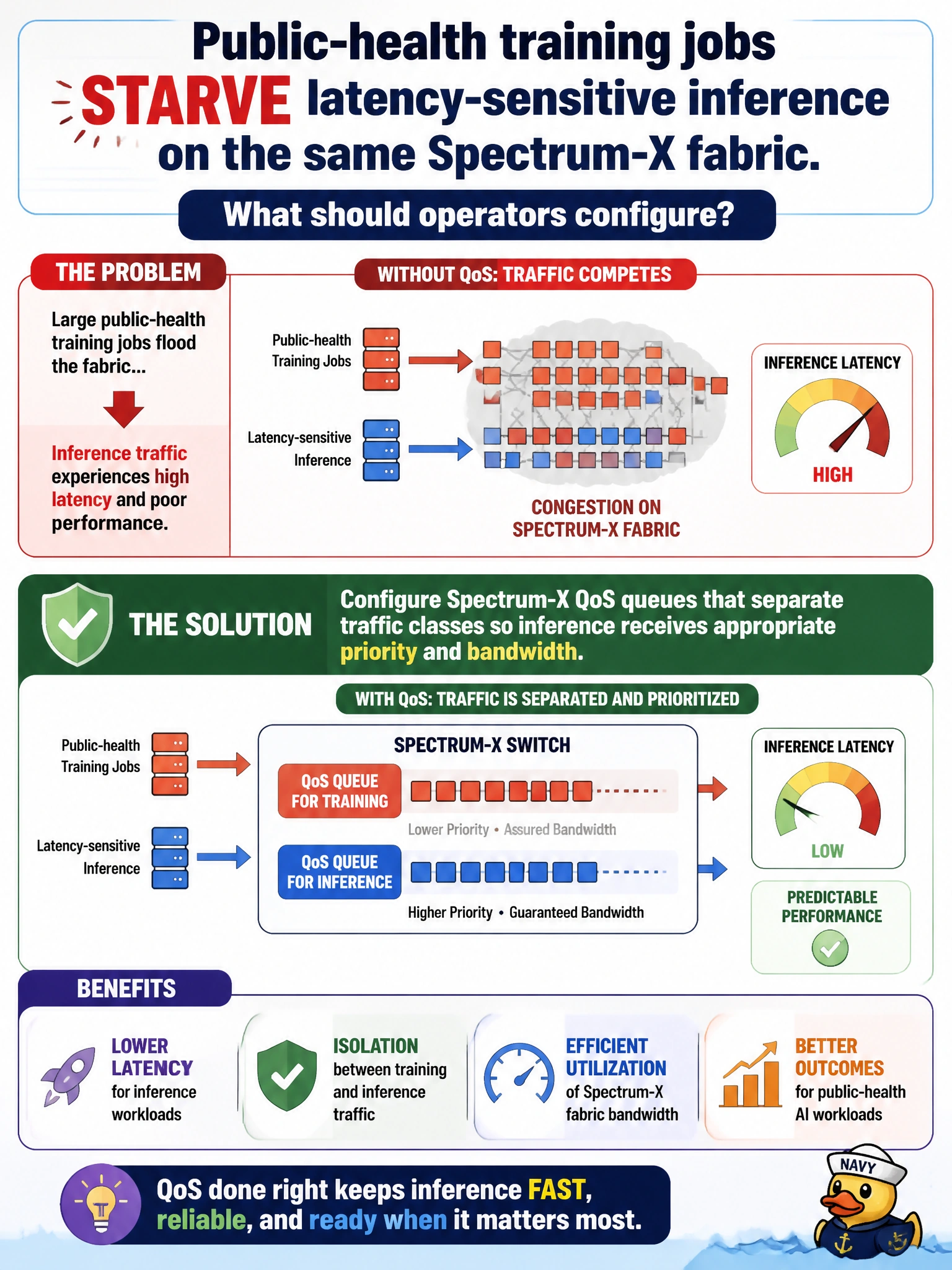
Public-health training jobs starve latency-sensitive inference on the same Spectrum-X fabric. What should operators configure?
Select an answer to reveal the explanation.
Short Explanation
When overnight public-health training bullies daytime inference, think city bus lanes versus freight trucks—Spectrum-X QoS queues keep the classes from crushing each other. Give inference its priority and bandwidth; don't count on adaptive routing that pushes training across spine links but leaves inference starving.
Full Explanation
When public-health training jobs starve latency-sensitive inference on the same Spectrum-X fabric, operators should configure Spectrum-X QoS queues that separate traffic classes so inference receives appropriate priority and bandwidth. Distinct queues and scheduling keep bulky training flows from monopolizing buffers and scheduler time that clinic inference needs for responsive service. Class separation is the standard Spectrum-X answer to mixed AI workloads on one municipal fabric.
Spectrum-X adaptive routing that balances large training flows across spine links maximizes fabric throughput for training, but it does not separate traffic classes or reserve priority and bandwidth for inference, so it cannot stop training from starving latency-sensitive clinic traffic. Spectrum-X SHARP in-network aggregation reduces gradient traffic from distributed training collectives, but it optimizes training collectives only and provides no QoS protection, priority, or bandwidth reservation for inference flows. Spectrum-X telemetry streaming exports detailed per-flow latency counters for training and inference visibility, but visibility alone does not enforce class separation, scheduling, or bandwidth guarantees that inference needs.
Exam caveat: mixed training/inference on Spectrum-X implies intentional QoS—not adaptive routing, SHARP aggregation, or telemetry as substitutes. Operational check: define training versus inference (and backup) classes on Spectrum-X, map RoCE/priorities accordingly, load-test with concurrent public-health training and inference, and verify inference latency/bandwidth SLOs hold; keep QoS enabled and do not rely on SHARP, adaptive routing, or telemetry as a “solution” for inference starvation.