
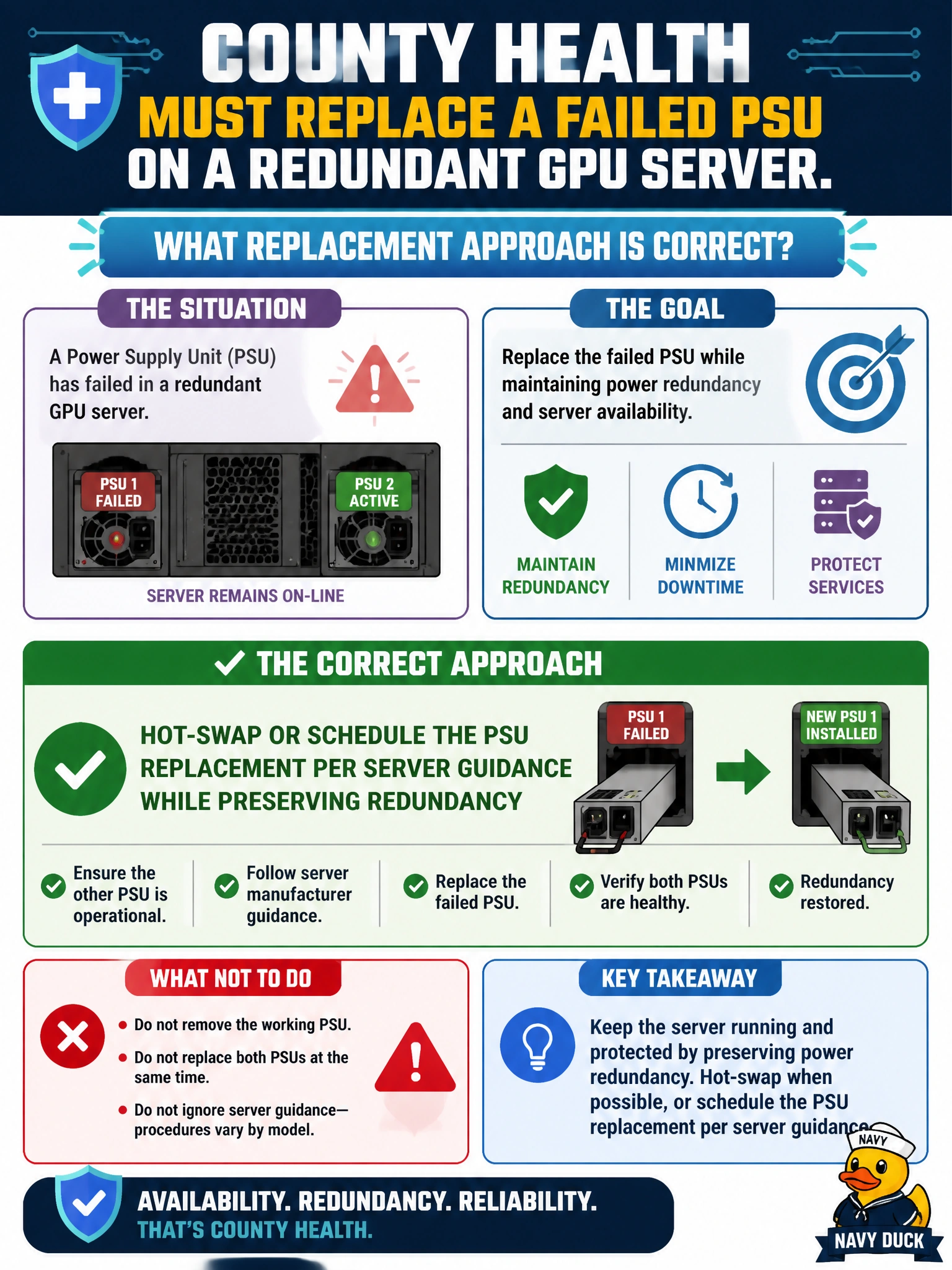
County health must replace a failed PSU on a redundant GPU server. What replacement approach is correct?
Select an answer to reveal the explanation.
Short Explanation
Keep one engine running while you change the other—same idea with redundant PSUs. County health should follow server guidance and preserve redundancy during the swap.
Full Explanation
County health replacing a failed PSU on a redundant GPU server must hot-swap or schedule the replacement per server guidance while preserving redundancy on the remaining supply. Domain 5 power-FRU practice keeps public-health AI hosts powered through the swap instead of creating an avoidable outage that interrupts training or inference. The surviving qualified supply is what makes maintenance safe; the procedure exists to protect that redundancy window. Pulling both PSUs at once to finish faster removes all feeds and drops the node regardless of how quick the swap feels. Replacing the PSU only after deleting all training checkpoints invents an unrelated data-destruction prerequisite that has nothing to do with power FRU procedure and needlessly endangers civic experiment state. Ignoring vendor guidance and using any ATX supply from a spare closet risks incompatible connectors, power ratings, and monitoring, and can damage the GPU server. Exam caveat: confirm whether the specific chassis supports true hot-swap or requires a short maintenance window; either path still keeps at least one qualified feed online until the new FRU is verified. Operational check: identify the failed supply via telemetry, replace it following the redundant-PSU procedure, confirm both supplies report healthy under a county health training peak, and update the asset record.