
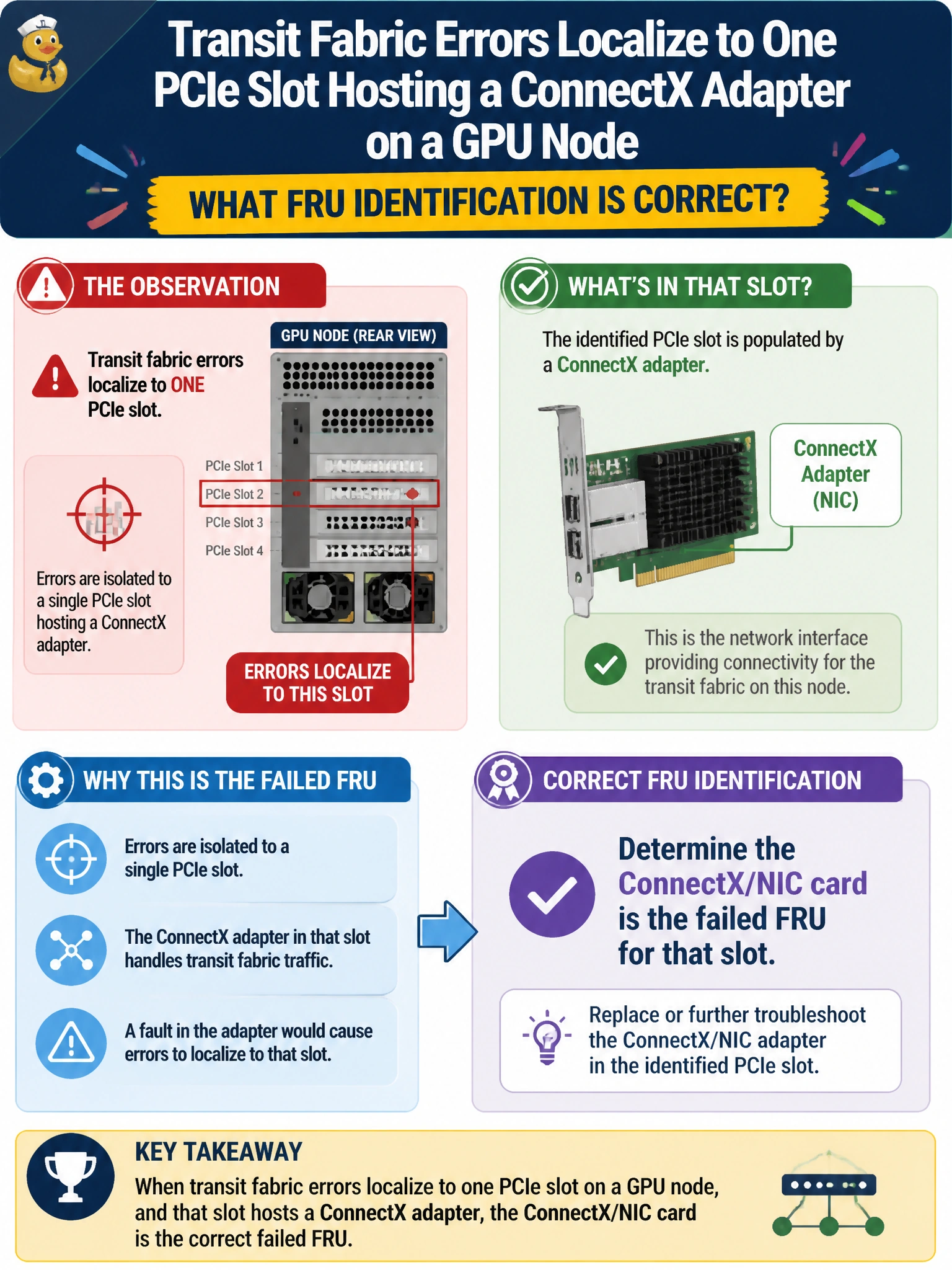
Transit fabric errors localize to one PCIe slot hosting a ConnectX adapter on a GPU node. What FRU identification is correct?
Select an answer to reveal the explanation.
Short Explanation
When the smoke trail stops at one PCIe slot, you can focus on the ConnectX card there—not the whole highway. Your FRU call is the NIC in that slot.
Full Explanation
Transit fabric errors localized to one PCIe slot hosting a ConnectX adapter identify that ConnectX/NIC card as the failed FRU for the slot. Slot-local PCIe AER, link flaps, and fabric counters support a focused fault identification rather than blame on unrelated components. When peer hosts and other slots remain clean while one BDF repeatedly logs errors, the evidence points to that adapter. Identifying every NVLink bridge as failed invents a GPU interconnect failure without evidence linking the bridges to the slot. RMAing the entire top-of-rack switch as the only option overshoots the localized evidence, especially when peer links and other hosts remain healthy. Blaming the Slurm fairshare plugin confuses scheduler policy with PCIe AER events and hardware link faults on a specific NIC. Exam caveat: bad cables or optics in the same path can mimic NIC failure, so check them before confirming the adapter as the FRU. Practical check: map AER and fabric errors on the transit GPU node to the ConnectX BDF and slot, verify peer ports and optics, replace the NIC if evidence stays with the card, then revalidate link state and NCCL after the swap.