
A city multi-GPU municipal server reports ECC failures but does not name which device is bad. What identification step is required?
Select an answer to reveal the explanation.
Short Explanation
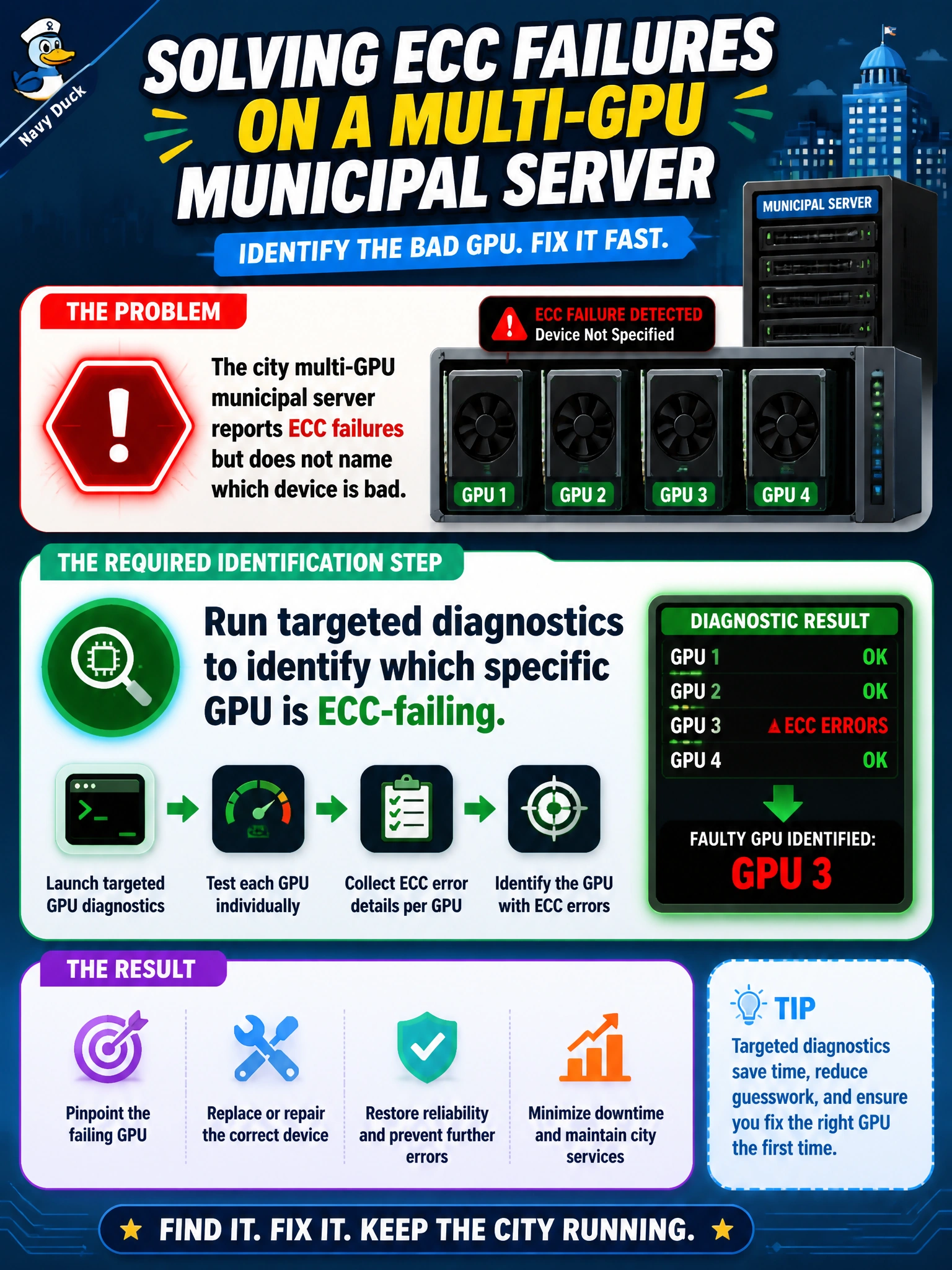
When the car says 'a tire is flat' but not which one, you still check each wheel—same idea with ECC on a multi-GPU box. City ops need targeted diagnostics to pin the failing GPU.
Full Explanation
A city multi-GPU municipal server that reports ECC failures without naming the bad device requires targeted diagnostics that identify which specific GPU is ECC-failing before any RMA. Domain 5 skill 5.2 is about isolating the faulty accelerator among peers so civic spare use and downtime stay proportional to the actual fault. Aggregate chassis alerts are a starting signal, not a license to replace every card in the box. RMAing every GPU in the chassis at once wastes inventory and extends outage when only one device may be accumulating uncorrectable or rapidly rising correctable ECC. Disabling ECC globally and declaring the node healthy hides memory integrity errors that municipal AI workloads may rely on detecting and can allow silent corruption into civic models. Swapping the BMC battery to clear ECC counters addresses a management clock or coin-cell component and does not identify or repair a failing GPU memory subsystem. Exam caveat: some chassis aggregate ECC alerts at the system event log; always drill to per-GPU counters via DCGM, nvidia-smi, or vendor tools before labeling a FRU. Operational check: run per-GPU ECC and memory diagnostics on the city host, record which UUID or index shows rising correctable or uncorrectable counts under a representative load, quarantine that GPU, and only then open the matching RMA with the per-device evidence attached.