
County health upgrades cooling and must show the change helped under load. What validation fits?
Select an answer to reveal the explanation.
Short Explanation
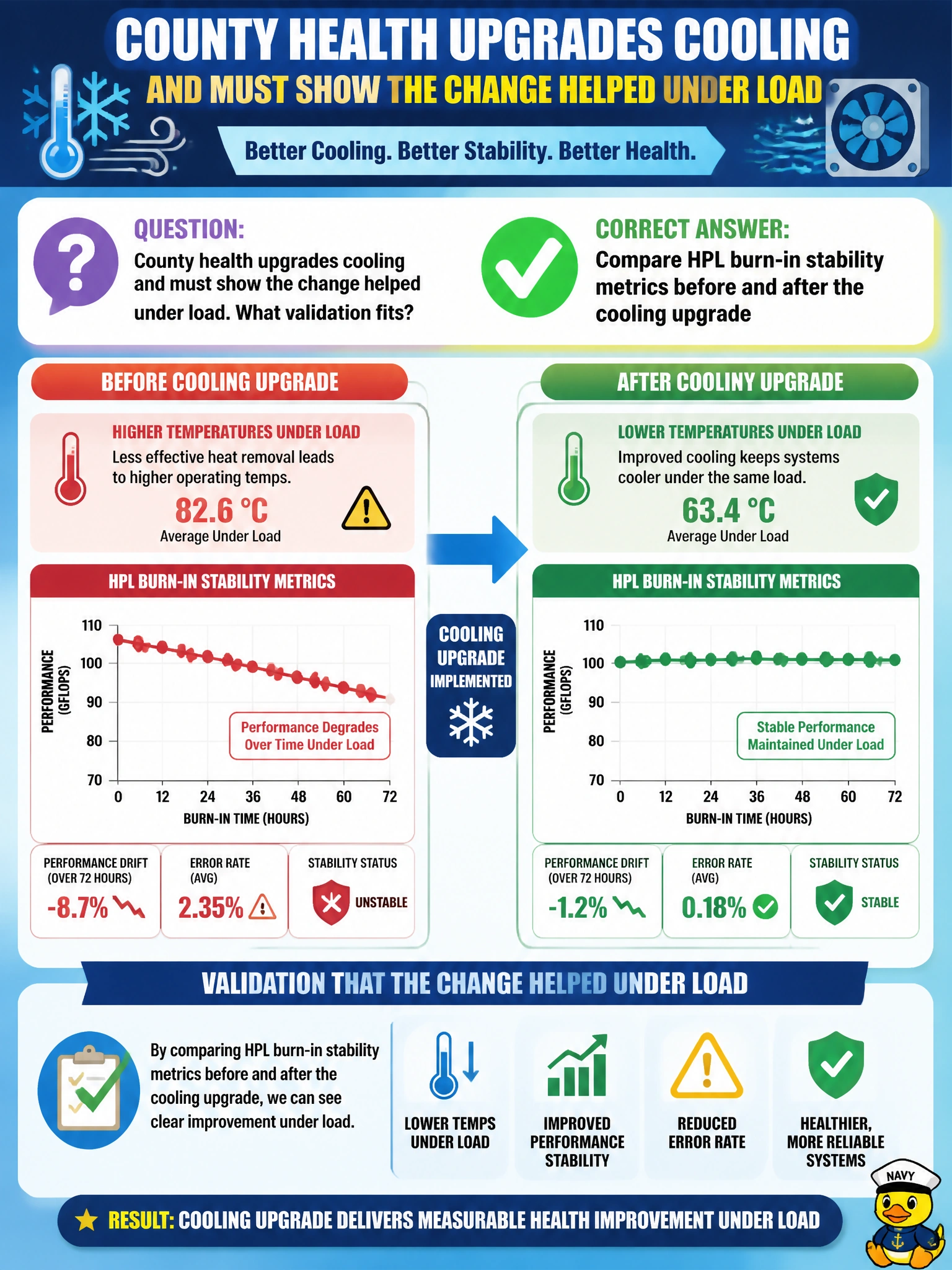
New cooling for county health? Prove it with HPL burn-in before-and-after—pretty empty-rack photos will not catch thermal throttle under Linpack.
Full Explanation
After county health upgrades cooling, operators should compare HPL burn-in stability metrics before and after the change to prove the environmental remediation actually helps under sustained compute load. Domain 4 validation ties facilities work to measurable GPU endurance outcomes, not to assumptions that new CRAC setpoints automatically fixed throttling. Assuming cooling upgrades never need compute revalidation skips the only workload-relevant proof that thermal or power limits improved for AI nodes. Comparing only empty-rack photos before and after documents aesthetics or airflow props, not Linpack stability, score decay, or thermal margins under load. Skipping HPL because NCCL already ran last quarter uses the wrong test class and stale timing—NCCL stresses collectives, while cooling fixes often show up first as compute thermal behavior under HPL. Exam caveat: keep topology and node software as constant as practical between before/after HPL runs so the comparison isolates the cooling change rather than mixed variables. Operational check: for county health, archive pre-upgrade HPL burn-in scores and thermals, apply the cooling change, re-run the same HPL burn-in profile, and accept the upgrade only when post metrics show improved or policy-compliant sustained stability.