
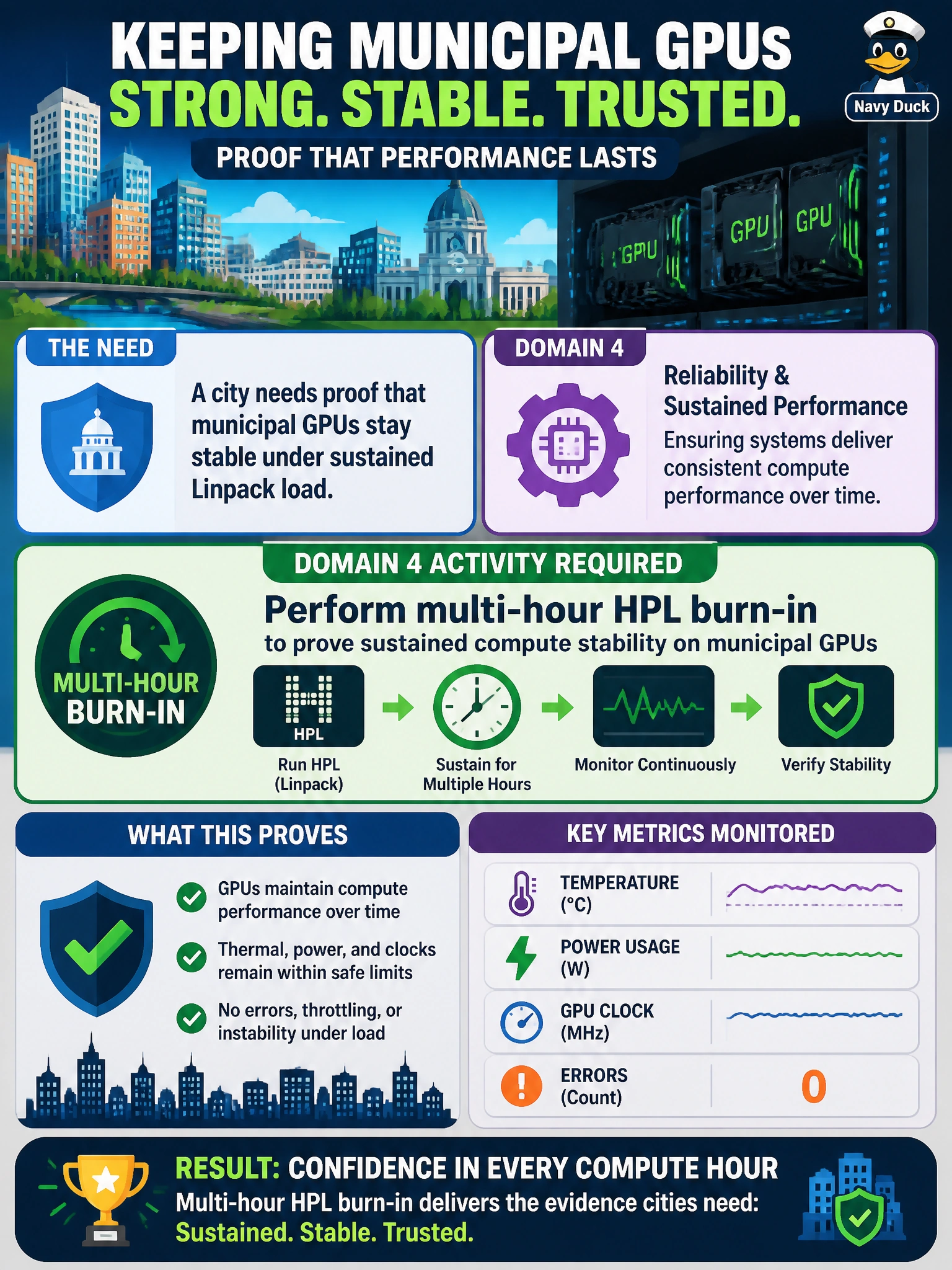
A city needs proof that municipal GPUs stay stable under sustained Linpack load. What Domain 4 activity is required?
Select an answer to reveal the explanation.
Short Explanation
City GPUs prove they can grind with a multi-hour HPL burn-in—idle watts and a firmware string are not the same workout.
Full Explanation
Municipal GPUs need multi-hour HPL burn-in to prove sustained compute stability under Linpack-class floating-point load, which is a core Domain 4 endurance activity distinct from idle observation. HPL stresses compute, power delivery, and cooling pathways that only appear healthy until dense GEMM traffic runs for hours. Running HPL for a few seconds only and calling it burn-in proves little about thermal soak, power throttling, or intermittent ECC/XID behavior under sustained load. Skipping HPL burn-in if idle power looks normal confuses resting power draw with stability under peak compute; idle watts do not exercise the failure modes training jobs will hit. Replacing HPL burn-in with a firmware version string check alone verifies inventory, not endurance—the string can be correct on a node that still throttles or faults under Linpack. Exam caveat: HPL burn-in complements NCCL and framework burn-in; passing HPL does not by itself prove fabric collectives or AI-framework paths, and the reverse is also true. Operational check: schedule multi-hour HPL burn-in on the city’s candidate GPU nodes, track scores, thermals, and errors over the window, and accept nodes into municipal capacity only after sustained stability meets written criteria.