
Transit ops debates whether a brief NCCL all-reduce equals full acceptance. How should the contrast be framed?
Select an answer to reveal the explanation.
Short Explanation
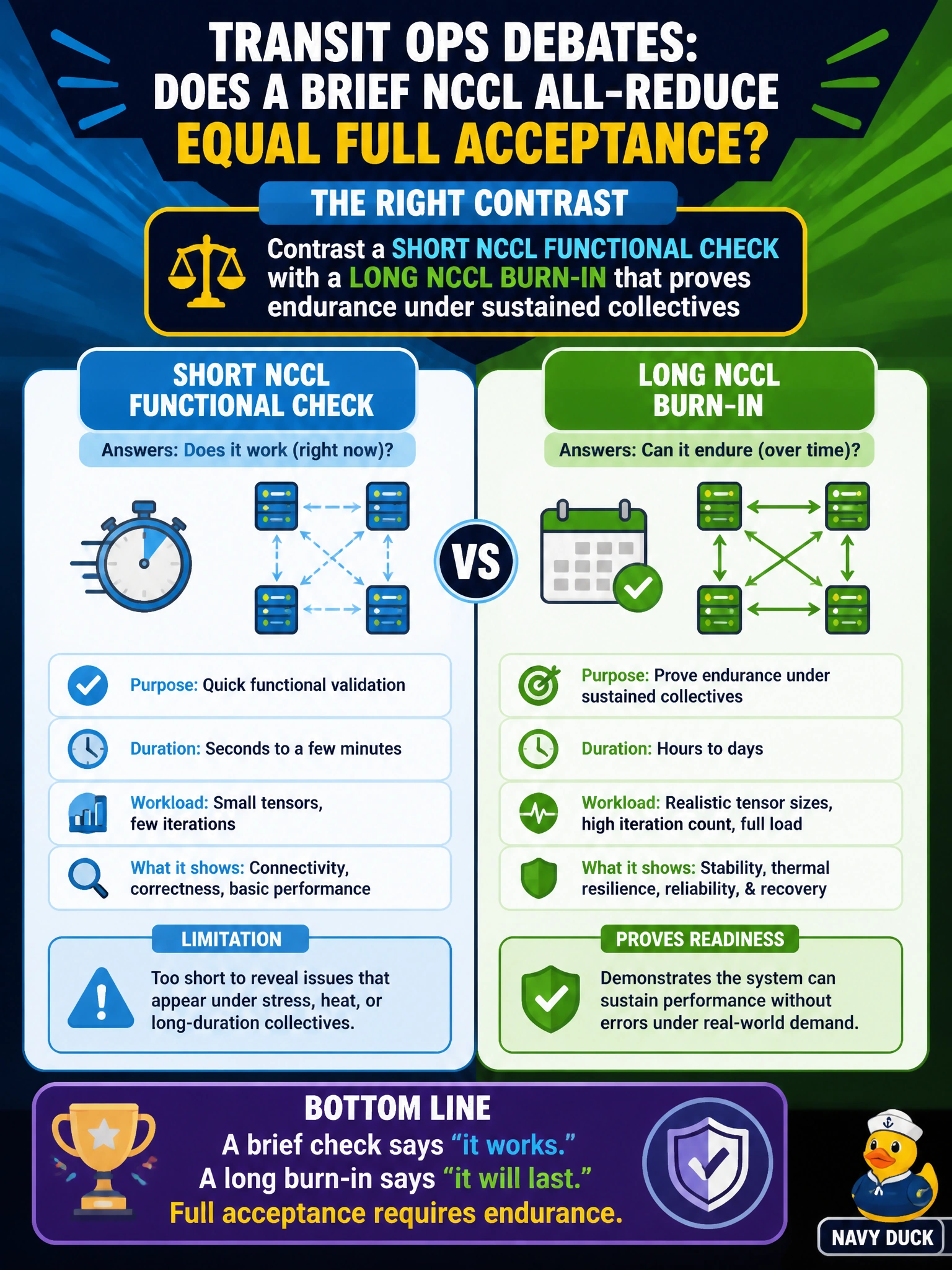
A quick NCCL peek says the pipes talk; a long burn-in says they keep talking—transit ops needs both stories, not one masquerading as the other.
Full Explanation
Transit ops should frame the contrast clearly: a short NCCL functional check confirms that collectives basically work, while a long NCCL burn-in proves endurance under sustained collective load. Domain 4 acceptance uses both ideas for different purposes—smoke versus soak—and equating them understates the rigor required before municipal GPU capacity is trusted. Treating a 30-second NCCL smoke check as identical to multi-hour burn-in collapses functional and endurance gates into one shallow test that intermittent faults can pass. Skipping burn-in whenever any short NCCL run returns a number accepts first-contact success as proof of overnight stability, which fabric and GPU wear-out modes often violate. Using burn-in only for non-GPU management switches misapplies the control; NCCL burn-in targets GPU nodes and the AI east-west fabric that carries training collectives. Exam caveat: both activities can share tooling (NCCL), but pass criteria differ—functional checks emphasize basic bandwidth/connectivity, burn-in emphasizes duration, error budgets, and stability trends. Operational check: document separate transit acceptance steps for short NCCL functional verification and long NCCL burn-in, record both results in the change package, and do not promote racks when only the smoke check exists.