
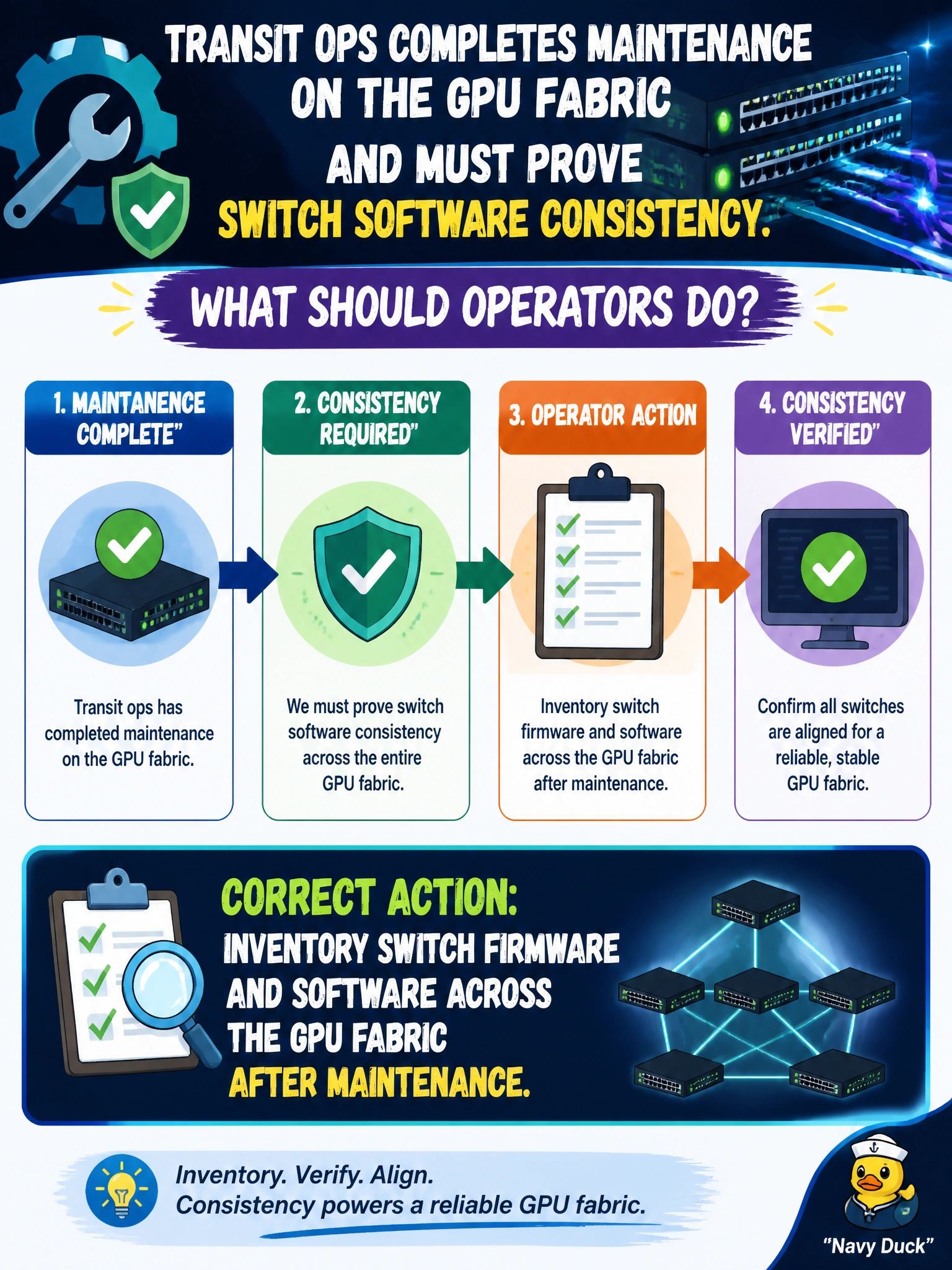
Transit ops completes maintenance on the GPU fabric and must prove switch software consistency. What should operators do?
Select an answer to reveal the explanation.
Short Explanation
After maintenance, walk the whole transit GPU fabric and inventory switch FW/SW—don't sample one box and call the fleet consistent.
Full Explanation
After maintenance on the transit GPU fabric, operators must prove switch software consistency across the plane—not infer it from a closed ticket. Inventorying switch firmware and software across the GPU fabric after maintenance detects leftover outdated nodes and mixed images before rider-facing jobs return to the row. Inventorying only one randomly chosen switch and extrapolating misses outliers that often appear after partial waves or incomplete automation runs. Skipping inventories because maintenance tickets imply success confuses change intent with verified outcome on every leaf and spine. Comparing versions only against an obsolete spreadsheet from years prior validates against the wrong baseline and can mark current approved images as “wrong.” Domain 4 expects fabric-wide FW/SW confirmation as part of post-maintenance verification for AI fabrics. Caveat: automation (Ansible, vendor fabric managers) can collect the inventory quickly, but the comparison target must be the current approved municipal standard, not tribal memory. Operational check: pull version strings from every transit fabric switch touched by or depending on the maintenance window, diff against the approved list, remediate skew, and attach the inventory to the change closure package.