
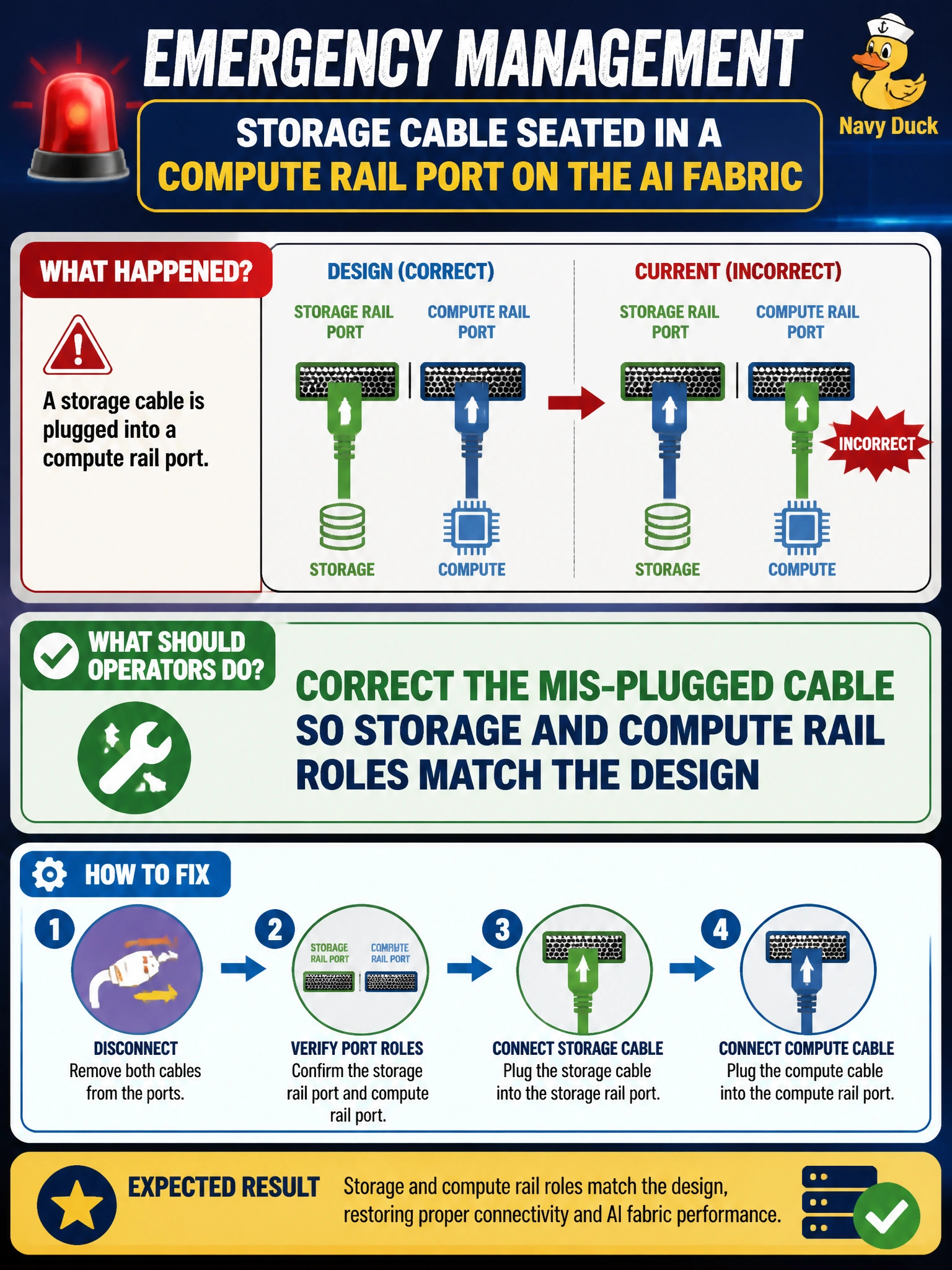
Emergency management finds a storage cable seated in a compute rail port on the AI fabric. What should operators do?
Select an answer to reveal the explanation.
Short Explanation
If it fits but it's the wrong role, it's still wrong—pull that storage cable out of the compute rail and put both ends where the emergency-management design says.
Full Explanation
Emergency management finds a storage cable seated in a compute rail port—mechanical fit does not equal design compliance on an AI fabric. Operators must correct the mis-plugged cable so storage and compute rail roles match the design, restoring intended traffic separation and topology for 911 NLP and related workloads. Leaving the mis-plug because both connectors fit mechanically accepts a role violation that can black-hole storage I/O or pollute the compute fabric with the wrong plane’s traffic. Renaming the storage VLAN to match the compute rail label is a paperwork fiction that does not move photons or electrons to the right plane. Declaring fabric verification complete based on connector fit alone mistakes insertion for correct interconnect intent and skips Domain 4 cabling confirmation. On the exam, role and plane correctness matter as much as QSFP seating; distractors celebrate “it plugged in” while topology is wrong. Caveat: after correcting the plug, re-check link state and signal quality on both the storage and compute ports involved so the fix is measured, not assumed. Operational check: pull the mis-seated emergency-management cable, land storage and compute ends on the ports named in the design, verify link and role labels, update the as-built map, and retain the correction in the verification log.