
Transit ops must prove each AI fabric cable lands on the intended ports. What verification practice fits?
Select an answer to reveal the explanation.
Short Explanation
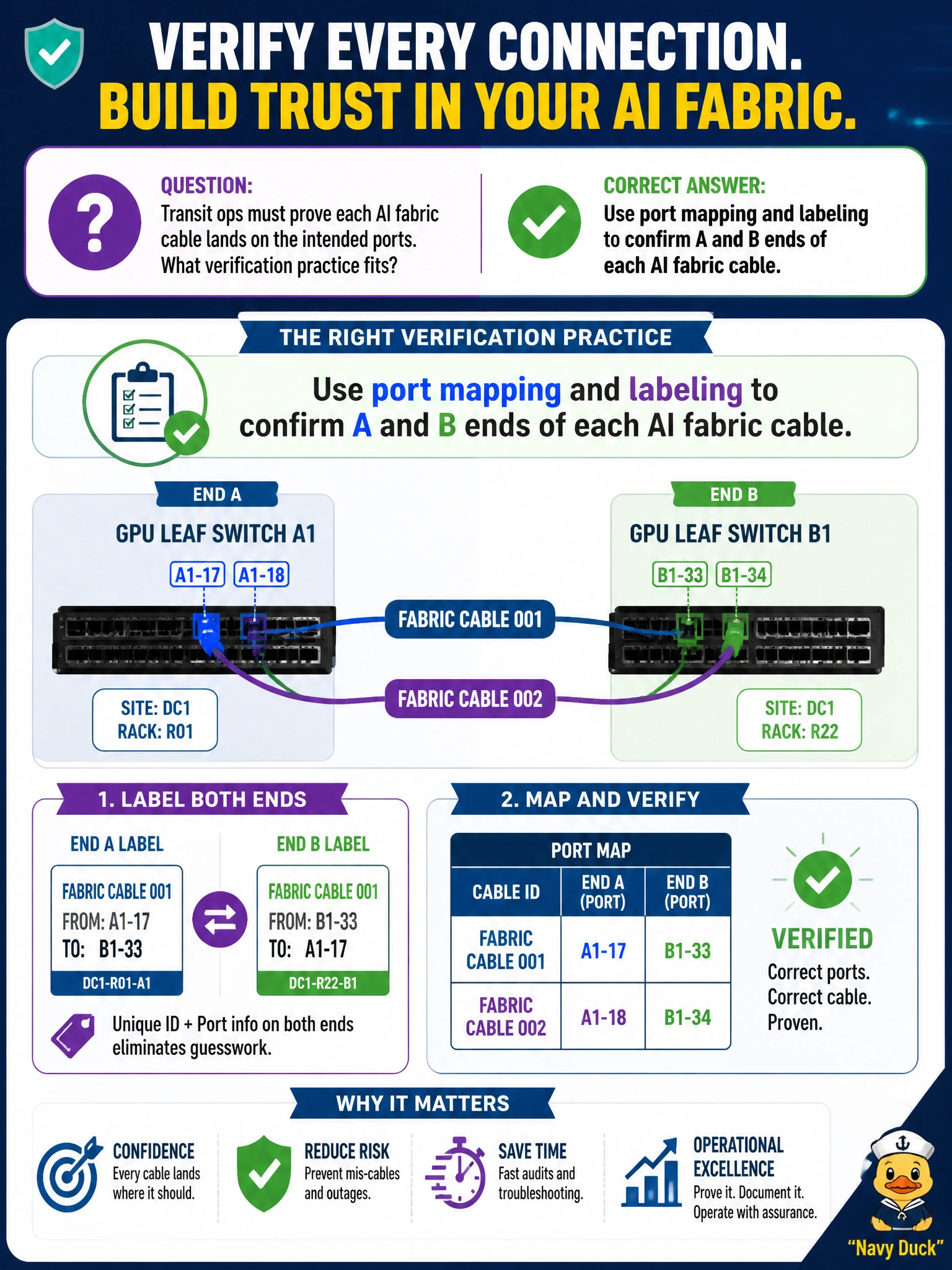
You need to prove that both ends of each transit fabric cable land on the ports specified by the design. Use the port map and labels to confirm the A and B ends, rather than relying on cable length or a lit LED.
Full Explanation
Transit ops must prove each AI fabric cable lands on the intended ports because a lit LED does not identify which far end was reached in a dense GPU row. Using port mapping and labeling to confirm the A and B ends of each AI fabric cable verifies the planned path against reality before riders’ workloads depend on that interconnect. Guessing endpoints from cable length alone is unreliable in dense trays, where many runs share similar lengths and dress patterns. Skipping endpoint checks once any LED is lit confirms link presence but can miss swaps between adjacent ports or rails that still negotiate. Validating only the middle of the cable run and ignoring both ends documents pathway routing without proving termination correctness on the leaf or GPU ports. Domain 4 skill 4.5 includes endpoint confirmation as part of correct cabling practice for AI fabrics. Exam caveat: a lit LED is evidence of link presence, not proof that the cable’s far end matches the intended port; the acceptance goal remains verified A–B identity against the design. Practical check: for each transit fabric cable, match the labeled A and B ends to the port map, correct mismatches, and record the verified mapping in the change or acceptance package before closing the work.