
A city must prove rail-optimized GPU fabric cabling matches design before load. What confirmation is required?
Select an answer to reveal the explanation.
Short Explanation
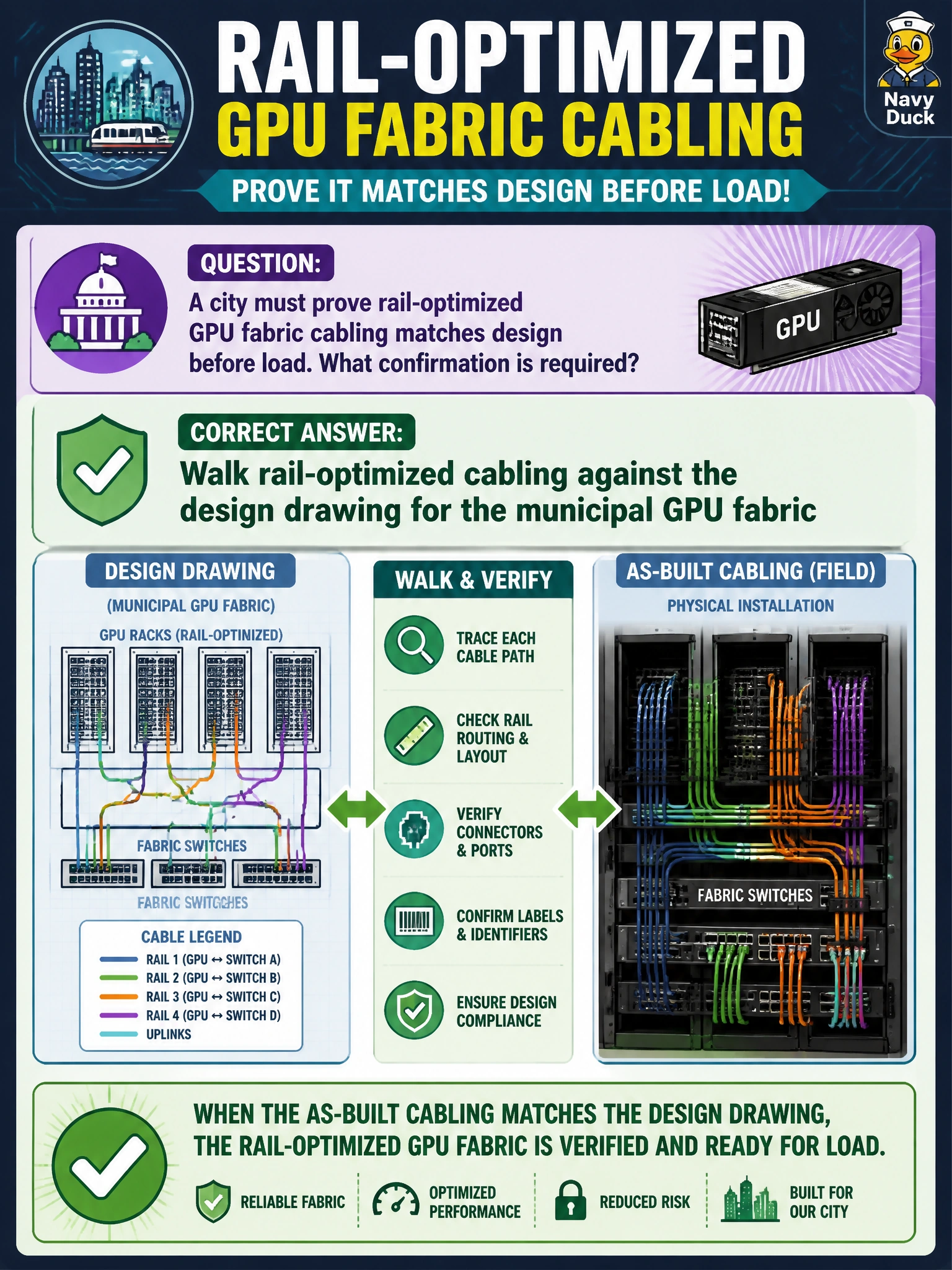
Walk the city fabric with the design drawing in hand—rail-optimized cabling has to match the plan, not just 'something plugged in and linked.'
Full Explanation
A city must prove rail-optimized GPU fabric cabling matches design before load because link-up alone cannot guarantee the topology collectives expect. Walking rail-optimized cabling against the design drawing for the municipal GPU fabric catches crossed rails, role-mismatched plugs, and ports that negotiated but break intended A–B paths. Trusting installer verbal assurances without walking the cables substitutes anecdote for physical confirmation. Confirming only power cords and ignoring fabric interconnects validates facility power while leaving the AI east-west plane unchecked. Accepting any plugged cable that negotiates a link confuses PHY success with design correctness—exactly the failure mode that later shows up as mysterious NCCL slowdowns. Domain 4 skill 4.5 emphasizes cabling confirmation against intended topology, not mere connectivity. Caveat: automated discovery can assist, but a drawing walk (or equivalent mapped verification) remains the acceptance standard when rail roles matter. Operational check: with the approved city fabric drawing in hand, trace each rail cable end-to-end to the labeled ports, note deviations, correct them, and only then proceed toward production load.