
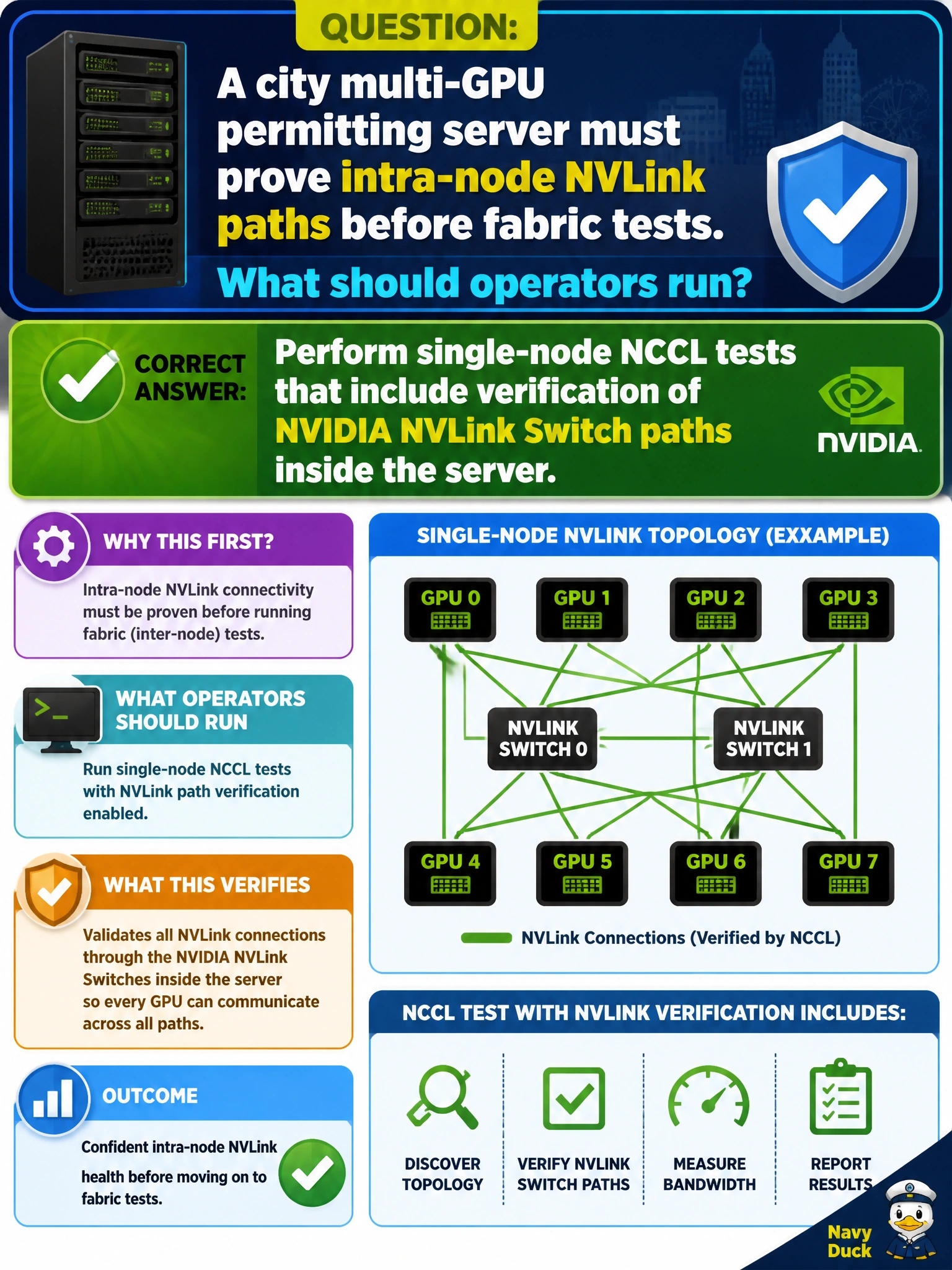
A city multi-GPU permitting server must prove intra-node NVLink paths before fabric tests. What should operators run?
Select an answer to reveal the explanation.
Short Explanation
Before you chase the big fabric, run single-node NCCL and make sure NVLink Switch paths inside that permitting server actually move bytes.
Full Explanation
A city multi-GPU permitting server must prove intra-node NVLink paths before fabric tests by performing single-node NCCL tests that include verification of NVIDIA NVLink Switch paths inside the server. Node-local collectives and topology checks catch broken or degraded NVLink Switch connectivity without confounding east-west fabric variables that would otherwise obscure the fault during multi-rack debugging.
Running only east-west multi-rack NCCL and skipping node-local checks fails by concept because multi-rack tests assume healthy intra-node paths; local NVLink faults then masquerade as fabric issues and waste cross-rack troubleshooting time. Pinging city DNS from a CPU-only container fails because DNS reachability is unrelated to GPU interconnect bandwidth or NVLink Switch health on the permitting server. Validating NVLink solely by counting physical cages without traffic tests fails because physical presence does not prove functional high-speed paths under NCCL load.
Exam caveat: Domain 4 skill 4.3 sequences single-node NCCL and NVLink Switch verification before broader fabric NCCL—prove the server’s internal paths first, then expand east-west.
Operational check: run the site’s single-node NCCL suite with NVLink Switch path verification on the permitting server, confirm expected topology plus bandwidth and latency against peer norms, record baselines with server identity, and only then proceed to fabric tests.