
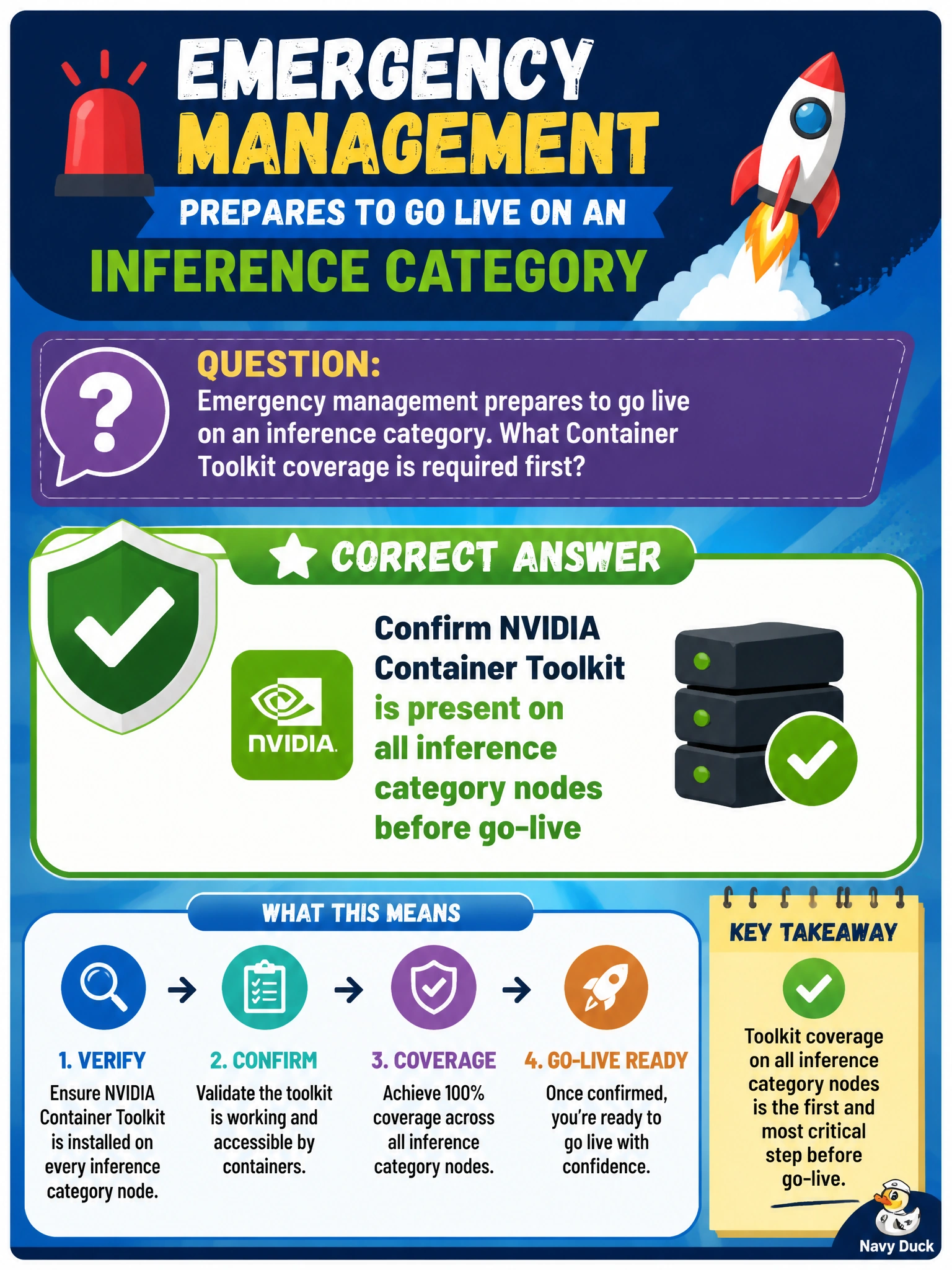
Emergency management prepares to go live on an inference category. What Container Toolkit coverage is required first?
Select an answer to reveal the explanation.
Short Explanation
Before go-live, make sure every inference-category node has the Container Toolkit—not just the lucky one. Hoping is not a rollout plan.
Full Explanation
Before emergency management goes live on an inference category, NVIDIA Container Toolkit must be present on all nodes in that category. Schedulers place inference containers on any eligible node; partial toolkit coverage creates silent failures when jobs land on unequipped hosts while a single “golden” node looked fine in testing. Category-wide coverage is a go-live gate for activation readiness, not an optional nicety, and it should be proven on more than one node before cutover.
Installing the toolkit on only one node and hoping images schedule elsewhere fails under real placement and load-balancing behavior. Deferring toolkit install until after production outages begin accepts preventable incidents as the discovery mechanism. Documenting that toolkit coverage is optional for inference categories contradicts GPU container operational requirements and weakens readiness audits.
Exam caveat: inference go-live requires toolkit on every category member—not single-node pilots treated as fleet-complete, deferred installs, or “optional” documentation.
Operational check: query BCM/category inventory for toolkit package/runtime config on all inference nodes, fix gaps, run sample GPU containers on more than one node, then approve go-live.