
Courts OCR farm rolls a GPU driver update across nodes. How should success be validated?
Select an answer to reveal the explanation.
Short Explanation
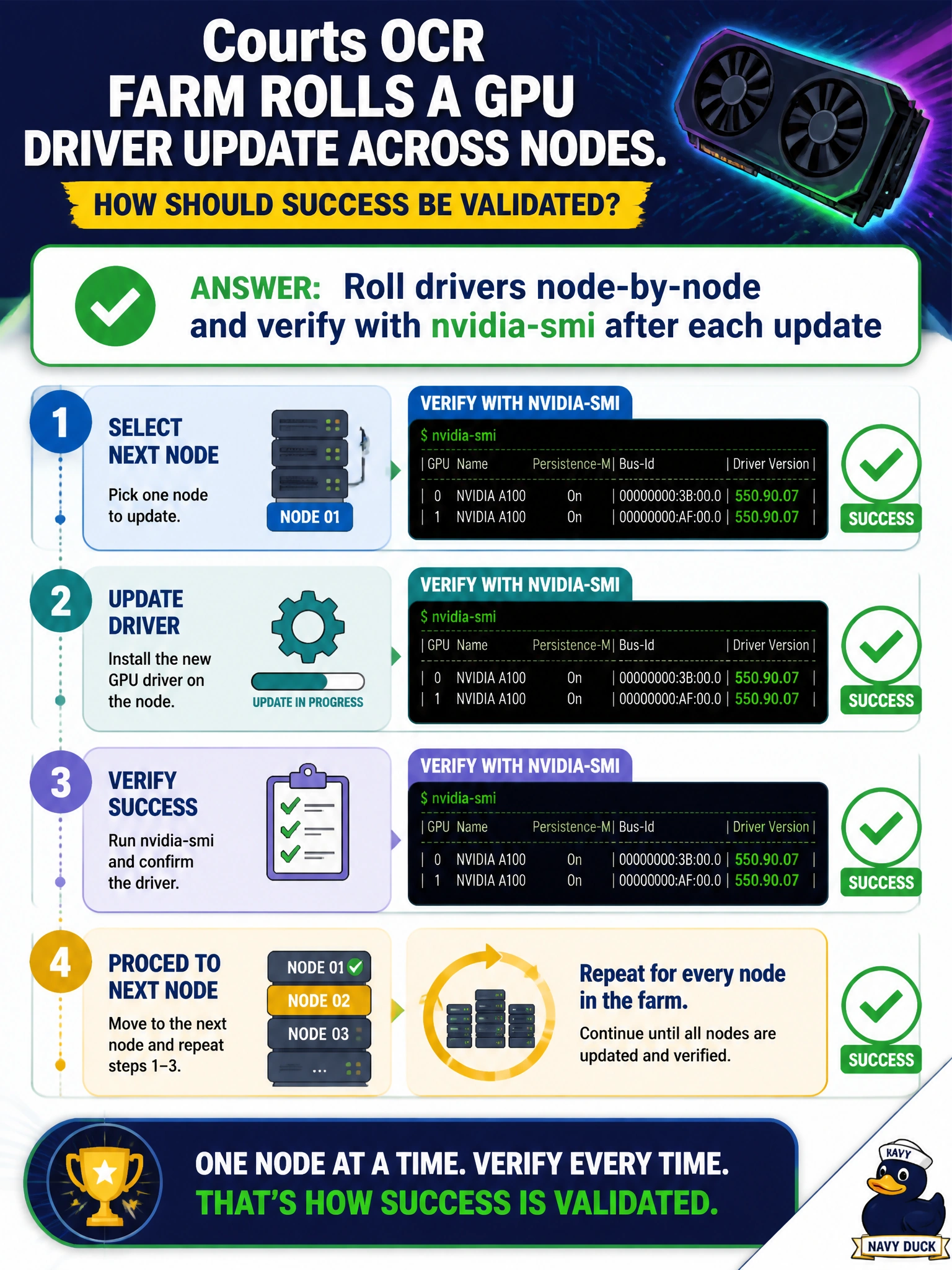
Walk the OCR farm node-by-node and run nvidia-smi after each driver bump—like checking each scanner after a firmware push. Blind mass updates hide the first failure.
Full Explanation
Courts OCR GPU driver updates should roll node-by-node with nvidia-smi verification after each update. Rolling limits blast radius so one bad package or firmware interaction does not darken the entire OCR farm; per-node SMI confirms GPUs enumerate, driver version matches, and devices are healthy before the next node is touched. That discipline protects case-processing capacity during maintenance waves and gives courts ops a clear stop point when the first node fails checks.
Updating every node simultaneously with no per-node checks maximizes correlated failure risk across the OCR farm. Skipping nvidia-smi and only pinging the BMC proves OOB reachability, not GPU driver success. Validating solely by counting packaging files in /tmp checks residue, not loaded driver or device health, and can pass while GPUs remain invisible to workloads.
Exam caveat: driver rollout validation pairs controlled rolling updates with nvidia-smi (or equivalent)—not simultaneous blind pushes, BMC-only pings, or /tmp file counts.
Operational check: update one OCR node, reboot if required, run nvidia-smi and a short GPU smoke test, document pass, then proceed through the farm; pause the wave on first failure.