
Courts e-filing OCR GPUs scale from one rack to multiple. When should planners expect an AI-factory topology redesign?
Select an answer to reveal the explanation.
Short Explanation
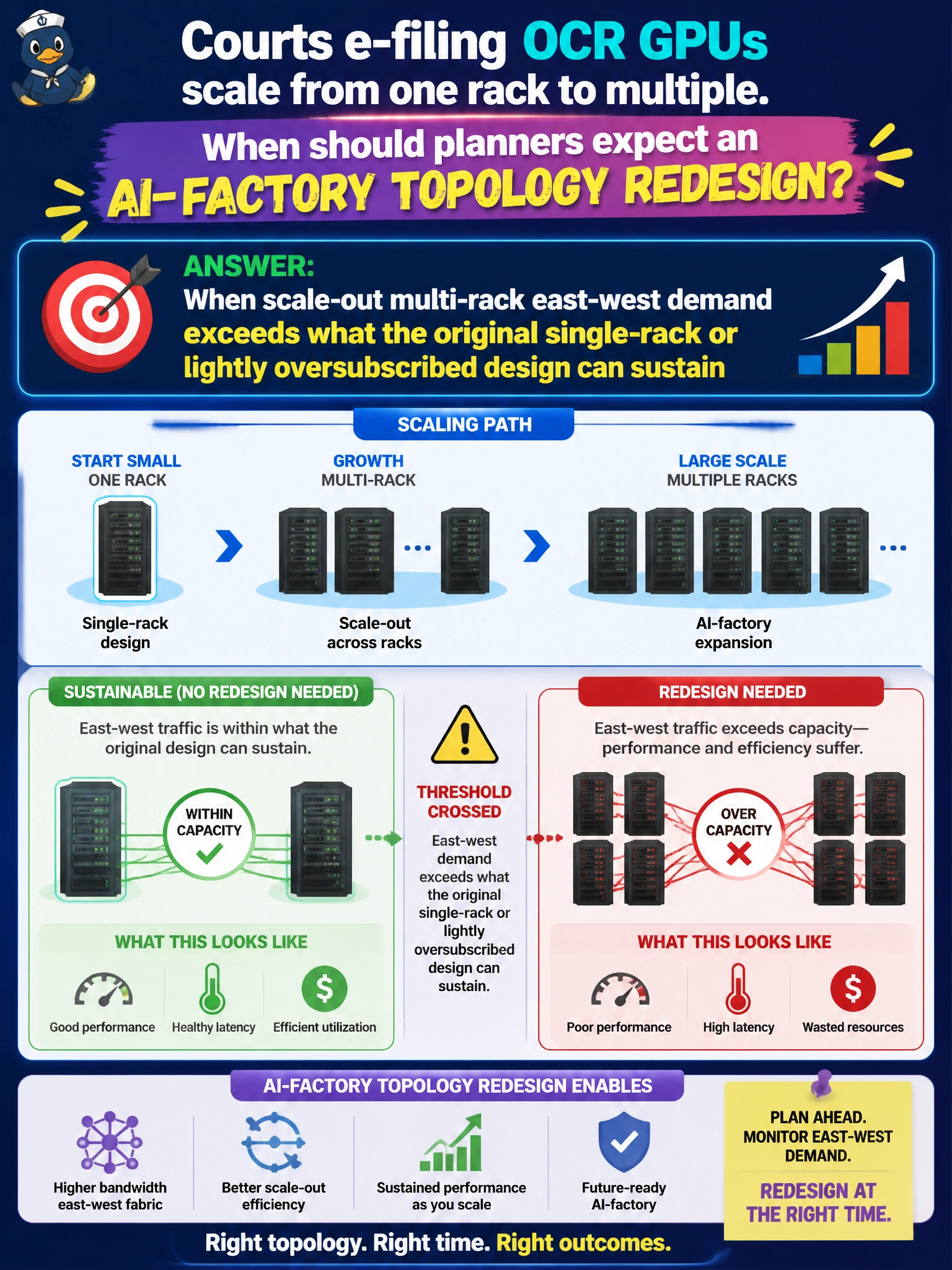
One quiet OCR rack can hide on a simple fabric; a whole row of courts GPUs shouting all-reduce at each other cannot. When east-west demand outgrows the first design, it is time to rethink the AI factory topology—not when someone adds an email mailbox.
Full Explanation
Courts e-filing OCR capacity that grows from one rack to many changes east-west demand: multi-rack all-reduce and parameter exchange can exceed what a single-rack or lightly oversubscribed design sustains. Planners should expect an AI-factory topology redesign when scale-out traffic and oversubscription ratios break latency and bandwidth targets for collectives, not when unrelated municipal IT changes. Adding a mailbox to the municipal email system does not alter GPU fabric bisection needs and is not a redesign trigger for OCR clusters. Assuming any leaf switch supports unlimited HGX all-reduce without redesign ignores radix, oversubscription, and multi-rack path engineering limits. Deleting InfiniBand or Ethernet monitoring entirely removes the telemetry that would reveal when redesign is required and is never the correct scale-out response. Exam caveat: early single-rack proofs of concept can look fine on simple fabrics; the exam focus is recognizing the scale-out inflection when east-west demand outgrows that design. Operational check: trend multi-rack collective bandwidth and job step times as courts OCR racks are added; when fabric counters show sustained congestion or collectives miss targets, initiate a topology redesign review before more racks land.