
A public library consortium asks why AI factories often use rail or fat-tree patterns instead of only a classic enterprise three-tier LAN. What is the best explanation?
Select an answer to reveal the explanation.
Short Explanation
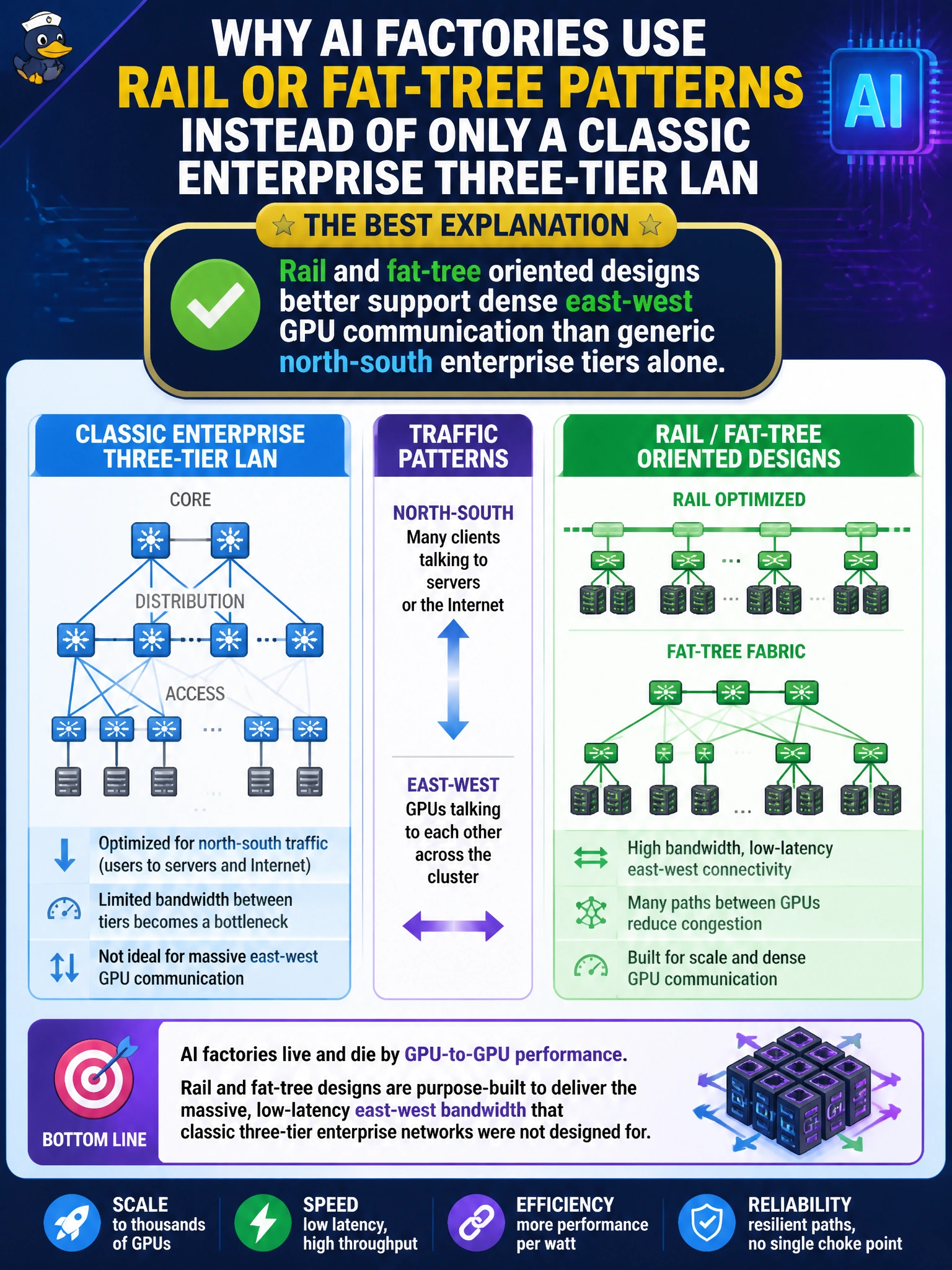
Library AI jobs talk sideways GPU-to-GPU a lot, and classic three-tier office networks were built more for users going up to apps and out to the internet. Rail or fat-tree style layouts are the ones that keep that sideways chatter from hitting a skinny choke point.
Full Explanation
Public library consortium AI factories favor rail or fat-tree oriented patterns because dense GPU jobs exchange large volumes of east-west traffic that generic north-south enterprise three-tier LANs were not sized to carry alone. Rail and fat-tree designs align leaf and spine capacity with collective communication so multi-node training and distributed inference do not collapse into oversubscribed aggregation layers meant for users browsing upstream services. Rail and fat-tree patterns are not campus Wi-Fi controller redundancy schemes; that distractor imports wireless HA language into GPU fabric design. Three-tier LANs do not always provide higher GPU all-reduce bandwidth than rail designs—often the opposite when east-west paths are heavily oversubscribed. AI factories do not forbid Ethernet or require consumer USB networking; media choice is orthogonal to choosing a topology that supports GPU east-west demand. Exam caveat: a classic three-tier LAN can still exist for campus and north-south services; the point is that GPU compute fabrics need additional topology attention beyond that pattern alone. Operational check: compare proposed library AI interconnect diagrams for east-west oversubscription and collective path counts, and reject designs that only show a generic office three-tier with no GPU fabric plan.