
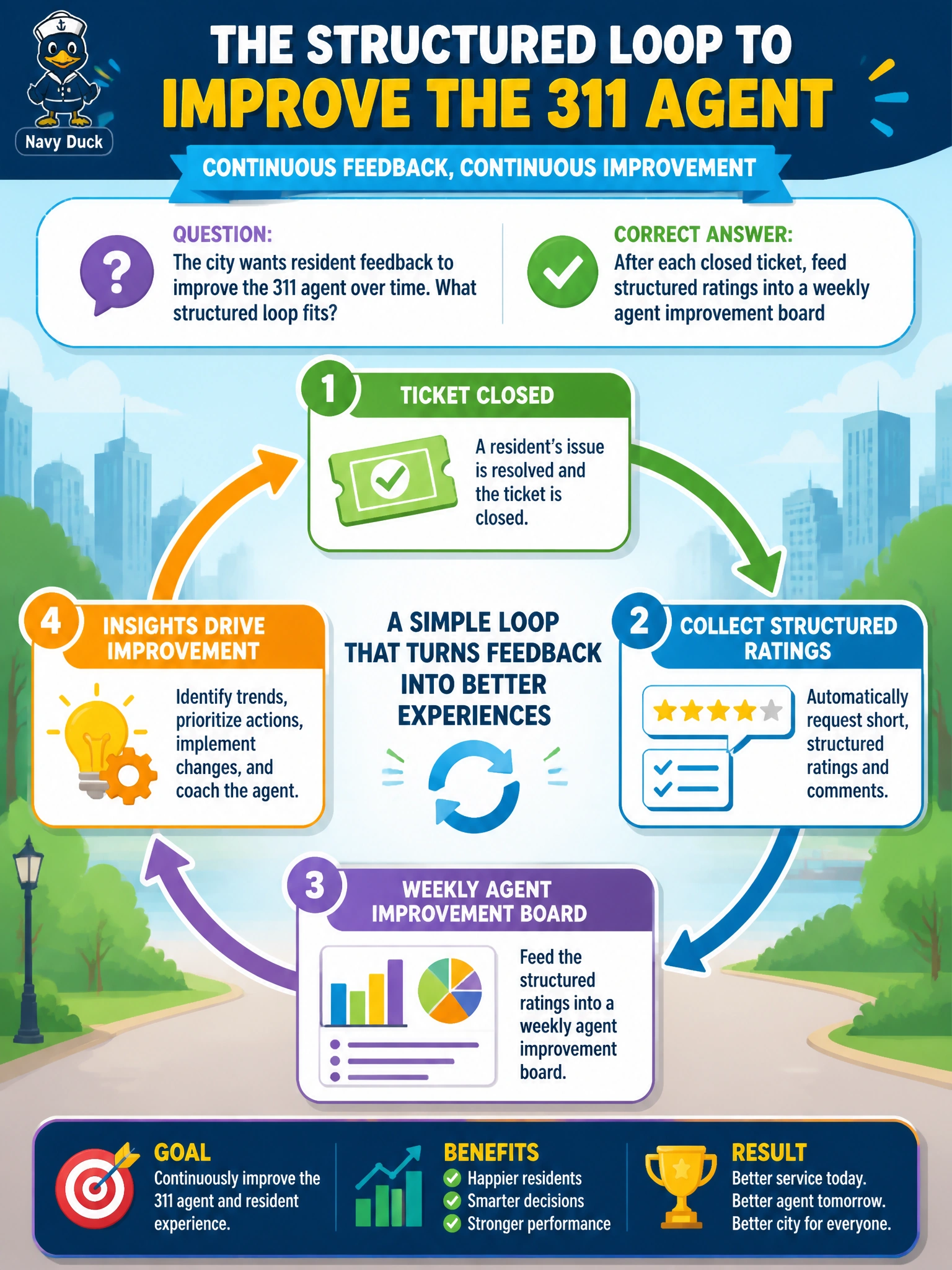
The city wants resident feedback to improve the 311 agent over time. What structured loop fits?
Select an answer to reveal the explanation.
Short Explanation
Vibes from Twitter aren’t a feedback system. Structured ratings after each closed ticket, reviewed on a weekly improvement board, actually steer the 311 agent.
Full Explanation
Improving a 311 agent over time needs a structured feedback loop: after each closed ticket, feed structured ratings into a weekly agent improvement board. Structured ratings (categories like wrong routing, bad citation, tone, unresolved) create aggregable signals; a weekly board turns those signals into prioritized fixes—prompt changes, retrieval updates, tool repairs—with owners and due dates. That loop beats anecdotal social listening as the primary improvement system.
Ignoring closed-ticket ratings and only reading occasional social media posts fails by concept because sparse social anecdotes are biased, incomplete, and not tied to ticket outcomes. Collecting freeform venting with no categories and never reviewing it fails because unstructured, unread feedback cannot drive systematic improvement. Deleting feedback weekly so teams never see recurring failure patterns fails because destruction of history prevents trend detection and repeated-defect learning.
Exam caveat: NCP-AAI feedback-loop questions prefer structured, reviewed operational data over social-only, unread freeform, or deleted signals. Look for closed-ticket structure plus a recurring improvement forum.
Operational check: add mandatory structured rating fields on ticket close; ETL ratings into a weekly dashboard; hold an improvement board that assigns remediations; track recurrence of top failure categories after releases.