
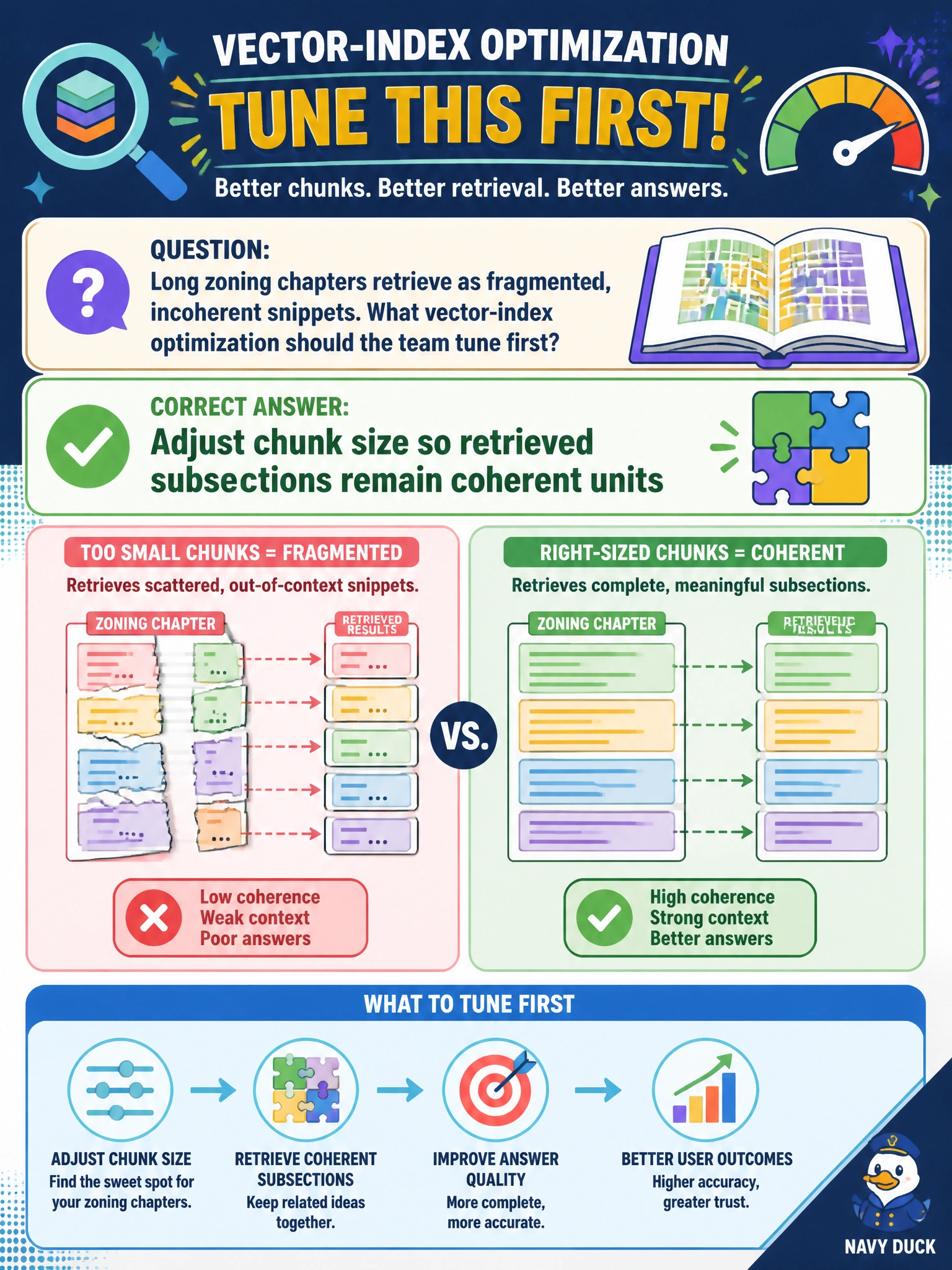
Long zoning chapters retrieve as fragmented, incoherent snippets. What vector-index optimization should the team tune first?
Select an answer to reveal the explanation.
Short Explanation
Chop a zoning chapter too small and you get puzzle pieces; too big and you get a haystack. Tune chunk size so each hit is a coherent subsection the agent can actually use.
Full Explanation
Long zoning chapters that retrieve as fragmented, incoherent snippets usually indicate poorly sized chunks. The first vector-index optimization to tune is chunk size (and related boundaries) so each retrieved unit remains a coherent subsection—enough context for defined terms and exceptions without drowning the agent in an entire title of the municipal code.
Deleting all zoning chapters from the corpus “to simplify the index” removes the authoritative source residents need. Increasing generator temperature so fragments sound fluent papers over bad retrieval with confident nonsense. Disabling nearest-neighbor search and returning alphabetical file names abandons semantic retrieval entirely.
Exam caveat: chunk size interacts with overlap, heading-aware splitters, and metadata; tune with retrieval metrics, not aesthetics alone. Operational check: sample zoning queries, score chunk coherence and answer faithfulness before/after resizing, and keep changes only when subsection integrity and citation accuracy improve together. Prefer heading-aware splits on zoning titles so chunk boundaries align with subsection structure. Keep a golden set of zoning subsection IDs and fail CI when median retrieved-chunk coherence scores drop after index changes.