
A city vector index holds policies spanning decades. How should the vector database be configured for precise permit retrieval?
Select an answer to reveal the explanation.
Short Explanation
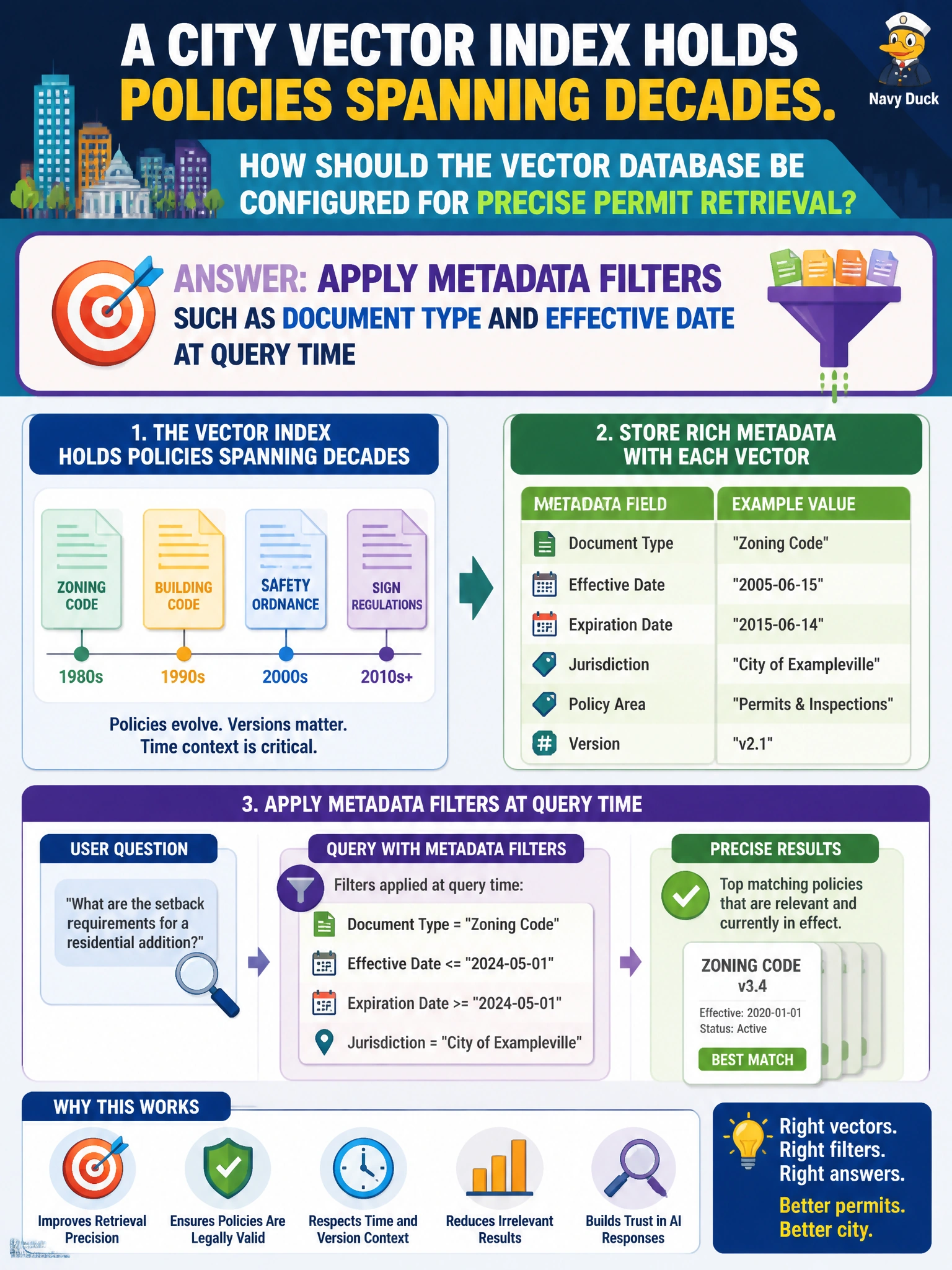
You wouldn’t pull a 1987 fee schedule when today’s fee ordinance is what matters. Metadata filters on document type and effective date keep the vector search in the right civic lane.
Full Explanation
City vector indexes spanning decades of policy need query-time metadata filters—document type, effective date, jurisdiction, and similar fields—so permit retrieval prefers currently applicable sources instead of superseded fee schedules or obsolete ordinances. Precise municipal retrieval is as much about filtering the candidate set as about embedding similarity.
Disabling all metadata so every query scans the entire unfiltered corpus maximizes noise from repealed or irrelevant documents. Storing only image thumbnails of PDFs without text embeddings removes the textual signal permit Q&A requires. Collapsing all documents into one mega-vector with no filters destroys item-level retrieval and attribution.
Exam caveat: metadata quality matters—wrong effective dates cause systematic mis-retrieval even with filters enabled. Operational check: query today’s fee and zoning rules with filters on document type and effective date, confirm obsolete versions are excluded, and periodically audit metadata completeness on newly ingested municipal PDFs. Version metadata schemas so newly ingested policies cannot enter the index without effective-date fields. Run a weekly job that samples permit answers and verifies cited documents’ effective dates are still active under the applied metadata filters.