
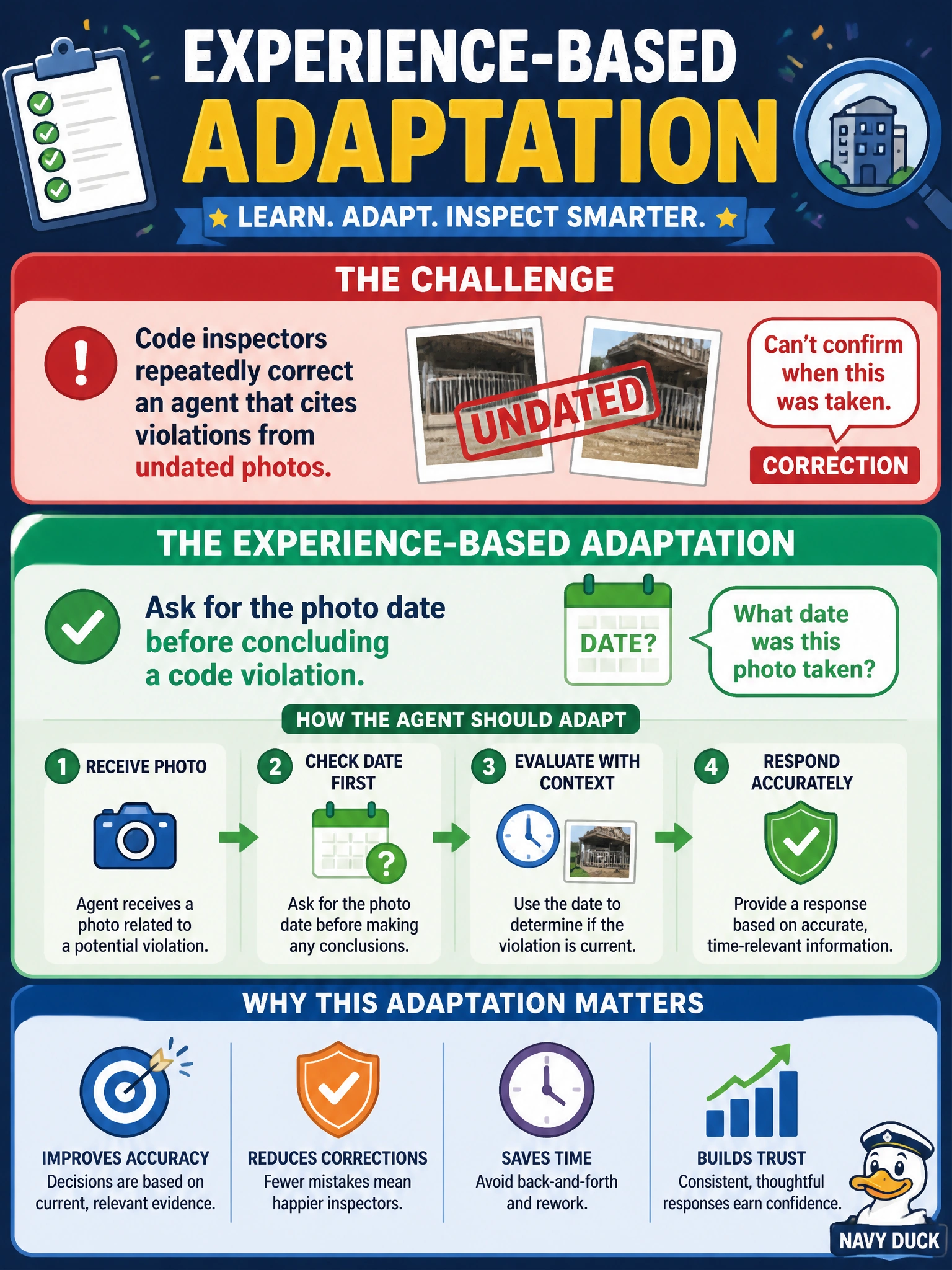
Code inspectors repeatedly correct an agent that cites violations from undated photos. What experience-based adaptation should the agent adopt?
Select an answer to reveal the explanation.
Short Explanation
Judging a yard from a mystery snapshot is like diagnosing a car without knowing when the noise started. After enough inspector corrections, the agent should ask for the photo date before calling a violation.
Full Explanation
Inspectors correcting an agent that cites violations from undated photos teach a procedural adaptation: ask for the photo date (or other temporal provenance) before concluding a code violation. Experience-based reasoning changes should encode missing-evidence elicitation so conclusions rest on timely, attributable field evidence rather than ambiguous imagery.
Disabling photo tools forces free-text-only site descriptions and throws away useful evidence channels. Assuming undated photos are always more than one year old invents facts and can both over- and under-enforce. Storing inspector corrections only in ephemeral GPU scratch memory fails to persist the learned procedure into durable policy or prompts.
Exam caveat: eliciting a date improves evidence quality; it does not by itself prove a violation without applying the correct code criteria. Operational check: route undated-photo cases through a gate that blocks violation conclusions until date/provenance is supplied or an inspector override is recorded, then verify corrections no longer recur in evaluation. Treat missing photo dates as incomplete evidence packets rather than weak-but-usable proof of a violation. Publish the photo-date requirement in the inspector playbook so human and agent workflows share the same evidence bar for code violations.