
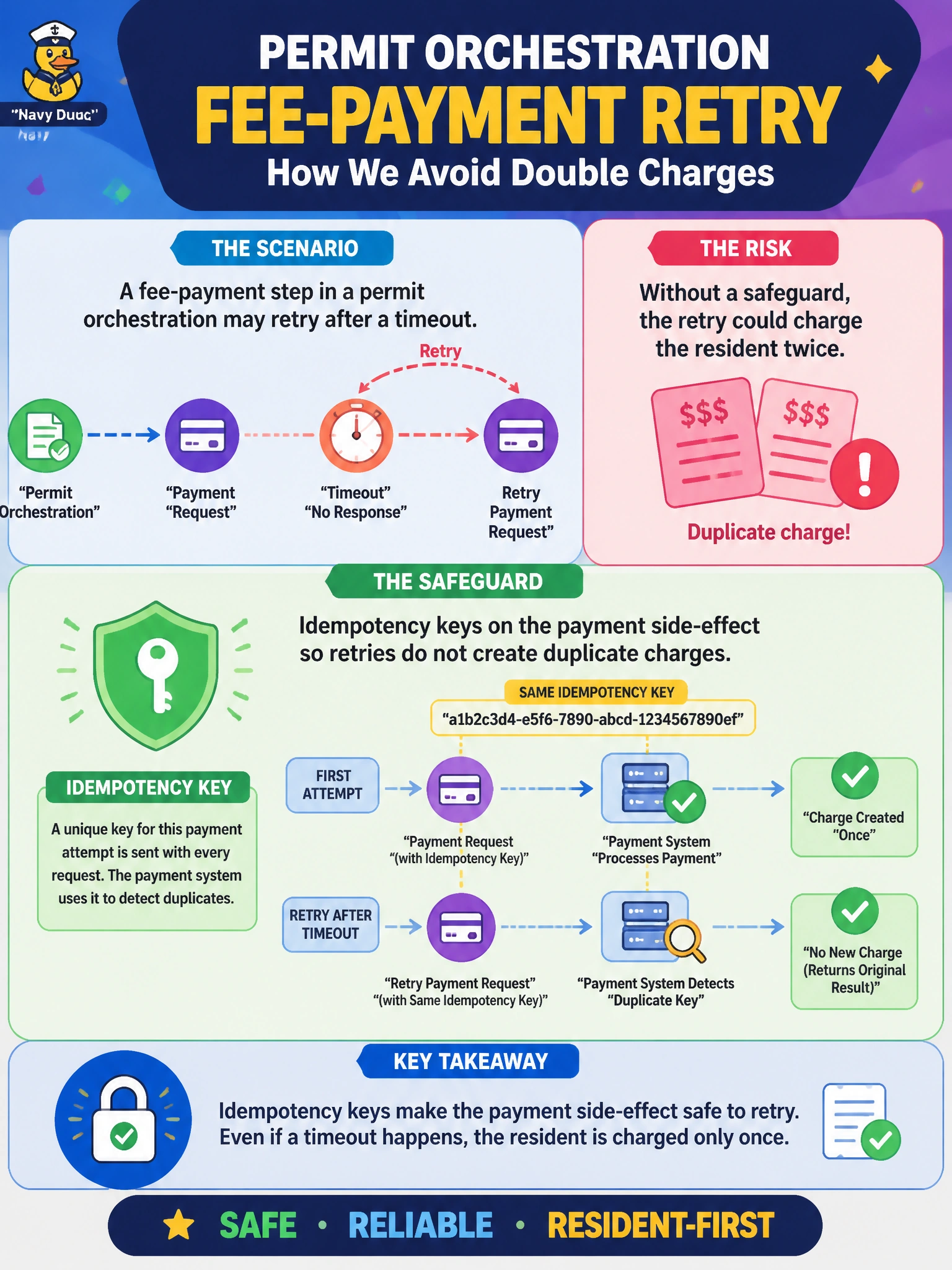
A fee-payment step in a permit orchestration may retry after a timeout. What safeguard prevents charging the resident twice?
Select an answer to reveal the explanation.
Short Explanation
Hitting “pay” twice at a parking meter shouldn’t empty your wallet twice. Idempotency keys make a retried fee step safe—same key, one charge—even when the orchestration times out and tries again.
Full Explanation
Fee-payment steps in permit orchestration are financial side effects. Timeouts and retries are expected under load, so the safeguard that prevents charging a resident twice is an idempotency key on the payment operation: the same logical payment attempt maps to one charge even if the orchestrator retries after uncertainty about the first response.
Increasing chain-of-thought verbosity until the payment API responds does not make retries safe; it only adds tokens and delay. Storing the credit-card PAN in short-term memory for faster resubmits creates a severe privacy and PCI-style exposure and still risks duplicate charges without idempotency. Disabling checkpoints so failed payments leave no audit trail worsens accountability and does not stop double charges.
Exam caveat: idempotency protects against duplicate side effects; it is not a substitute for encryption or tokenization of card data. Operational check: replay the same payment step with the same idempotency key in a test gateway and confirm a single capture/authorization, with orchestration logs showing safe retry rather than a second charge. Prefer server-side idempotency at the payment processor plus orchestration-level keys for defense in depth.