
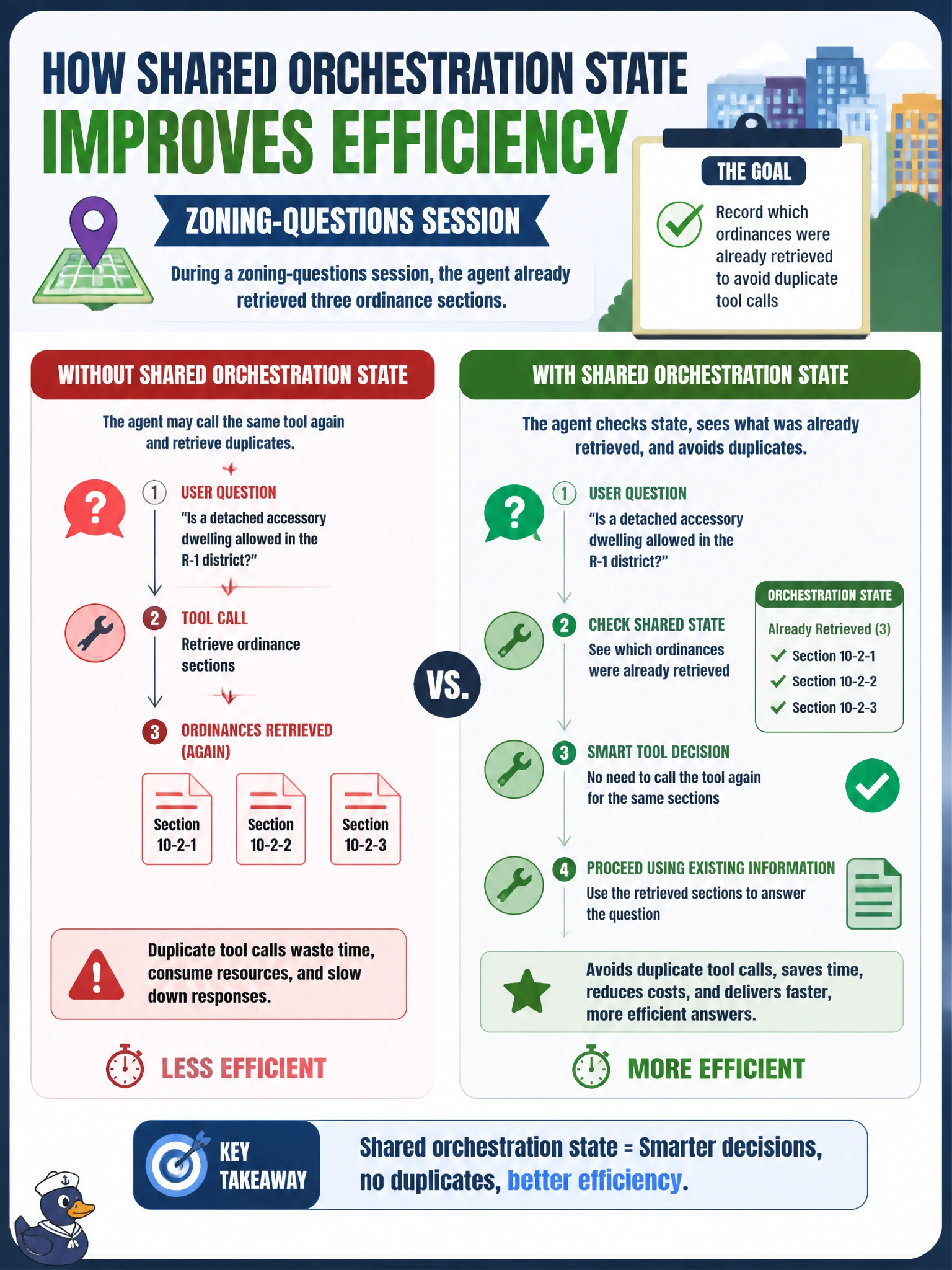
During a zoning-questions session, the agent already retrieved three ordinance sections. How should shared orchestration state improve efficiency?
Select an answer to reveal the explanation.
Short Explanation
If you already pulled the zoning book off the shelf, don’t walk back to the stacks for the same chapter. Shared state that remembers which ordinances were retrieved stops the agent from hammering the same tools again.
Full Explanation
Shared orchestration state improves efficiency in multi-turn zoning sessions by retaining which ordinance sections were already retrieved. Recording prior tool results (ordinance IDs, section identifiers, or cached excerpts) lets the agent answer follow-ups without repeating identical retrieval calls, cutting latency and load on municipal knowledge services while keeping answers grounded in the same cited sources for consistent resident guidance.
Discarding retrieved ordinances after each turn forces empty-context restarts and duplicate tool traffic. Storing only the resident’s phone number ignores knowledge reuse—the expensive work was ordinance retrieval, not contact capture. Replacing retrieval with a single static FAQ for all parcels fails parcel-specific code paths where applicability varies by zone, overlay, or amendment.
Exam caveat: shared state should cache provenance-aware results, not invent ordinance text. Operational check: in a multi-turn zoning chat, assert that a second question about an already-fetched section does not re-invoke the same retrieval tool unless the resident asks for a different code version or the cache was invalidated by a content refresh. Persist tool-result fingerprints in the session store so multi-agent handoffs inherit the same ordinance cache.