
Before a transit agency launches its paratransit booking agent cluster, what load-profiling step best proves reliability under distributed demand?
Select an answer to reveal the explanation.
Short Explanation
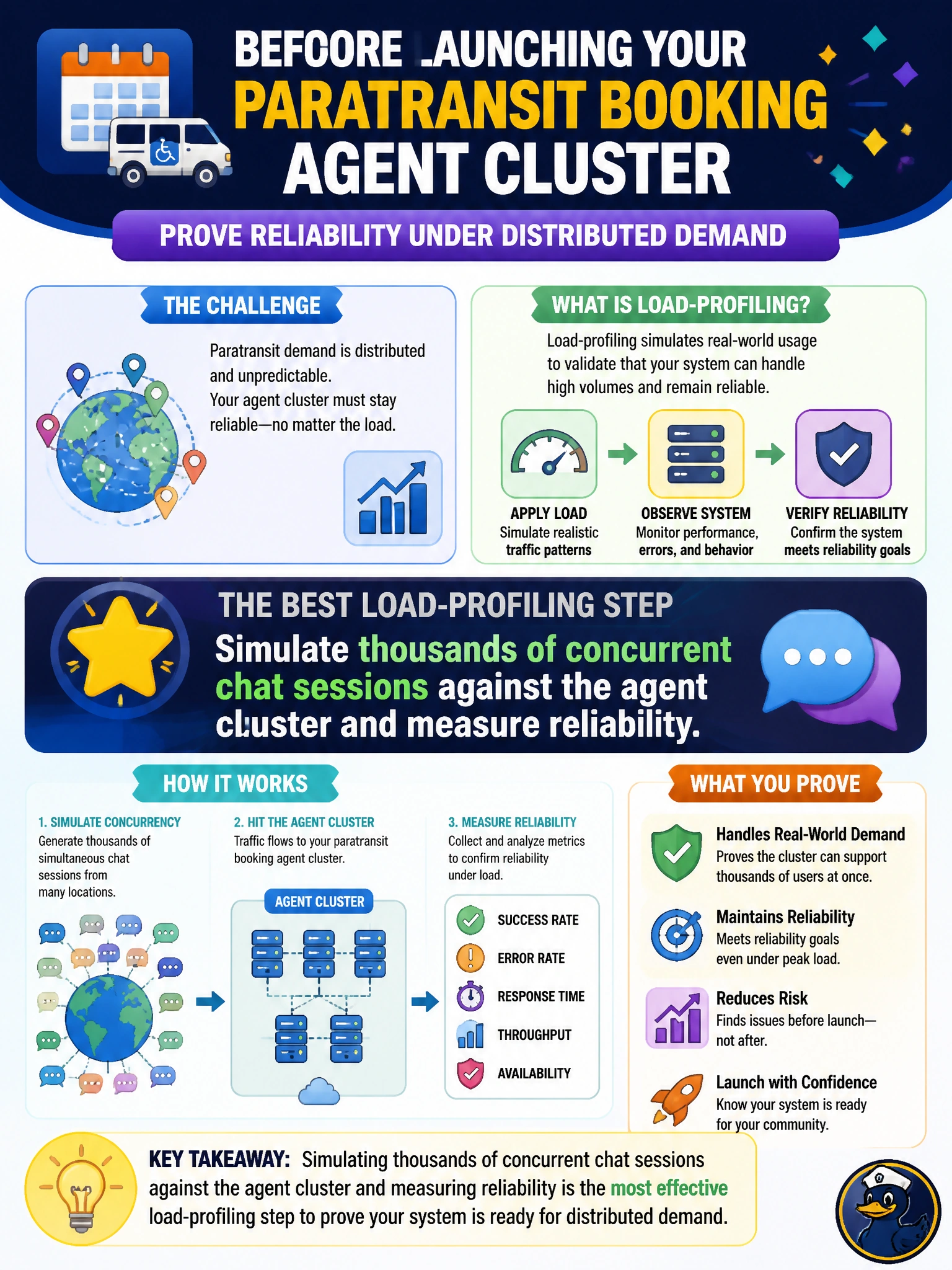
One volunteer at lunch is not rush hour. Blast the cluster with thousands of concurrent paratransit chats and measure how it holds up. Laptop demos and muted health checks won’t tell you when the system buckles for real riders.
Full Explanation
Reliability for a transit agency’s paratransit booking agent cluster must be proven under distributed concurrent demand, not under a single interactive click path. The correct load-profiling step is to simulate thousands of concurrent chat sessions against the cluster and measure success rate, tail latency, queue depth, and failure modes as load ramps. Paratransit booking mixes conversational turns with backend reservations, eligibility checks, and GIS/schedule calls; only concurrent synthetic load reveals connection-pool exhaustion, hot shards, rate-limit collisions, and autoscaling lag before launch day.
Asking one volunteer to click around during lunch fails conceptually because a single user exercises neither concurrency nor contention; it is exploratory QA, not a reliability profile. Assuming laptop-demo latency will match citywide concurrent usage fails because demo hardware, empty caches, and near-zero contention systematically understate production RTT and queueing. Disabling health checks so failures do not interrupt the test narrative fails because the purpose of load profiling is to observe and quantify failure—masking health signals falsifies the reliability evidence the agency needs for go/no-go.
Exam caveat: concurrency simulation must be realistic (think time, session length, geographic distribution, and peak booking windows) and must include dependency stubs or production-like backends; otherwise you may certify the chat front door while the reservation API collapses. Also distinguish soak tests from spike tests—both matter for civic peaks.
Operational check: define pass/fail SLOs before the run (for example p95 reply latency and booking-commit success under N concurrent sessions), execute progressive load stages, capture GPU/CPU and dependency error rates, and require remediation of any saturation or error-budget burn before production cutover.