
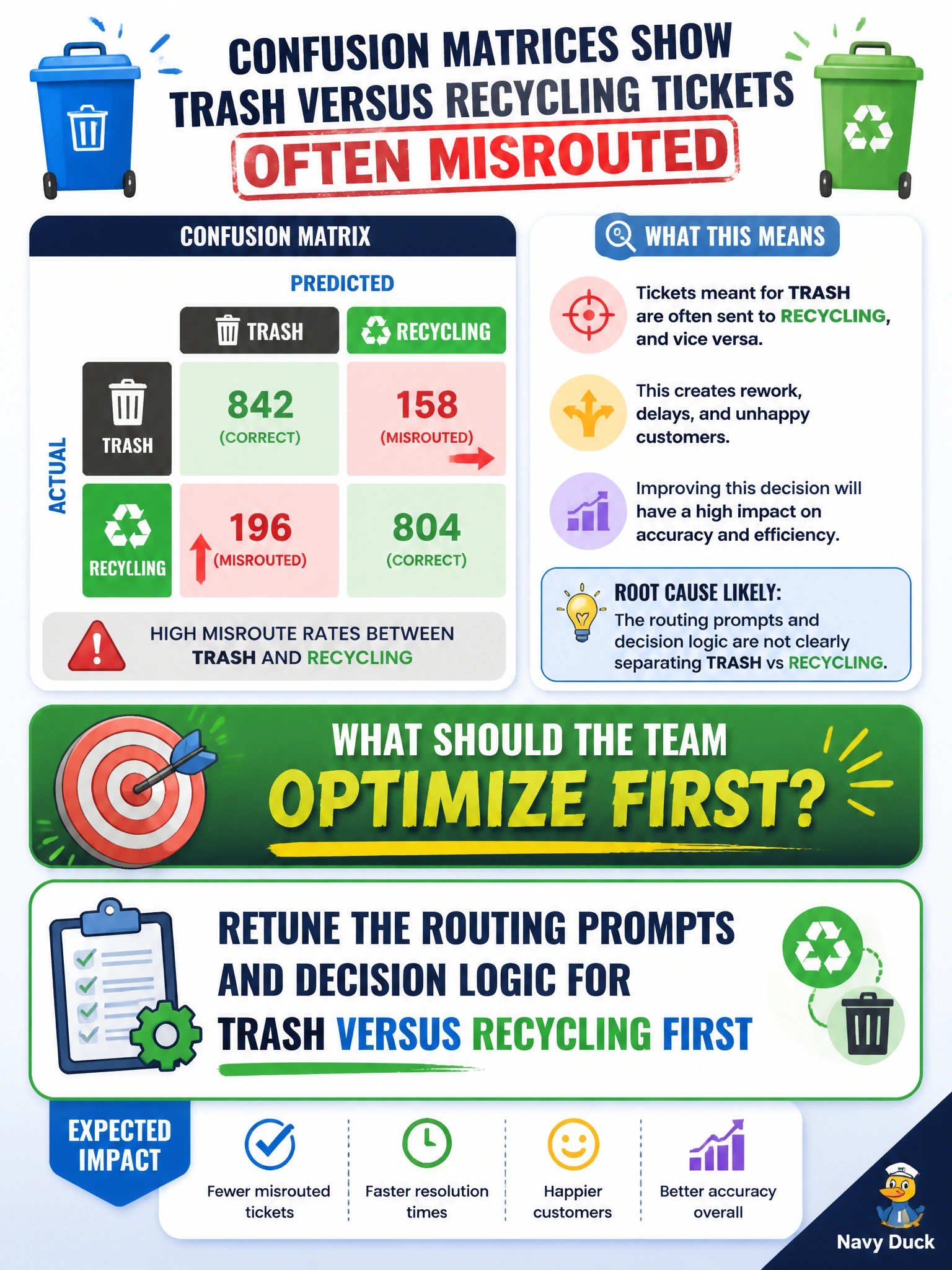
Confusion matrices show trash versus recycling tickets often misrouted. What should the team optimize first?
Select an answer to reveal the explanation.
Short Explanation
When the matrix says trash and recycling keep swapping lanes, fix the traffic cop—the routing prompts—first. Full rebuilds, hiding the chart, or merging labels just paint over the mistake. Targeted retuning follows the failure mode.
Full Explanation
Failure-mode analysis from confusion matrices should guide targeted agent decision optimizations, starting with the routing prompts and logic that confuse trash versus recycling classes. When misroutes concentrate on those two ticket types, retuning the decision boundary—few-shot examples, label definitions, tool choice, or specialist handoff criteria—converts eval insight into measurable dispatch quality for public-works intake. Focused changes preserve the rest of a working multi-agent stack while closing the observed gap.
Replacing the whole multi-agent stack before inspecting routing prompts is an unjustified rebuild that skips diagnosis and multiplies risk. Silencing the confusion matrix so leadership cannot see misroutes hides the problem instead of fixing it and weakens governance. Merging trash and recycling into one label so errors disappear on paper falsifies operations data and may send the wrong crew with the wrong equipment.
Exam caveat: act on the confusion-matrix failure mode with focused routing retunes; do not erase class distinctions or suppress metrics to manufacture a green dashboard. Operational check: after prompt and decision-logic changes, recompute the trash-versus-recycling confusion matrix on a held-out week of tickets, confirm misroute rate drops below the municipal threshold, and spot-check that field crews still receive the correct work type in the work-order system.