
A transit agency clusters free-text rider complaints into themes for agent improvement. What should the team do first with that unstructured feedback?
Select an answer to reveal the explanation.
Short Explanation
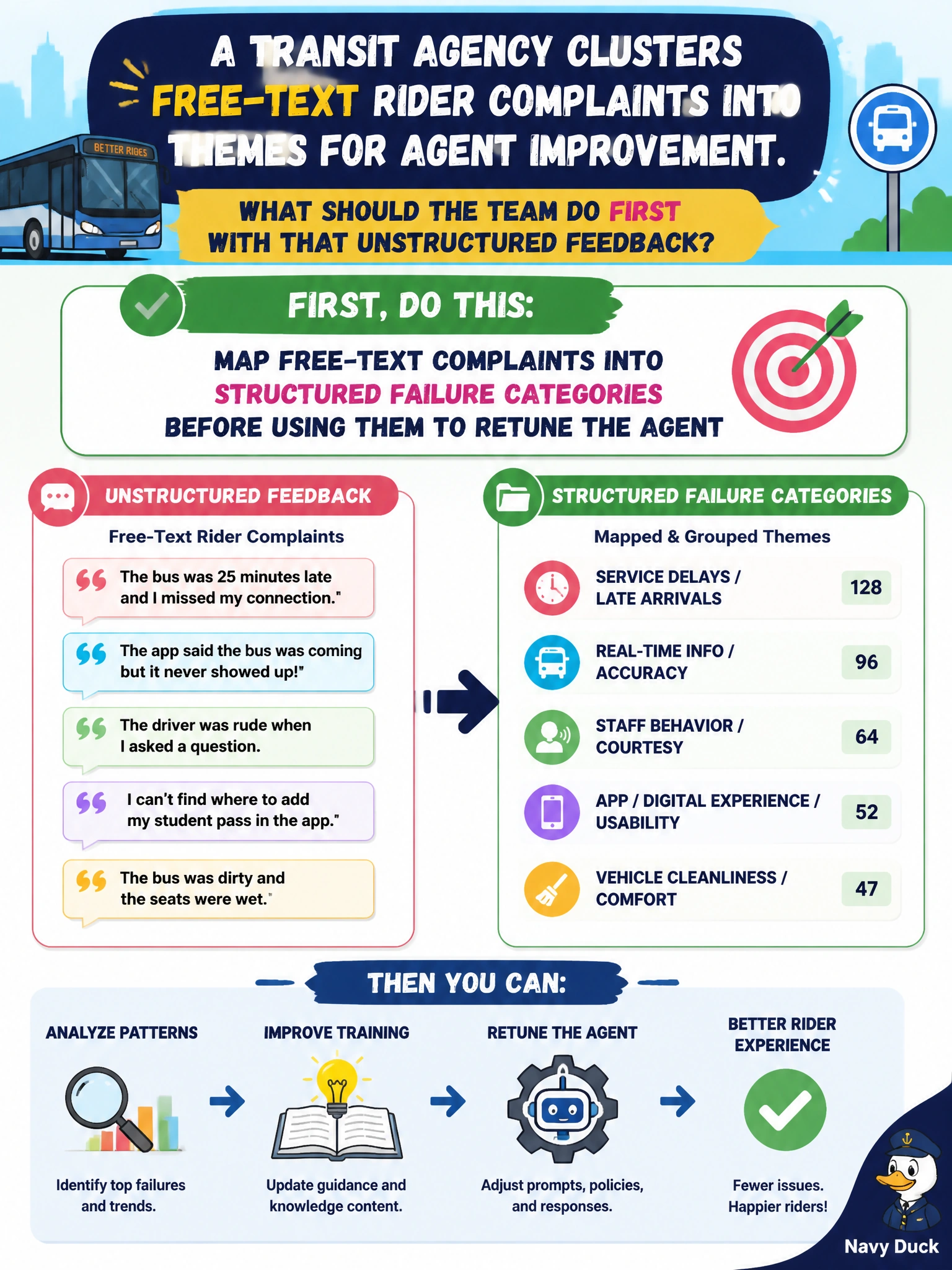
Raw complaint text is a messy junk drawer—useful only after you sort it. Cluster themes like late buses or broken fare readers into labeled failure buckets, then feed those structured categories into retuning. Dumping raw text into the prompt or keeping only star ratings leaves the real failure patterns buried.
Full Explanation
Structured feedback pipelines for civic agents convert unstructured rider narrative into labeled failure themes that evaluation and tuning can act on. For a transit agency clustering free-text complaints, the first productive step is mapping those narratives into structured failure categories—late arrivals, broken fare readers, inaccessible stops—before any retune of the rider-facing agent. Theme buckets let product and ops prioritize the failure modes that actually move service quality, rather than drowning the tuning loop in raw prose.
Pasting every raw complaint into the system prompt without categorization injects noise and PII risk into generation without creating measurable failure labels. Ignoring complaint text and tracking only star ratings collapses rich civic signal into a blunt average that cannot tell “fare reader outage” from “rude tone.” Deleting all feedback weekly so the eval store never grows removes the longitudinal improvement signal municipalities need for iterative agent quality work.
Exam caveat: clustering and labeling unstructured feedback is a precondition for useful retuning—volume of text is not the same as actionable evaluation data. Operational check: take a sample of rider complaints, map them into an agreed failure taxonomy, confirm each category has enough labeled examples for an eval slice, then only then attach those categories to prompt or retrieval changes and re-measure theme-level scores.