
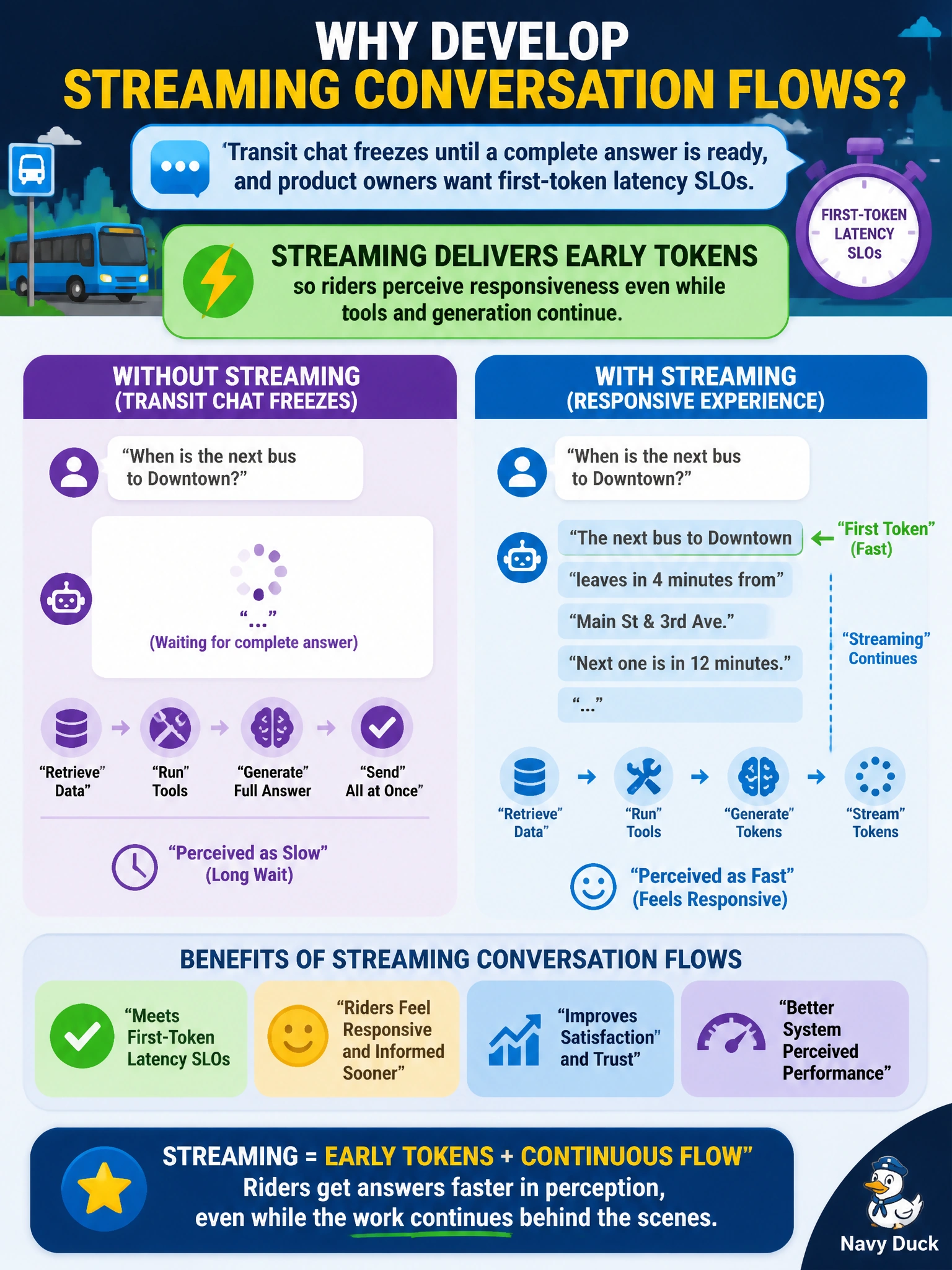
Transit chat freezes until a complete answer is ready, and product owners want first-token latency SLOs. Why develop streaming conversation flows?
Select an answer to reveal the explanation.
Short Explanation
Waiting for the whole speech before saying hello feels broken on a phone. Streaming shows the first words fast so riders know the app is alive. It doesn’t magically fix facts or replace staff—it fixes the frozen-screen feeling.
Full Explanation
Transit riders experience a frozen chat that waits for a complete answer as unresponsive even when total generation time is acceptable. Streaming conversation flows deliver early tokens so riders perceive responsiveness while tools and generation continue, which is why product owners set first-token latency SLOs for public agents. Time-to-first-token often dominates perceived quality for municipal assistants; progressive display keeps the session feeling alive during schedule lookups and multi-step tool use without claiming that every early token is final truth.
Streaming does not remove the need for backend transit schedule tools; those tools still supply authoritative times and routes. Streaming does not guarantee factual correctness of every schedule claim—grounding, validation, and tool results still matter. Streaming also does not automatically replace human call-center staffing; it is a UX and latency technique, not a workforce substitute.
Exam caveat: first-token latency improvements from streaming are orthogonal to accuracy SLOs; both must be measured for transit agents. Operational check: compare frozen complete-block delivery versus streaming on the same schedule question, measure time-to-first-token against the product SLO, confirm riders see progressive output while tools continue, and verify schedule claims still come from transit tools rather than assuming streaming alone made them correct.