
During a storm, GIS lookup times out for a flooding advisory agent. Which error-handling approach is most appropriate?
Select an answer to reveal the explanation.
Short Explanation
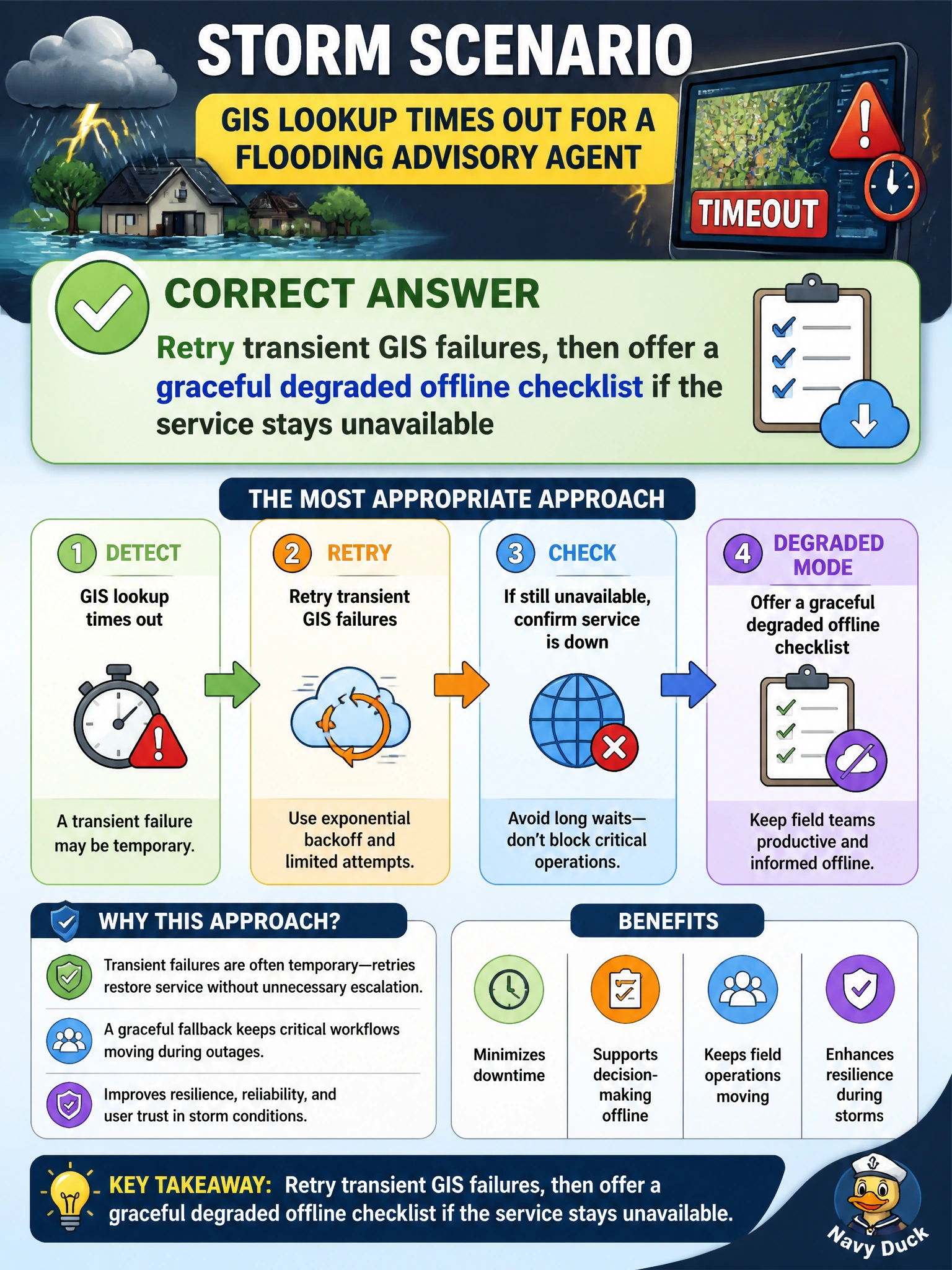
Storm-night GIS outages happen—retry a bit, then give people a usable fallback. A degraded offline checklist beats a silent crash or an endless retry loop. Don’t announce that the flood maps are gone forever after one blip.
Full Explanation
During storms, GIS lookups for flooding advisory agents often time out under load. Appropriate error handling retries transient GIS failures with bounded attempts and backoff, then offers a graceful degraded offline checklist if the service stays unavailable—so residents still receive actionable safety guidance. Crashing the 311 session silently, retrying forever without backoff, or claiming maps are permanently deleted after one failure all worsen resident outcomes during an emergency.
Crashing the entire 311 session with no resident message when the first timeout occurs fails by concept: it abandons the caller without explanation during peak need. Retrying forever without backoff until the storm ends amplifies load on an already stressed GIS dependency and delays any fallback. Telling residents the flood maps are permanently deleted after one failure communicates false permanence and creates panic or distrust.
Exam caveat: degraded checklists must be pre-approved by emergency management and clearly labeled as non-live map substitutes. Distinguish transient timeouts from authenticated configuration errors that retries will not fix.
Operational check: simulate GIS timeouts in a storm drill, verify limited retries with backoff, confirm the offline checklist is offered with accurate caveats, and ensure the 311 session remains responsive with a clear resident message throughout.