
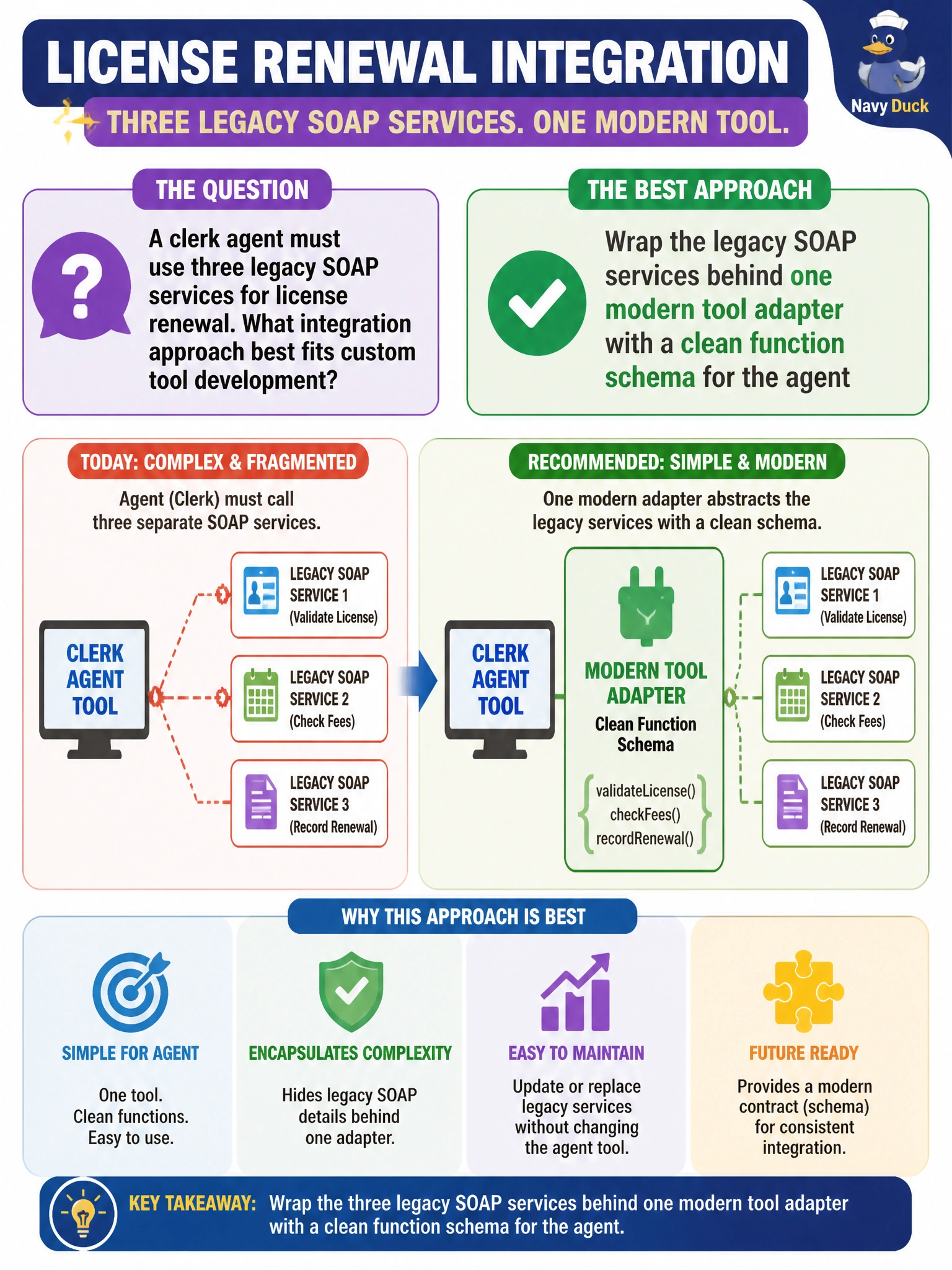
A clerk agent must use three legacy SOAP services for license renewal. What integration approach best fits custom tool development?
Select an answer to reveal the explanation.
Short Explanation
Legacy SOAP is plumbing the clerk agent shouldn’t see. Wrap those three services in one modern tool adapter with a clean schema. Don’t make the LLM hand-edit XML envelopes every turn.
Full Explanation
Clerk agents renewing licenses against three legacy SOAP services should not manipulate raw XML envelopes in the LLM context. Custom tool development best wraps those services behind one modern tool adapter that exposes a clean function schema—inputs like license ID and renewal options—while the adapter translates to SOAP, handles faults, and returns structured results. That keeps municipal legacy protocols behind an engineer-owned boundary and gives the agent a stable tool interface. Teaching residents to call SOAP directly or abandoning renewals until SOAP disappears are not viable integration strategies for current operations.
Pasting raw SOAP envelopes into the LLM context and asking it to edit XML by hand each turn fails by concept: models are brittle XML editors, and envelope mistakes break renewals or leak protocol details. Teaching residents to call SOAP endpoints directly from their browsers shifts integration burden onto the public and exposes backend surfaces. Abandoning renewals until all SOAP systems are deleted without replacements halts a required civic service instead of integrating pragmatically.
Exam caveat: the adapter must enforce auth, timeouts, and idempotency for renewal submissions so retries do not double-charge or double-issue licenses. Schema evolution of SOAP backends should be absorbed in the adapter, not pushed into prompts.
Operational check: execute a staging renewal through the clean tool schema, inspect adapter logs for correct SOAP translation, and confirm the LLM never receives raw envelopes—only typed tool results and errors.