
A municipal 311 analytics desk receives irregular ticket timestamps and must prepare them for an hourly demand forecast. What should they do first?
Select an answer to reveal the explanation.
Short Explanation
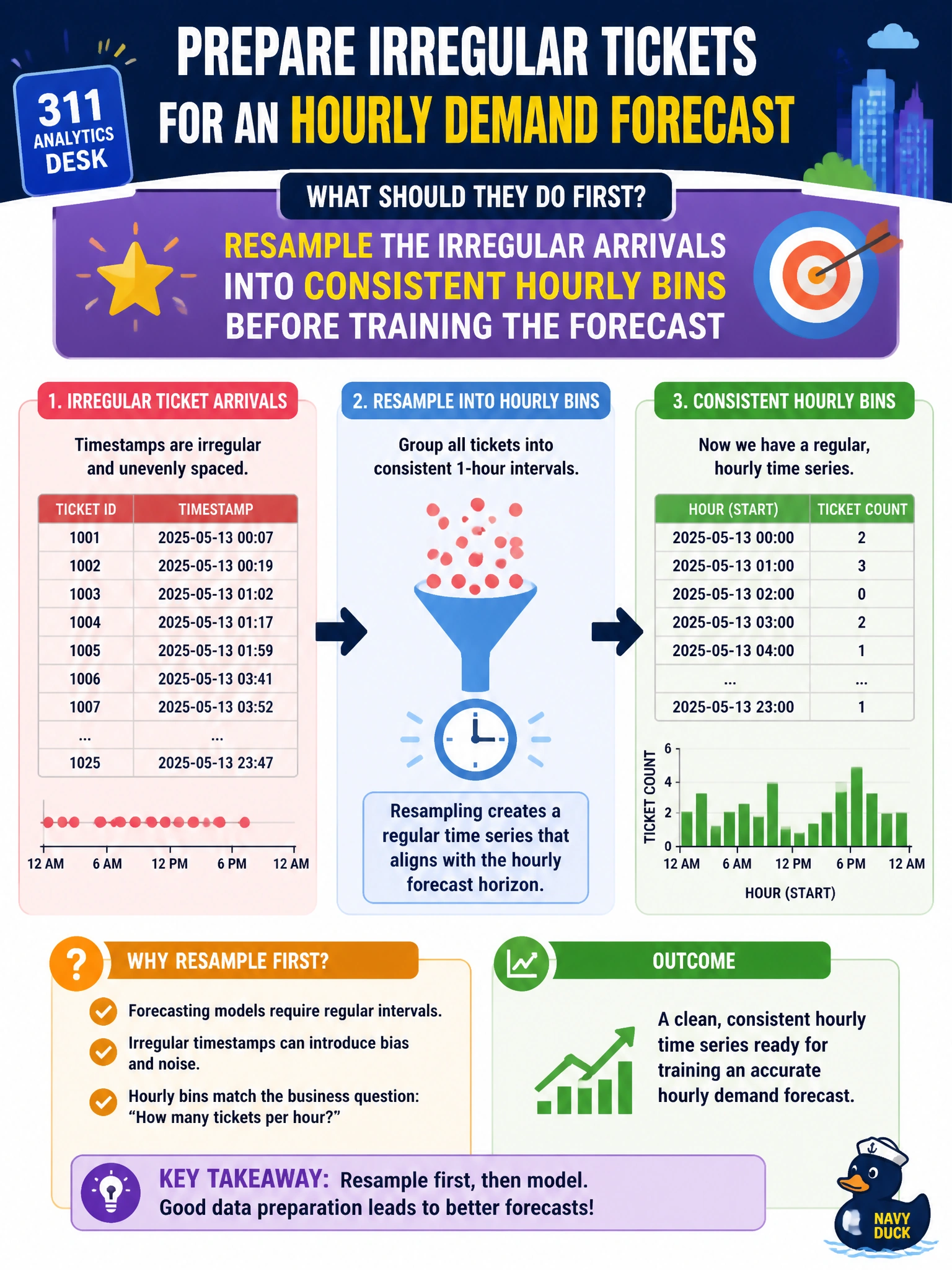
You’ll get a more reliable hourly forecast when you first resample the irregular tickets into steady hourly bins. That gives you a consistent timeline to learn from.
Full Explanation
Before forecasting hourly 311 demand, you need to establish a regular sampling frequency. Resampling the irregular arrivals into consistent hourly bins—by counting tickets or aggregating their attributes—creates a defined timeline that forecasting models, lag features, seasonal indicators, and chronological splits can share. Discarding off-hour ticket times and forecasting the remaining arrivals without aligning them to hourly intervals loses valid demand and can undercount busy periods. Treating each raw event as an independent tabular row with no temporal frequency abandons time-series structure, so you cannot build meaningful lags or rolling windows or evaluate an hourly forecast. Converting timestamps to fiscal-year labels and ignoring intra-day timing removes the hourly resolution needed for staffing and queue forecasts. Exam caveat: resampling is a preparation step, not a model; afterward, use chronological validation and decide whether empty hours represent true zeros or missing feeds. Do not confuse event-level classification, which may retain irregular timestamps, with demand forecasting, which needs a regular grid. Practical check: confirm that every hour in the civic calendar appears once, that empty hours are explicitly zero or flagged as missing by policy, and that the chronological holdout uses the same hourly frequency as production scoring.