
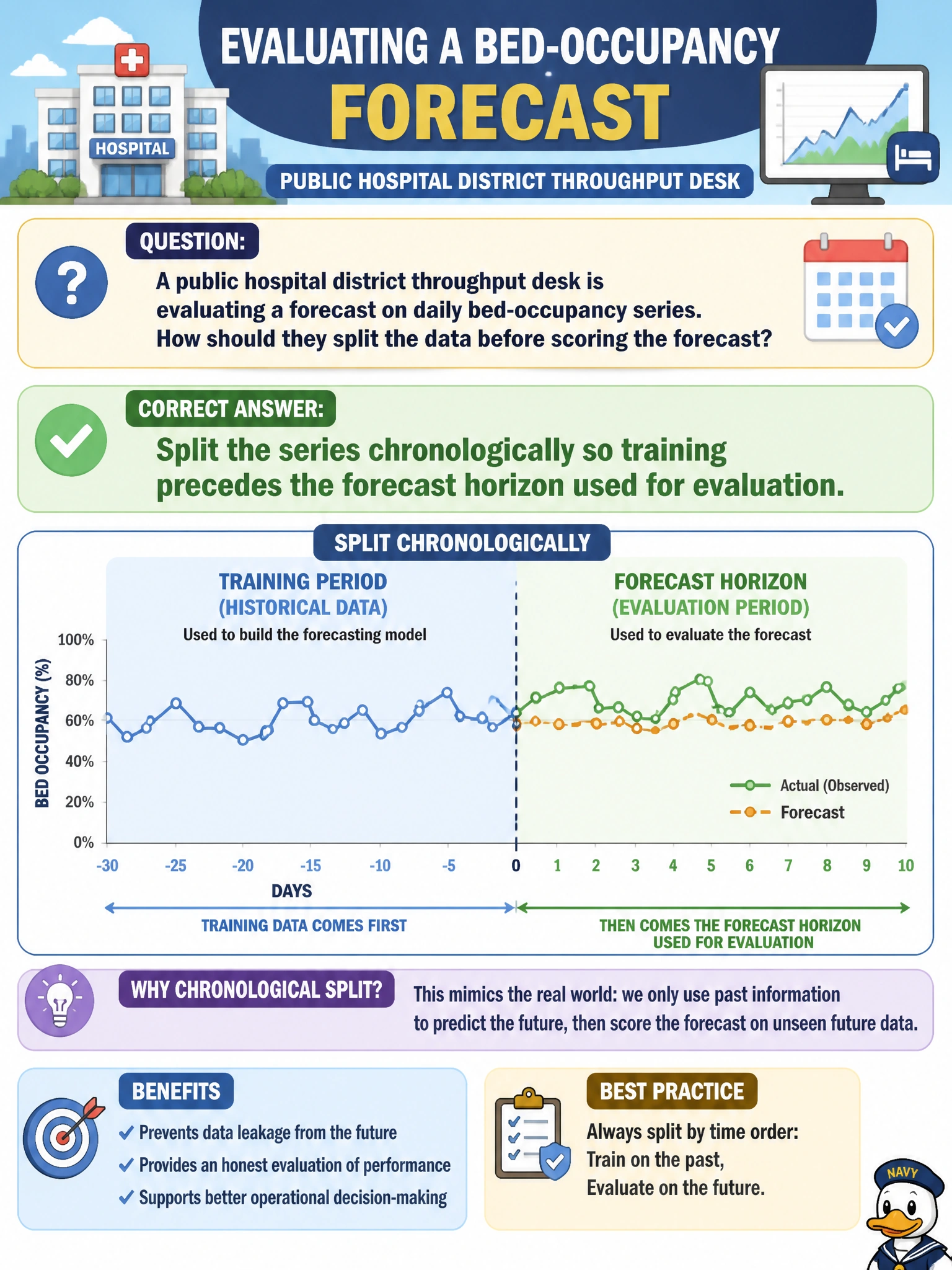
A public hospital district throughput desk is evaluating a forecast on daily bed-occupancy series. How should they split the data before scoring the forecast?
Select an answer to reveal the explanation.
Short Explanation
Time has a direction—train on the past stretch, then score the future horizon; don't shuffle days like a card deck.
Full Explanation
A public hospital district throughput desk evaluating a forecast on daily bed-occupancy series should split the series chronologically so training precedes the forecast horizon used for evaluation. Time-series validation must respect temporal order: the model may use past occupancy to predict a future window, but it must not train on days that occur after the evaluation horizon. Chronological splits produce honest forecast metrics for bed planning.
Shuffling all days randomly into train and test like an i.i.d. table fails by concept: random mixes leak future information into training and inflate accuracy relative to real forecasting. Putting only weekends in training and only weekdays in testing with no time order fails because it confounds day-of-week regime with forecast skill and still ignores chronology. Training on future weeks and testing on past weeks fails by reversing causality—using the future to predict the past is not an operational forecast protocol.
Exam caveat: tabular i.i.d. shuffle habits are wrong for ordered series; hospital occupancy forecasting requires past-before-future splits.
Operational check: define an evaluation horizon (for example, next 7 or 14 days), train only on days strictly before that horizon, score forecast error on the horizon, and repeat with rolling origins before approving the bed-occupancy model for planning use.