
A library program attendance analytics team supporting flood-planning partners sees residual error rise on storm weeks for a deployed demand model. What should monitoring trigger?
Select an answer to reveal the explanation.
Short Explanation
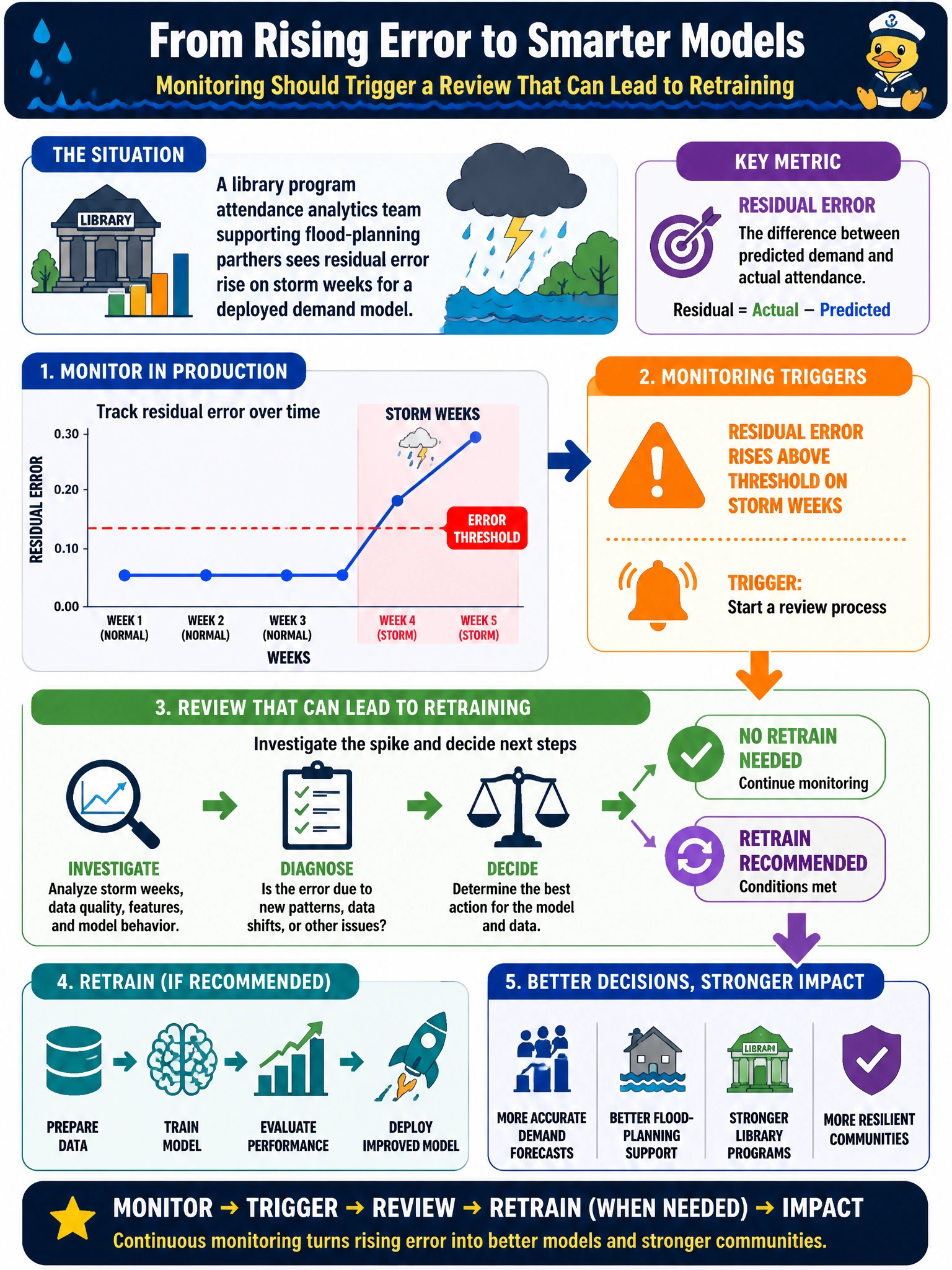
Storm-week error spikes are a nudge to reopen the hood—monitoring should trigger review and possible retrain.
Full Explanation
A library program attendance analytics team supporting flood-planning partners that sees residual error rise on storm weeks for a deployed demand model should let monitoring trigger a review that can lead to retraining. Regime shifts—storm weeks altering attendance and partner demand—can invalidate a model fit on calmer periods. Linking production error monitors to a human review (and possible retrain) is associate MLOps practice: detect, investigate, then update the model if the new regime is persistent or recurring.
Permanent silence because storms are irrelevant to civic models fails by concept: storm weeks clearly moved residuals, so they are relevant to this demand model. Deleting all historical storm data from every archive fails because it erases the evidence needed to learn storm-week behavior and harms auditability. Automatically claiming hardware must be replaced with no analysis fails by jumping to an unrelated infrastructure conclusion without examining features, labels, or seasonality.
Exam caveat: monitoring should connect to retraining decisions; not every spike means retrain immediately, but review is mandatory when production error rises under a known regime.
Operational check: alert on elevated storm-week residuals, slice errors by weather flags, decide whether to add storm features or schedule a retrain on a storm-inclusive window, and re-validate before the next flood-planning partnership cycle.