
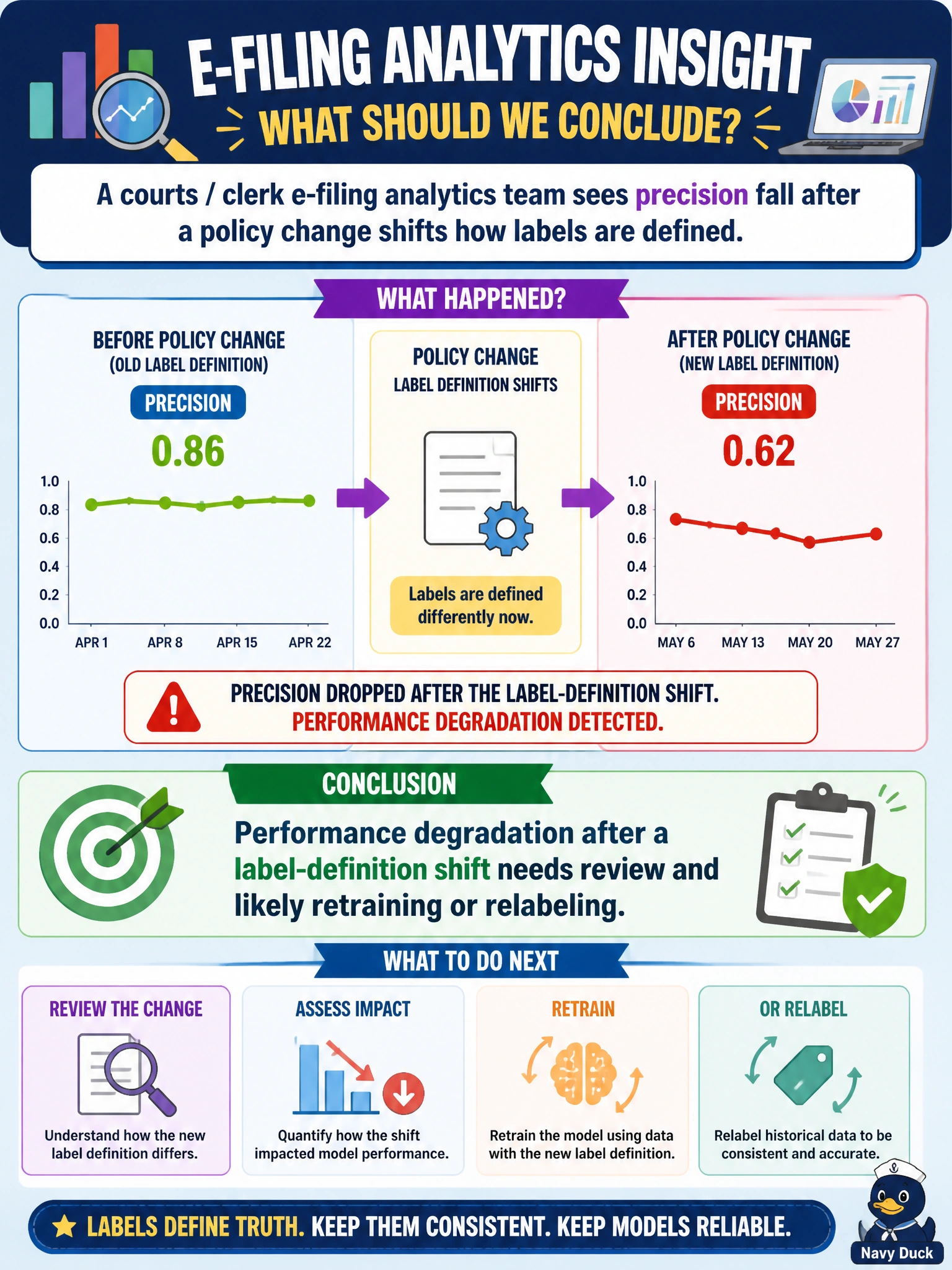
A courts / clerk e-filing analytics team sees precision fall after a policy change shifts how labels are defined. What should they conclude?
Select an answer to reveal the explanation.
Short Explanation
When policy rewrites the answer key, precision can tank—treat the drop as degradation that needs review, not vibes.
Full Explanation
A courts/clerk e-filing analytics team that sees precision fall after a policy change shifts how labels are defined should conclude that performance degradation after a label-definition shift needs review and likely retraining or relabeling. When the answer key changes, historical labels and the serving model's decision boundary no longer match current ground truth. Associate monitoring treats the metric drop as an operational incident: investigate label policy, refresh labels or retrain, and re-validate before clerks trust the scores again.
Claiming precision drops are always random noise and need no review fails by concept: a drop timed with a label-policy change is a causal lead, not dismissible noise. Asserting that label policy changes never affect production metrics fails because metrics are defined against labels; redefining labels changes what precision means. Saying the model should never be evaluated after deployment fails because post-deployment evaluation is how civic teams detect exactly this class of degradation.
Exam caveat: label shift is a distinct failure mode from pure feature drift; both can hurt metrics, but label-policy changes specifically invalidate prior evaluation assumptions.
Operational check: freeze automated decisions that depend on the affected precision metric, document the new label definition, measure precision on freshly labeled e-filing samples, and schedule retrain or relabel workflows before restoring clerk-facing scoring.