
A city open-data portal team is policy-blocked from SaaS experiment trackers but still needs comparable trial history. What should they do?
Select an answer to reveal the explanation.
Short Explanation
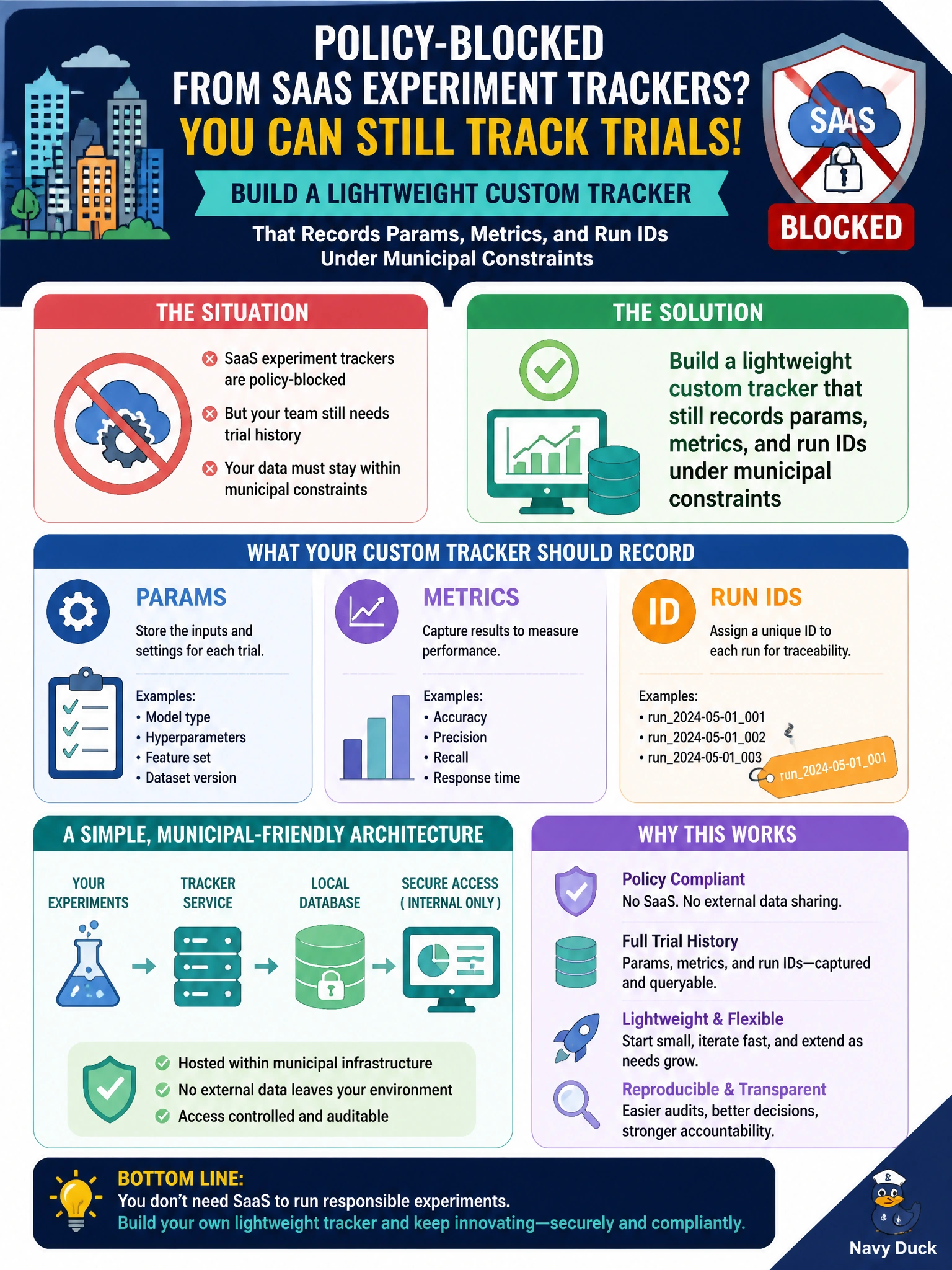
When SaaS is blocked, a skinny custom tracker still beats hallway memory—capture params, metrics, and run IDs locally.
Full Explanation
A city open-data portal team that is policy-blocked from SaaS experiment trackers should still build a lightweight custom tracker that records parameters, metrics, and run IDs under municipal constraints. The point of experiment tracking is comparable history, not a particular vendor. A local or on-prem skinny tracker that stores the same essentials—what was tried, how it scored, and a stable run identifier—keeps open-data model trials auditable when cloud SaaS is forbidden by policy.
Forbidding any record of parameters and metrics entirely fails by concept: without structured history, trials cannot be compared or reproduced for portal analytics governance. Storing only unlabeled zip files on a shared desktop fails because unlabeled blobs lack queryable params, metrics, and run IDs. Relying on verbal hallway updates as the system of record fails because oral memory is incomplete, non-durable, and useless for audit or rollback.
Exam caveat: when SaaS is blocked, the correct answer is still to capture tracking fields somehow—not to abandon tracking altogether.
Operational check: stand up a minimal municipal tracker (database or structured files) that requires params, metrics, and run ID on every open-data trial, and reject promotion discussions that cite only hallway recollection.