
A city planning zoning analytics team uses multi-stage Dask GPU tasks and needs auditability between stages. What should they materialize?
Select an answer to reveal the explanation.
Short Explanation
Think of Parquet checkpoints as sticky notes between assembly stations—materialize them so auditors (and restarts) can see each stage.
Full Explanation
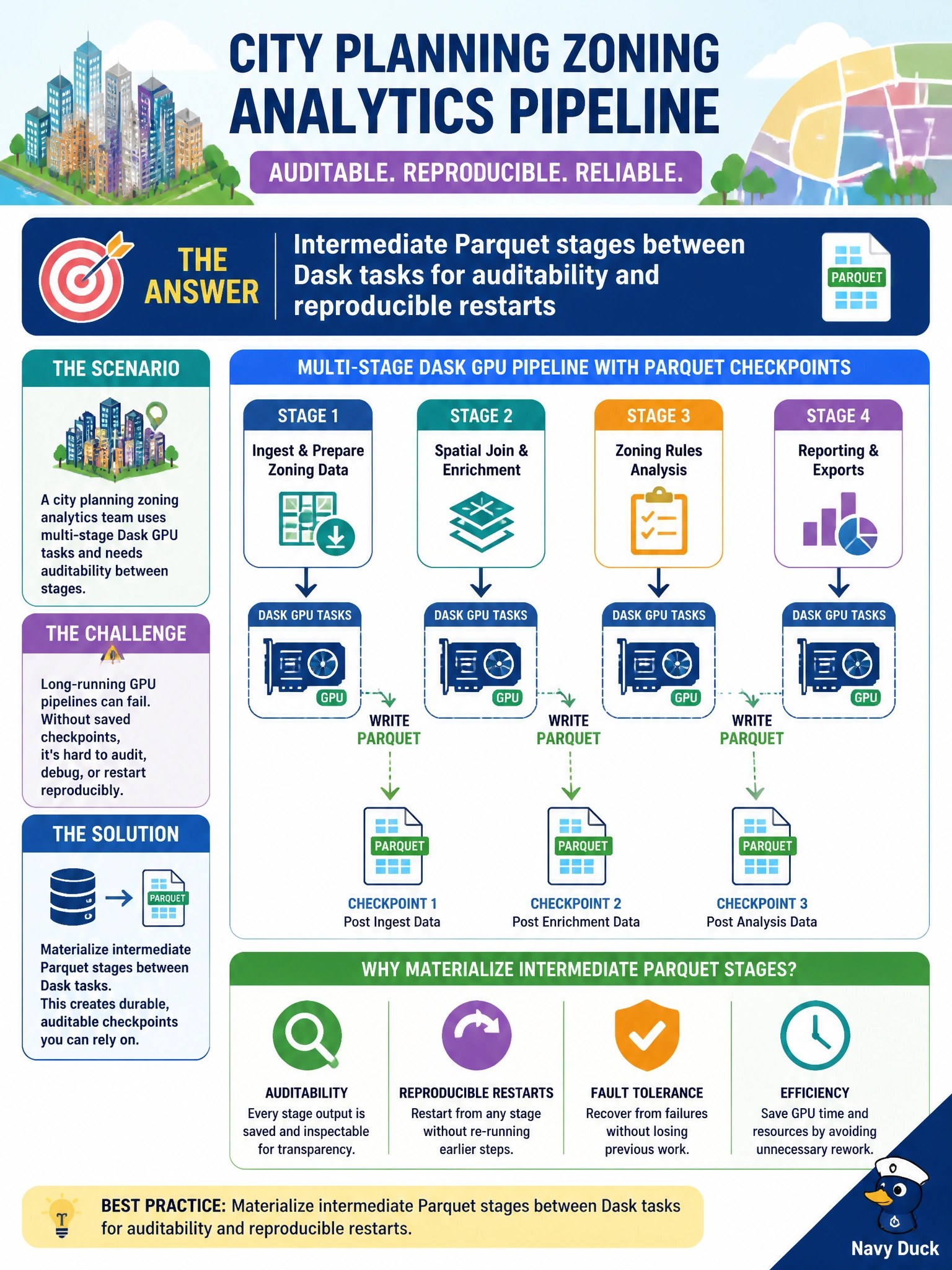
City planning zoning analytics that run multi-stage Dask GPU tasks should materialize intermediate Parquet stages between tasks. Persisted Parquet checkpoints give auditors a tangible artifact per stage, enable debugging of which transform introduced an error, and allow reproducible restarts without recomputing the entire GPU DAG from scratch after a mid-pipeline failure. Keeping only anonymous in-memory blobs with no persisted checkpoints defeats auditability and makes failed mid-pipeline jobs expensive to resume under zoning deadlines. Treating final PowerPoint slides as the sole pipeline artifact captures presentation output, not data lineage between Dask stages that produced the numbers on those slides. Unversioned CSV dumps overwritten in place with no lineage destroy history and invite silent corruption of zoning intermediates that auditors cannot reconstruct. Exam caveat: multi-stage Dask/RAPIDS workflows should materialize versioned intermediate Parquet for audit and restart—not memory-only blobs, slides-only artifacts, or overwritten CSV. Operational check: write partitioned Parquet after each major zoning stage with run IDs, retain per policy, verify an auditor can inspect stage N outputs, and confirm a failed stage N+1 can restart from that Parquet without full recompute.