
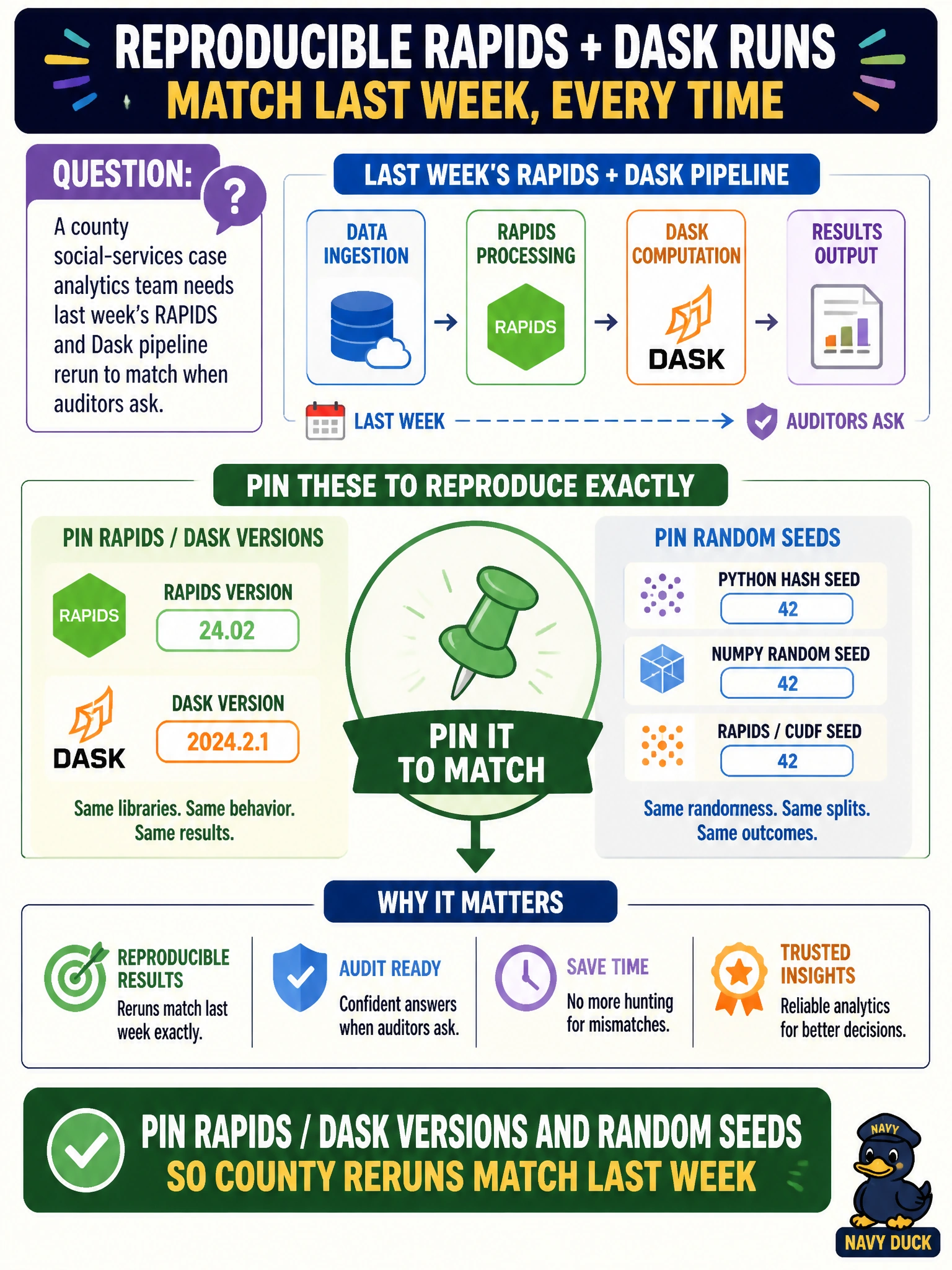
A county social-services case analytics team needs last week’s RAPIDS and Dask pipeline rerun to match when auditors ask. What should they pin?
Select an answer to reveal the explanation.
Short Explanation
Auditors love déjà vu—pin the RAPIDS/Dask versions and the random seeds so last week’s run can happen again on purpose.
Full Explanation
County social-services auditors who ask to match last week’s RAPIDS and Dask run need pinned dependency versions and controlled random seeds (plus related configs such as input snapshot IDs). Pinning makes reruns intentionally comparable instead of accidentally different when libraries float underneath the same notebook title. Pinning only the notebook title while leaving library versions floating allows RAPIDS or Dask upgrades to change numeric results mid-audit without any intentional model change. Pinning seeds alone while silently upgrading RAPIDS mid-audit still breaks bitwise or metric reproducibility across library and kernel changes. Accepting that reruns always differ rejects reproducibility as a civic audit requirement and leaves the county unable to explain score drift. Exam caveat: reproducible RAPIDS/Dask pipelines pin versions and seeds (and inputs); title-only or seed-only controls are insufficient on the exam and in practice. Operational check: lock RAPIDS, Dask, and key dependency versions in the environment spec, record seeds and input dataset versions with each social-services run, and periodically re-execute last week’s job to prove match within documented tolerance.