
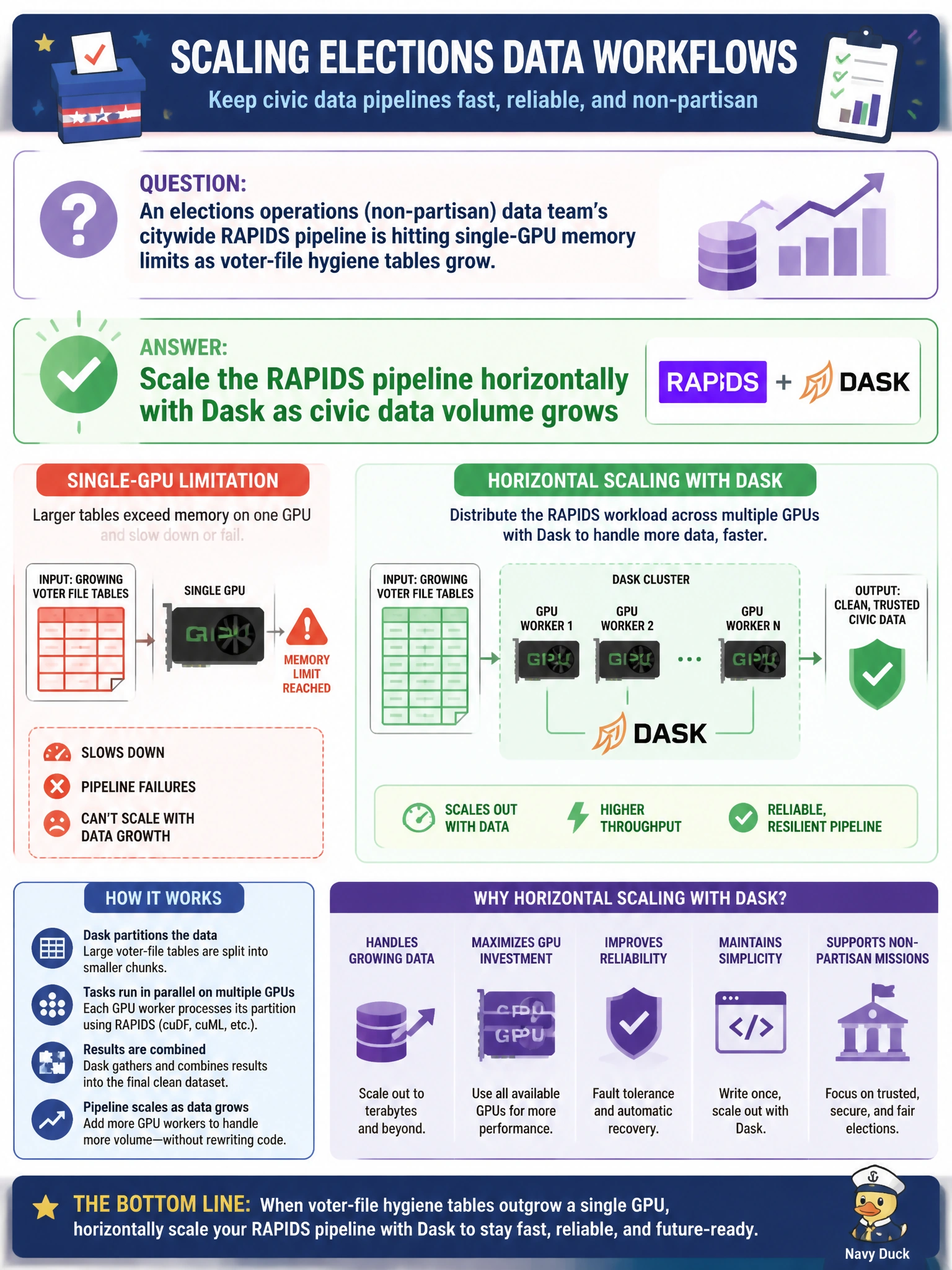
An elections operations (non-partisan) data team’s citywide RAPIDS pipeline is hitting single-GPU memory limits as voter-file hygiene tables grow. How should they scale the workflow?
Select an answer to reveal the explanation.
Short Explanation
When one GPU’s backpack is full, add Dask workers like extra carts on the loading dock—scale out instead of cramming every year into one bag.
Full Explanation
Elections operations (non-partisan) voter-file hygiene tables that outgrow single-GPU memory should scale the RAPIDS workflow horizontally with Dask—partitioned frames across workers—so civic volume growth does not force unsafe deletions or CPU for-loop regressions. Horizontal scale keeps the RAPIDS acceleration path while respecting memory limits that a single device cannot satisfy as rolls and history accumulate. Forcing all historical years into one oversized single-GPU frame forever eventually OOMs and does not scale with enrollment or hygiene-table growth. Deleting older years without documenting retention may “fit” memory but breaks auditability and retention policy for elections data that auditors may still need. Rewriting as nested Python for-loops on CPU only abandons the RAPIDS and Dask scale path the exam associates with growing municipal workloads. Exam caveat: beyond single-GPU memory, choose Dask horizontal scale with RAPIDS—not silent deletion or CPU-loop rewrites. Operational check: profile GPU memory on peak voter-file hygiene jobs, introduce Dask partitions and workers, verify end-to-end hygiene metrics match the single-GPU baseline on a sample year, then roll out citywide with documented retention.