
A solid-waste route optimization analytics team’s KPI is continuous fine amounts, not discrete violation categories. What modeling mistake should they avoid?
Select an answer to reveal the explanation.
Short Explanation
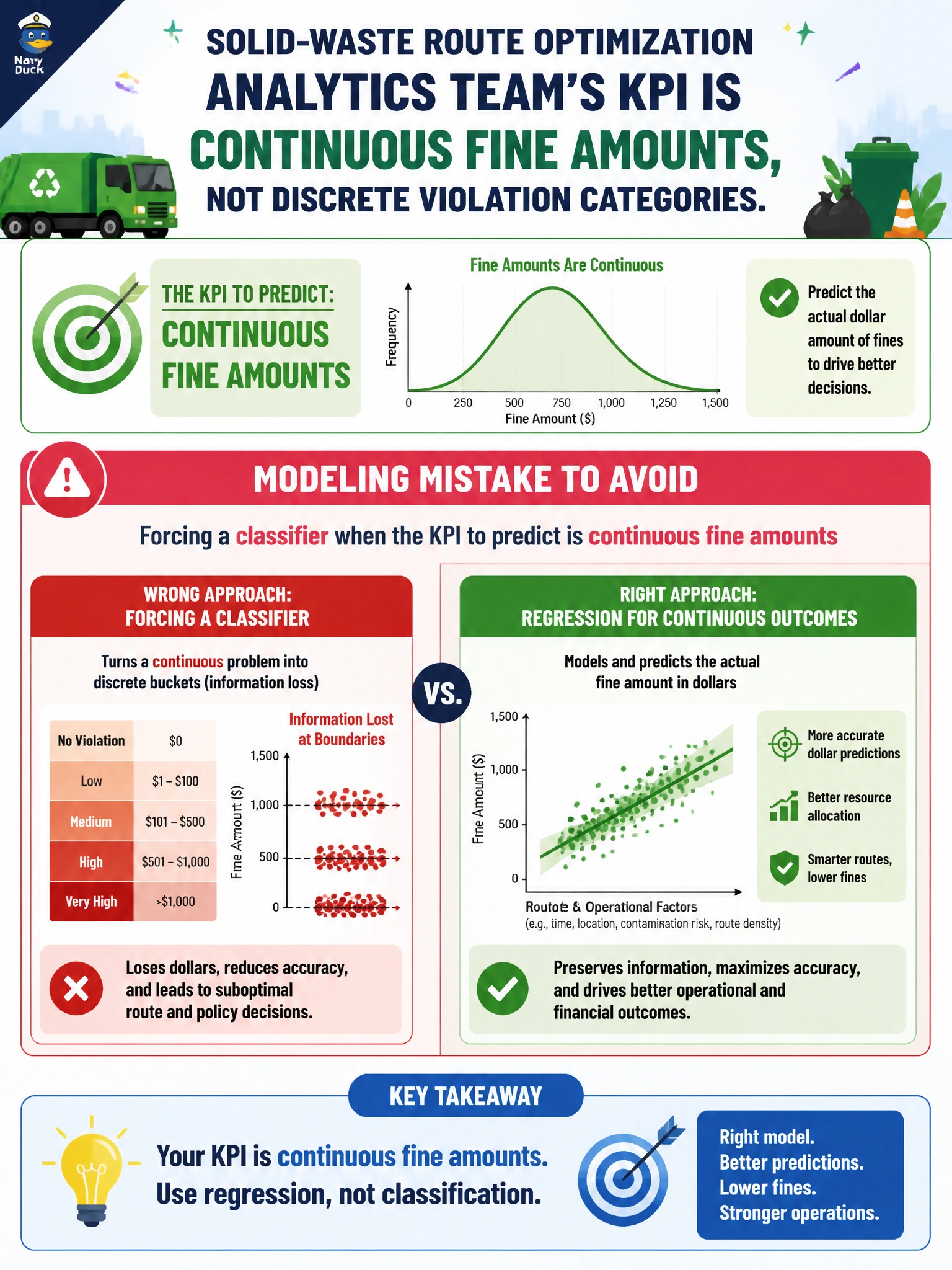
If the city cares about how many dollars the fine is, don’t smash it into yes/no classes—that’s forcing a classifier onto a tape-measure problem.
Full Explanation
When a solid-waste route optimization analytics team’s KPI is continuous fine amounts, the modeling family must preserve that numeric target. The mistake to avoid is forcing a classifier when the KPI to predict is continuous fine amounts: binning or classifying fines throws away magnitude, invents arbitrary category boundaries, and answers a different question than “how large is the fine.” Regression (or another continuous estimator) keeps the dollar-valued civic KPI intact.
Using regression when the prediction target is a continuous fine amount is not a mistake—it is the appropriate family. Evaluating continuous predictions with appropriate error metrics is correct practice, not an error. Keeping fine amounts as numeric targets in the training frame is likewise correct and necessary for regression. The distractors that describe proper continuous modeling therefore fail as “mistakes”; only classifier coercion mismatches the KPI.
Exam caveat: even with regression, watch leakage (fines known only after adjudication), heavy tails, and policy changes that redefine fine schedules—good family choice does not fix a broken label pipeline. Operational check: confirm the training target column is numeric fine amount, refuse any HPO trial that converts the target to class labels without a documented discrete KPI change, report MAE/RMSE (and maybe quantile error) on a holdout period, and review largest residuals with route supervisors before using predictions in optimization.