
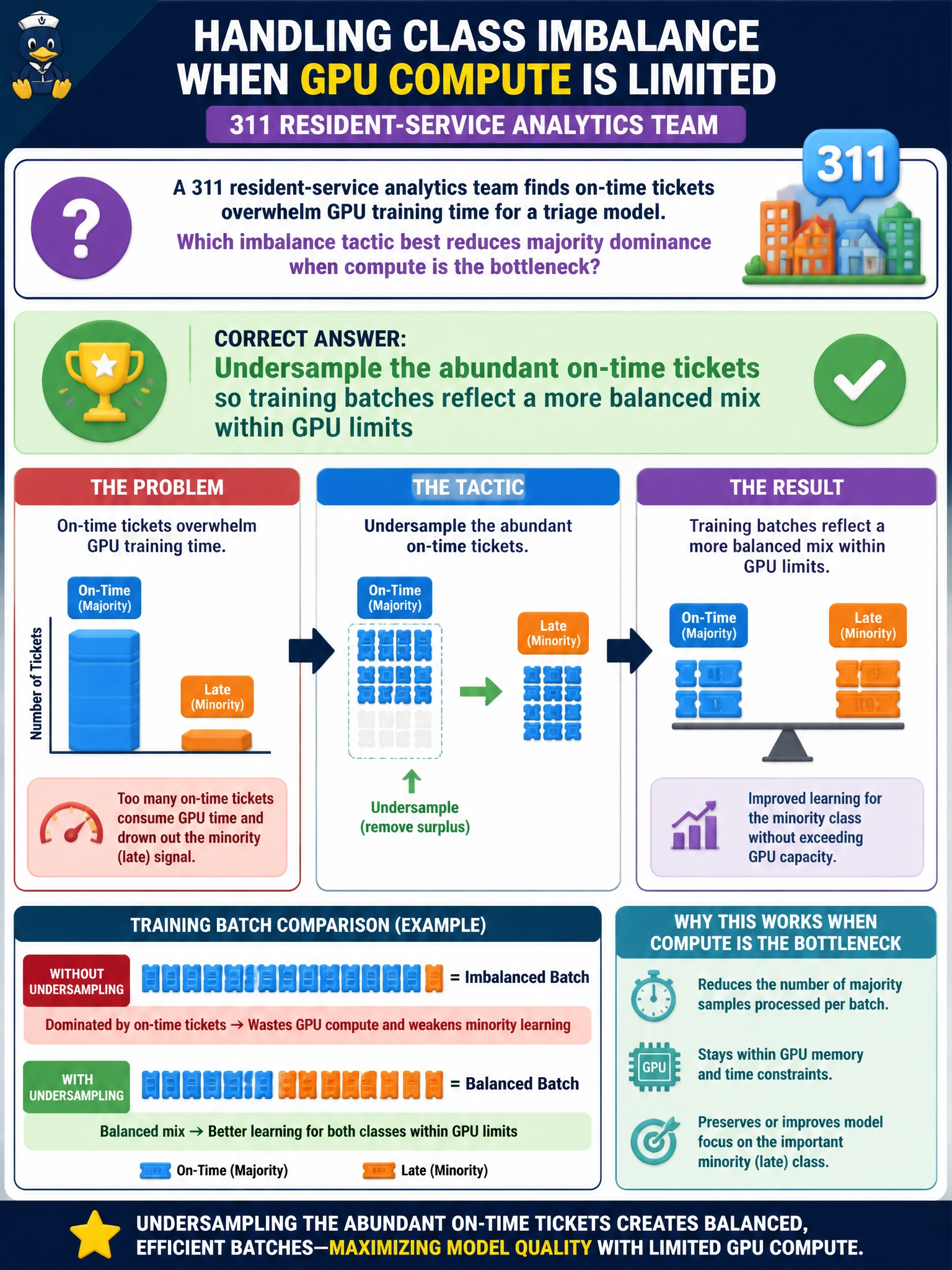
A 311 resident-service analytics team finds on-time tickets overwhelm GPU training time for a triage model. Which imbalance tactic best reduces majority dominance when compute is the bottleneck?
Select an answer to reveal the explanation.
Short Explanation
When on-time tickets flood the GPU like rush-hour cars in every lane, you do not need more cars—you thin the majority lane. Undersampling those plentiful on-time rows frees memory and time so late tickets get a fairer seat at training.
Full Explanation
A 311 resident-service analytics team whose on-time tickets overwhelm GPU training time should undersample the abundant on-time majority so batches reflect a more balanced mix within device and schedule limits. Undersampling shrinks majority dominance and wall-clock cost when millions of routine civic tickets drown rare late or escalated cases. With compute as the bottleneck, thinning on-time rows is the imbalance tactic that directly reduces training volume while keeping late tickets fully available to the triage model. Duplicating every late ticket until the job exceeds the overnight window fails by concept: it worsens the compute bottleneck the stem states. Training only on on-time tickets and evaluating later on late tickets alone fails because the model never learns late-ticket features during fitting. Replacing triage labels with ticket free-text length fails by changing the prediction target; length is not a substitute for on-time versus late triage labels and does not solve class imbalance. Exam caveat: aggressive undersampling can discard majority subtypes that still matter in production 311 routing; stratify or retain representative on-time strata when possible. Operational check: undersample on-time tickets inside the training window to a planned ratio, measure GPU fit time and minority late-ticket recall on holdout, and confirm overnight batch completion without quietly dropping critical late subtypes from training coverage.