
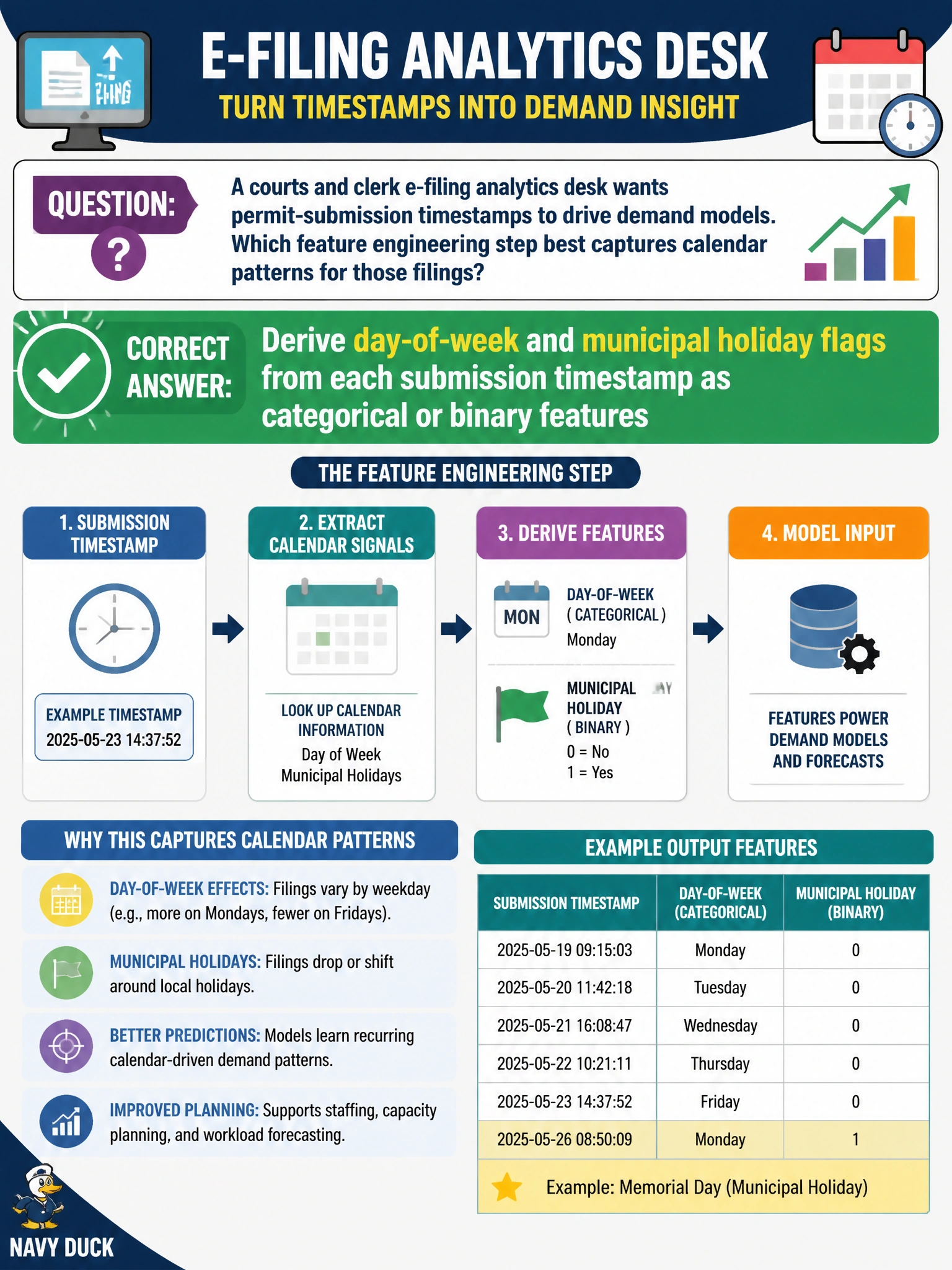
A courts and clerk e-filing analytics desk wants permit-submission timestamps to drive demand models. Which feature engineering step best captures calendar patterns for those filings?
Select an answer to reveal the explanation.
Short Explanation
Think of the clerk queue like a coffee shop that gets slammed Mondays and empty on holidays—the clock face matters. Pulling day-of-week and holiday flags from the timestamp gives the model those calendar rhythms instead of a raw epoch blob.
Full Explanation
A courts and clerk e-filing desk modeling permit-submission demand needs calendar structure, not opaque time encodings. Deriving day-of-week and municipal holiday flags from each submission timestamp turns wall-clock values into categorical or binary features that mirror how city offices actually operate—weekday rushes, Friday cutoffs, and holiday closures. Those signals let GPU models learn recurring civic filing cycles that drive staffing and backlog forecasts, while remaining interpretable to clerk supervisors who already think in workdays and observed holidays. Hashing the full ISO timestamp into a single opaque integer fails by concept: it discards weekday and holiday semantics and replaces them with an arbitrary code the model cannot map to municipal calendars. Replacing every timestamp with Unix epoch seconds alone fails because absolute time encodes trend and order but hides weekly and holiday patterns unless you still engineer calendar features. Dropping timestamps after sorting rows fails by assuming row order alone encodes weekly cycles; shuffled batches, filtered extracts, and parallel GPU reads break that assumption and leave no explicit holiday signal. Exam caveat: calendar features help only when timezone and municipal holiday calendars match the filing jurisdiction; a state holiday list that differs from city closures will mislabel demand. Operational check: build day-of-week and city-holiday flags from e-filing timestamps, verify holiday alignment against the clerk office calendar, aggregate filing volume by those flags, and confirm the demand model’s feature importance or partial dependence reflects weekday and holiday structure before production scoring.